
Last year Iris Van Herpen sent dresses down the runway that were alive, gowns pulsing with millions of bioluminescent algae that had to be tended like houseplants. And the only way to top living couture, it turns out, was to leave Earth entirely! Her Fall 2026 collection, “Sonic Starquakes,” begins with the fact that stars are not silent: pressure waves ripple through their plasma depths the way earthquakes shudder through stone, and each star sounds its own note, the giants droning low like tubas and double basses, the small ones piping in thin celestial flutes.

Van Herpen translated that unheard music into cloth. Tens of thousands of hand-blown glass spheres, graduated in size from seed pearl to soap bubble, float on illusion tulle so the body seems to dissolve into a fizz of light at its edges. Hand-pleated chiffons sweep into half-wheels suspended within moon-curved carbon fiber boning, drifting as if moved by an unseen current. Laser-cut velvets undulate down the body in dark vertical rivulets past the hem of the fabric onto bare skin in hand embroidery, so that garment and wearer blur at the border. The palette descends through the night sky: midnight black into sapphire, cobalt into moonstone green, nebula red, storm-lit silver, all of it unspooling across the Élysée Montmartre over a floor boiling with dry ice.

The showpieces, though, weren’t merely inspired by science; they were made of it. The Helix Nebula dress carries two crescent lunar forms of hand-blown glass arching from the shoulder, each one filled with actual plasma, the luminous fourth state of matter, a charged cloud of ions and free electrons that constitutes more than 99% of the visible universe and, until this month, zero percent of haute couture.

Its deep red glow is the light of electrons leaping between energy levels, the same physics that paints the auroras and ignites the nebulae where stars are born. Bring a hand near the glass and the filaments inside bend toward it; worn, the dress draws the body into its electrical field, wearer and gown briefly sharing a single electromagnetic system. And then, the Fractal Universe look, a molded glass-like minidress charged inside a particle accelerator and kept cryogenically preserved at minus 100 degrees Celsius before the show, a garment holding billions of trapped electrons in suspension, a wearable reservoir of storm.

The plan was to discharge it dramatically on the runway. Instead, before the show, the captive electricity found its own way out: branching Lichtenberg figures erupted across the surface, lightning fossilized mid-strike, fractal channels burned permanently into the material. Van Herpen has been seeing those fern-like patterns everywhere since, river deltas, root systems, the veins branching beneath the wrist. I saw all of it through a screen, thousands of miles away, and the hairs on the back of my neck rose anyway. Electrical fields, spooky action at a distance, awe and shiver arriving across an impossible divide.


If you enjoy posts like these or if you have ever enjoyed or been inspired by something I have written, and you would like to support this blog, consider buying the author a coffee?

✥ comment

I am getting to this a little late (everyone else probably saw this already over a month ago) but in addition to this blog being a place to share things with you, it’s also a memory book of things for me. And this collection is worth remembering!
I have been carrying The Transylvania Chronicles around with me since ABODI released it earlier this year — not unlike the Castle Bag itself, which is to say: a vessel for haunted imaginations, strange dreams, and whatever it is that makes certain people feel more at home in the dark.


Led by creative director Dora Abodi, the brand has always operated less like a fashion house and more like what she herself calls “a boundless imaginary republic,” and this collection is exactly that, governed by ancient creatures, Transylvanian mythology, and a very particular, very beautiful kind of strangeness.
The photographs, shot by Szilveszter Makó with an art direction that sits somewhere between studio portraiture and mythological documentation, are the kind of images you might find in a weird storybook, high on a shelf, hidden from young little hands. Model Ursula Wångander shapeshifts through a gallery of dark archetypes — Elisabeth Báthory, Dracula, spectral ghosts, the Cat Mermaid, the elusive water vila — each one presented as if suspended within a painting rather than a photograph. The overhead shots, especially those of models arranged against illustrated sets like figures in a darkly illuminated manuscript, create an incredible, uncanny paper-doll effect.


The garments themselves are extraordinary. The Chronicles dress is ornamented with Abodi’s own paintings, a non-linear visual diary of childhood memories, myths, and history drifting through enchanted forests, blue-painted Secler houses, folk dancers, wandering ghosts, the vampire prince, the blood queen — an entire mythology compressed into fabric.
The Landscape of Dreams coat is made from hand-woven antique hemp, fully hand-painted, then patchworked and three-dimensionally applied with figures and shapes through what Abodi describes as a long meditative painting process followed by intuitive assembly. It is explicitly, emphatically impossible to recreate.The Bokály Dress reimagines the iconic ceramic vessel of the Székelys of Transylvania, a piece whose graceful curves and richly ornamented surfaces carry centuries of folk tradition, into living woven form. And there is antique broderie anglaise lace described in the collection notes as “delicate as breath, yet carrying centuries within its threads,” the collection’s mythology embedding itself even into the perforations of the fabric: it is said that Elisabeth Báthory once stared into such lace and saw the shadow of her own destiny unfolding in its fragile tracery.


Speaking of Báthory — she is a central figure here, reinterpreted not as monster but as symbol of demonized female power, a woman feared for her refusal to submit. And the collection’s notes offer one of the more quietly devastating framings of her story: Báthory was afraid of mirrors. They reflected reality, and the slow vanishing of youth. Her face had become a diary of the past, and she could not bear it.
Meanwhile, across the collection’s mythology, Dracula was magnetic with dark authority, younger, stronger, at the peak of his power, and yet could never enjoy his own face, because mirrors showed him nothing. We are all lured by what we don’t have, and blind to what we do. I had to think on that for a while, and when it finally settled, it felt less like a moral and more like a key, the thing that unlocks both of them at once, their particular hungers, their particular blindnesses.


Then there is Artefact 2, a padded, scalloped-silhouette oversized jacket, and in the presentation, when it was worn, bats took flight from within its sculptural folds. A soft cavern stitched from memory, opening its wings.
And then there is the Castle Bag!!. A black sculptural bag inspired by Dracula’s Castle, retailing for around €850, which I would kinda maybe consider? I would consider it. One Reddit commenter said they would sell a kidney for it, and I don’t think that’s entirely hyperbolic. It began as a headpiece created with no commercial intention at all, total imaginative freedom, and only became a bag after Jaden Smith wore the original to the Grammys, and it went viral. But for real, the only piece from this collection within actual reach is the Cat Mermaid socks, and at $112 a pair, can buy does not equal should buy. I am choosing to experience this particular desire from a respectful distance!


There is a quote from Abodi that I keep returning to: she describes the ambition of ABODI Transylvania as the establishment of an autonomous and creative domain where her legendary creatures (including myself, she writes) can freely create and feel at home. Including myself. She counts herself among the legendary creatures. It would be easy to call that charming or empowering, but I think it’s something more than either of those.
It’s a delirious collapsing of the distance between maker and myth. She isn’t standing outside the universe she built, directing it from a safe distance… she’s inside it, one of its creatures, subject to the same ancient forces and folklore as Báthory and Dracula and the other Carpathian icons. There’s a kind of radical imaginative humility in that, or maybe the opposite of humility. She made the world, and then she walked into it, and became part of it.
If you enjoy posts like these or if you have ever enjoyed or been inspired by something I have written, and you would like to support this blog, consider buying the author a coffee?
✥ 1 comment

What do a marshmallow pipecleaner Tuxedo Mask, Darkman the Lepidopterist, a cobalt devil girl from Mars with her in-utero cannibalized twin emerging at the wrist, and a molten gold icon with a sword stabbed through its heart but still looking fabulous, all have in common?
Aside from all stalking the runway at Robert Wun S/S26, they’re also visions only this designer could have brought to life. And at the very heart of this show is staying true to your vision, no matter how strange or impossible. No matter how hard the world works to convince you it’s pointless, to question its purpose, to reduce it to product.


Robert Wun orchestrated his Spring 2026 couture collection as three acts of a designer’s reckoning. Library gave us black and white restraint, precise forms of grandiose ideas delicately rendered from his student sketchbooks. Luxury confronted us with the uncomfortable truth about value, when pure ideals meet crass commerce—crystal masks obscuring the face, gowns tailored like high-jewelry display stands. And finally, Valor: mythology and metallic armor, swords piercing through the body, a celestial ballgown holding the entire cosmos.


Against the tumult and chaos of a digital thunderstorm, he revealed the importance of dreaming when dreams seem impossible, of holding onto what made you want to create in the first place when the world pressures you to compromise, of fighting for art in a world that questions whether art matters at all.


If you enjoy posts like these or if you have ever enjoyed or been inspired by something I have written, and you would like to support this blog, consider buying the author a coffee?
✥ comment

…As one grew bright as is the sun,
So coal black grew the elder one…
In Schiaparelli’s Spring 2026 couture, Daniel Roseberry presents The Scorpion Sisters. One might imagine a murder ballad threaded through it—the bright one in transparent chiffon, a bustier where the scorpion tail is embroidered in delicate bas-relief, almost childlike, held festooned with an innocence of posies. The dark one draped in black crin and chantilly, predatory, silver needles bristling, white lace ruffles like innocence cloaking something venomous.

What jealousy lives between them? Which one drowns the other—the one who learned to sting, or the one who learned to shine? Roseberry doesn’t tell us. He just places them side by side on the runway. Daydream and nightmare, the poison and the cure.
If you enjoy posts like these or if you have ever enjoyed or been inspired by something I have written, and you would like to support this blog, consider buying the author a coffee?
✥ comment

Noir Kei Ninomiya’s Spring 2026 collection opened with Japanese poet Aoyagi Natsumi’s voice reciting the names of sea creatures, but what emerged on the runway looked less like anything from the ocean and more like someone’s childhood bedroom ceiling come to life : goth Syfy channel creatures wearing the cosmos.
Star-shaped metal frameworks sprouted from bodies in geometric sprawls, crusted with crystals and glittering elements that looked like Ninomiya had raided several glamorous aunties’ jewelry boxes, plucked out all the most aggressively bling and sparkly bits, and used them to bedazzle the night sky.
Tulle dresses exploded into impossible three-dimensional structures – one resembling a tutu crossed with a full-body loofah – while sharp blazers and crystalline pentagram bralettes anchored the more sculptural experiments. Harnesses extended into sprawling wire halos, and dresses grew pointed, silvery tinsel-esque extensions that swayed and bobbed with movement.
Shinji Konishi’s molded headpieces looked like they’d been constructed by alien insects, wasp nests made from something inorganic and vaguely sinister, bulbous forms painted in midnight hues with surfaces that suggested secretion rather than craft. The Jimmy Choo collaboration brought loafers studded with star-shaped grommets which seemed oddly practical footwear for otherwise celestial beings!
The designer said he wanted something playful, “like childhood, the first drawing,” and you can see that impulse in garments as modular systems where fabric and metal build wardrobes for a dimension where midnight skies walk around on two legs and the stars from a pulpy Ed Emshwiller comic book cover illustration have developed their own sartorial obsessions, complete with Lookbook.nu accounts and everything.


If you enjoy posts like these or if you have ever enjoyed or been inspired by something I have shared, and you would like to support this blog, consider buying the author a coffee?
✥ comment

I got yelled at on Reddit* today, so this explosion of runway ridiculousness was exactly what I needed.

Kevin Germanier turns haute couture into a glittering trash compactor’s fantasy ball where carnival debris, parade detritus, and party store castoffs become evening wear and rejected plastic bottles metamorphose into sculptural flames shooting from shoulders. This Swiss designer has appointed himself the fashion industry’s most glamorous garbage collector, transforming literal waste into a rainbow-bedazzled ball-pit apocalypse worn by models who look like they’re preparing for Crayola Eurovision end times.


The runway showcased gowns of toilet paper origami meets ice sculpture architecture, Big Bird pom-pom warehouse rave explosions, and lite-brite ninja fantasy attack catsuits (which sounds like a Sailor Moon move – “In the name of sustainable fashion, I’ll punish you!”) Watching a model stride down the runway encased in a phallic riot of colored balloons while Hello Kitty mascots shimmy in the front row feels like witnessing a children’s birthday party but make it DRUGS.
His “Les Joueuses” collection closed Paris Couture Week with the kind of unhinged optimism that comes from one who has perfected the alchemy of turning trash panic into glittering catharsis and sequined salvation.
*Anyway, sorry, Reddit lady, that my experience with and opinion about a totally subjective thing was not expressed to your liking and that I triggered you (despite my multiple content warnings!) Go look at Hello Kitty dressed up in your grandma’s old fiber optic lamp from the ’80s and calm down! Also, someone else patronizingly told me what I write amounts to “perfume fanfic.” Which…okay, that’s fair.
If you enjoy posts like these or if you have ever enjoyed or been inspired by something I have written, and you would like to support this blog, consider buying the author a coffee?
✥ 2 comments

Harbingers of doom, vessels of secrets, survivors of catastrophe—rats have worn many historical hats (often that of “carrier”) but now they’re the ones being toted. Copenhagen Fashion Week has given us a metallic disco rat clutch that feels like ancient plague vermin reincarnated as glittering dance floor devotees.

Models prowled runways and lurked in photos with shiny vermin tucked under their arms like tiny, glamorous familiars, creatures whispering of witness to humanity’s cycles of excess and collapse, and which now spread fashion contagion instead of bubonic plague.
These are rats who’d fit right into a Studio 54 revival, complete with glass eyes that have seen civilizations crumble and probably know where to find the best after-party powders and pharmaceuticals. Anne Sofie Madsen and Esben Weile Kjær have created familiars for the disco apocalypse—rodent companions carrying FASHUN FEVER instead of actual fever.
To whoever is going to comment on this, I know, I know, someone else did it first. Probably even someone before that! You’re very smart. You know all the things. I probably should have consulted you before I wrote this. As a matter of fact, you probably should have written this! Wait…where are you going?
If you enjoy posts like these or if you have ever enjoyed or been inspired by something I have written, and you would like to support this blog, consider buying the author a coffee?
✥ 2 comments

Robert Wun’s Fall 2025 couture collection felt like stumbling into someone else’s fever dream about getting dressed for a funeral that might also be a wedding that might also be a fundraising gala for surrealists in a parallel universe. In the pitch-black Théâtre du Châtelet, models drifted out like sleepwalkers draped in the remnants of interrupted morning rituals—quilted coverlets stained with phantom blood as if breakfast in bed had been a cannibalistic affair, handbags sporting formal wear, prosthetic limbs offering assistance where none was needed, one model adorned with what looked like a high-end Korean face mask infused with something like fermented eel placenta and pickled starfish extract and imprinted with Dr. Who’s Lady Cassandra.
Wun turned the act of getting dressed into a gothic haunted house attraction complete with the uncanny body horror of disembodied hands and shadow people adjusting hemlines and smoothing imaginary wrinkles, while veils were held up by tiny figures perched on heads like Ralph Wiggum chirping, “I’m helping!”
It was like watching someone get ready for prom or the Kentucky Derby in an avant-garde horror film directed by Klaus Nomi and the Brothers Quay—otherworldly elegance and operatic theatricality mixed with stop-motion surrealism and decaying beauty.


If you enjoy posts like these or if you have ever enjoyed or been inspired by something I have written, and you would like to support this blog, consider buying the author a coffee?
✥ 2 comments

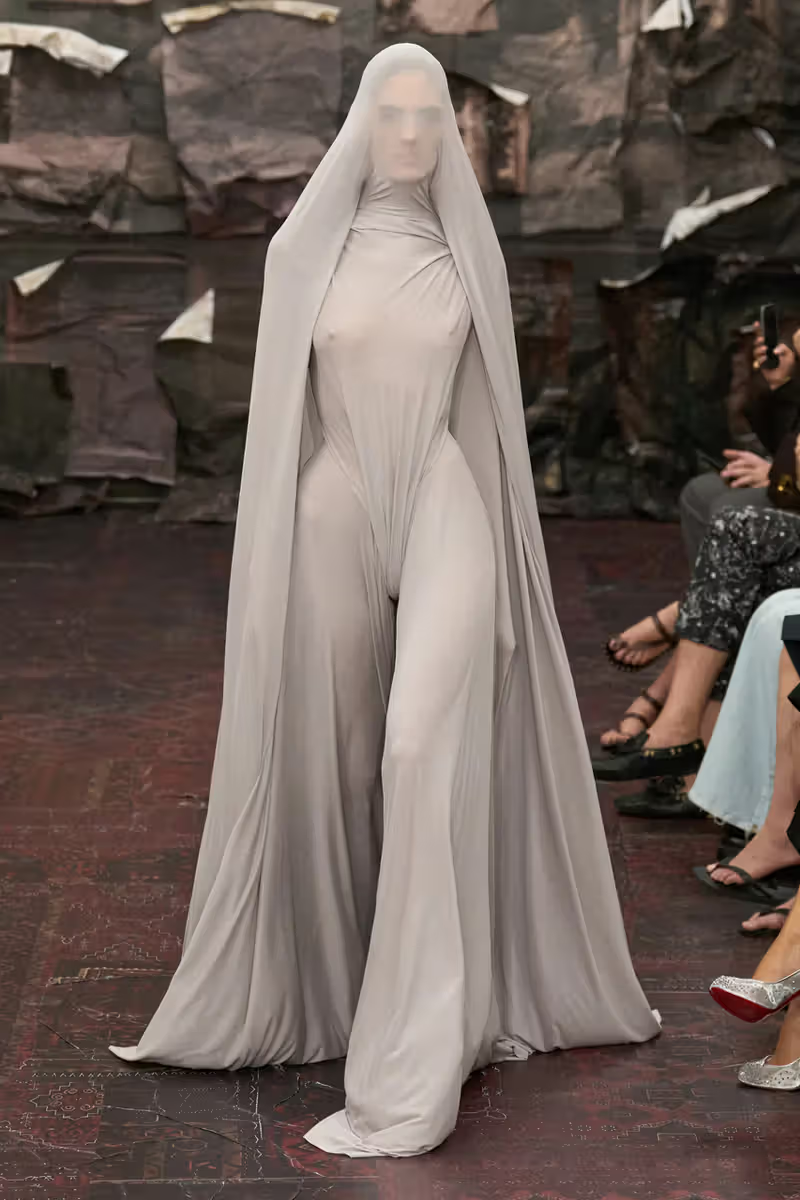
Glenn Martens raided the crypts of Maison Margiela and reanimated everything he found there. In chambers lined with peeling wallpaper and mismatched furniture, models emerged like Silent Hill nurses wearing wasp nest masks, wrapped in what appeared to be the contents of a Flemish manor house estate sale curated by crafty ghosts. Figures draped in metallic duchess satin moved like molten church bells over antique embossed wallpaper, their faces hidden behind masks crafted from discarded boxes, battered metal, shattered crystals, sheer organza, and appliqué lace—Martens’s homage to Margiela’s iconic face coverings.
These were gowns that looked like Renaissance tapestries had been photocopied, crumpled, and then lovingly reconstructed into sculptural forms worthy of cathedral altars, each surface a palimpsest of Dutch still-life paintings layered with vintage costume jewelry reliquary. Among them moved ghostly grey spectres sleekly draped in dim muted tones, figures that glided like shadows along ancient parapets and through secret corridors, their forms pared down to pure haunted elegance. Martens conjured an elegantly decaying world where saintly stone figures had raided the attics of crumbling chateaux, emerging with armfuls of tarnished treasures transformed into an unholy hodgepodge of hypnotic drama.
It was quite the sepulchral estate sale séance!




If you enjoy posts like these or if you have ever enjoyed or been inspired by something I have written, and you would like to support this blog, consider buying the author a coffee?
✥ comment

I have a category on my blog here called “not a fashion blog” because it’s not! I write about all kinds of things. But I also have an interest in FASHUN that cannot be denied when the runway becomes a portal to something so otherworldly and strange.
Iris Van Herpen’s Fall 2025 couture collection was precisely this kind of oceanic witchcraft—dresses that breathed and pulsed with 125 million bioluminescent algae, gossamer gowns that floated through the air like alien cnidarians pulsing through ethereal extraterrestrial tides, and sculptural forms that twisted skyward like alien hydrothermal vents frozen mid-eruption. Van Herpen has conjured living garments that glow cyan in the dark and require daily care like houseplants, fashion as symbiotic organism where couture meets marine biology in a very extra off-world-abyssal-rave-from-another-dimension way. These dresses belonged in glass cases at some future museum of extinct oceanic wonders that never were.
There were also moments of faceted filigree Art Nouveau chrysalis work, as well as couture versions of those dramatic birds that resemble rich Victorian widows whose last four husbands died under mysterious circumstances.
The whole spectacle was accompanied by a bespoke Francis Kurkdjian fragrance, an olfactory score, that wafted through the venue like invisible oceanic waves, while models walked in heel-less shoes surrounded by cascading metal halos that echoed the structure of sonar waves. It was quite the fantastical metamorphic menagerie!
Read more about Iris van Herpen’s Sympoiesis at Paris Haute Couture Week here.
(Thank you, D., for bringing this to my attention!)


If you enjoy posts like these or if you have ever enjoyed or been inspired by something I have written, and you would like to support this blog, consider buying the author a coffee?
✥ 1 comment