A pale face emerges from a writhing, slithering mass of beetles and larvae, yet Jana Heidersdorf’s macabre portrait mesmerizes, not disturbs. In her cover art for the gothic metal project Wurmpalast, inspired by Poe’s Ligeia, insects arrange themselves into baroque adornments around serene features while a lone specimen makes its pilgrimage across her lips. The beetles become ornamental headdress transforming infestation into coronation. Decomposition, but make it elegant devastation.
When I was curating The Art of Darkness and later, The Art of Fantasy, Jana’s work found its way into both collections. She finds genuine beauty in traditionally unsettling imagery and tenderness in decay. Her approach to the darker things feels emotionally vulnerable rather than gratuitous or manufactured for shock.
Consider her mermaids, which she’s created by the dozens. The Queen of Eels pulses with inner light in crushing ocean depths, her elongated form more alien than human, while serpentine creatures coil around her in devoted attendance. She commands these deep-sea dwellers through presence alone. Jana paints underwater realms in midnight blues and greens where strange creatures generate their own light. Her mermaids feel genuinely otherworldly and more than a little terrifying, closer to what such beings might actually be if they ruled kingdoms we can’t fathom.
Her fairy tale reimaginings reveal similar subversive instincts. In “Wolfwood,” the beast has grown large enough to encompass entire forests within its dark fur, each strand housing shadowed trees and hidden paths. His luminous eyes burn like twin moons above a tiny figure in red…but this isn’t the cowering child of familiar stories. She stands her ground in the starlit clearing, neither fleeing nor advancing, her posture suggesting curiosity and wonder rather than fear; she’s genuinely interested in this encounter. The blue-gray mist shrouding the trees gives it a dreamlike quality, and we’re not sure if this is a nightmare, but we’re also not afraid to find out.
There’s a ritualistic quality to many of her pieces that speaks to deeper mythologies. “Dreambird” captures a covenant sealed in crimson, not violence but offering, as a small brown bird pierces a ghostly palm in one clean swoop. Each feather rendered with medieval manuscript devotion, the creature becomes both communion wafer and consecrating priest. The blood that wells speaks not of wound but willing sacrifice, each ruby drop a prayer offered up. Against mottled jade darkness, the pale hand becomes altar, the bird transformed from woodland creature into mystical messenger.
“Spider’s Cradle” continues this theme of sacred exchange. Death extends jewelry with a grandmother’s care, skeletal fingers cradling web-work as if spun from moonbeams. Each dewdrop caught in the strands gleams like baroque pearls while a white spider bears a ruby birthmark – the crimson sigil of small sovereignty. The phantom face veiled in green shadows suggests inheritance rather than transaction, ancient wisdom passed from bone to the eight-legged makers of delicate snares.
Not everything dwells in shadow. In “Apparition,” the night sky’s dreams of swans takes wing in luminescent clouds. The ethereal bird materializes from stardust, its form shifting between solid grace and celestial vapor as it glides through velvet darkness. Below, a solitary figure witnesses from their balcony – summoner or blessed observer, we can’t tell. It’s the artist at her most hopeful, yet mystery persists even in gentler visions.
Her book cover work demonstrates how these sensibilities translate to commercial projects. For Don’t Let the Forest In, a formal portrait fissures along organic lines as wild roses and thorned branches spill through tears in the photographic surface. A pale butterfly settles among the chaos. A crimson stain spots a collar. Violence and fragility. Blood and wings.
“Tears,” created for Month of Fear 2018, captures a nocturnal being that could be timeless elemental spirit or simply someone out past their bedtime. The question hovers in wide, unblinking eyes – one of which nestles a tiny white spider like a glowing moonstone. What slumbering spirits is she communing with? What midnight magics is she calling forth?
In “Make a Devil Out of Me,” elongated fingers curve into a shape that could be horns – or is it just the way pale hands twist in darkness? Each fingertip sharpens to wicked points while rose vines coil around bone-thin digits. Above, lurid red eyes glower from shadows. Are we seeing transformation, or just the power of suggestion? The pose suggests both invitation and challenge – someone who already feels monstrous finally showing us what they see in the mirror.
Jana finds the sacred in decay, the tender in transformation. Her creatures don’t exist to frighten but to reveal something true about change, about how what we fear might actually offer gifts, how the grotesque can reveal hidden forms of grace, how what repels and disturbs us, what we instinctively avoid might be precisely what we need to see. Through her art, Jana proposes that wisdom often wears frightening masks, that beauty and horror might be closer companions than we’d like to admit. That perhaps our discomfort is a compass, pointing toward the truths we’re not yet ready to face but desperately need to find. That change isn’t something to endure but something to embrace, that our deepest growth might come from the very deepest, darkest places.
Below are a few more of my favorites among the dispatches from the dark corners of Jana’s imagination…
If you enjoy posts like these or if you have ever enjoyed or been inspired by something I have written, and you would like to support this blog, consider buying the author a coffee?
Engraving of a Young Girl Smelling Flowers, Mary Ellen Edwards
Note: These brief impressions are just the surface layer of what each fragrance evokes for me. Over on my Midnight Stinks Patreon, you’ll find the full stories behind these scents—where Xinū VetiVerde becomes a complete botanical horror narrative about zombie apocalypses and colonial privilege, or how Mischief Academy’s Hansel & Gretel transforms into a meditation on Instagram envy and curated domesticity complete with $400 balayage and Williams Sonoma measuring cups.
You’ll get the atmospheric deep dives, cultural rabbit holes, and personal tangents that turn a simple fragrance review into something closer to creative nonfiction. Plus behind-the-scenes glimpses into my creative process, archival reviews from two decades of fragrance writing, and the kind of deeply personal observations that don’t quite fit in public blog posts. The free tier disappears August 1st, so if you’ve ever been curious about how a scent can become a fairy tale retelling or why certain fragrances remind me of mean girls with MBAs in witch she-devilry, now’s your last chance to peek behind the curtain before these musings become members-only territory.
BPAL x bloodmilk Dreaming Mandragora Baptismal linen, lavender-pressed and yellowed, moth-eaten sweetness. Fae changeling cradled in lace and linen, ruffled sack of secrets. Mound of dirt spiced and sweet, loam and leaf, twig and root. Old earth magic’s powder-soft pretense, Lacunae of child, empty rosewood coffin, pile of dust and twisted hay. The pores of the earth opening, breathing, exhaling; mulberry-stained fingers emerge. Blinking in the light. Tiny, grasping, changed. Crawling home to hollow hills.
Aesop Rōzu A rose I immediately enjoy is a rare creature indeed, and this one conjures the fierce tenderness of Yosano Akiko’s verse. I don’t know how this extraordinary poet would feel about this fragrance, but we are channeling her today for these impressions.
Ancient wood smoke
drifts between scattered fog.
Morning bell echoes—
I taste metal on my tongue,
spring’s sharp, necessary cut.
Green leaf floating in
the temple’s shallow puddle
reflects my true face.
A mantis waves its thin arms
in mock benediction.
Thorn-pricked finger traces
rose oil, crimson poems
on sleep-soft limbs,
bitter sutras cannot wash
this sweetness from memory.
Villa Erbatium is a Korean brand I’m not familiar with, but their romantic gothic aesthetic suggested something …different? than what Allegria delivers. With its airy powdery vanilla, cloying sweetness and “clean” conformity, Allegria is the fragrance embodiment of weaponized beige, Christian girl autumn energy in a bottle (there’s nothing autumnal about it, it’s just aggressively calling to mind this “Christian girl autumn” photo that I remembered seeing on reddit.) It’s the olfactory equivalent of overpriced artisanal laundry powder and “fresh linen” candles lit for LuLaRoe parties or some shit, the sort of aroma designed to be so universally appealing it becomes suffocating in its blandness. This is the scent of people who insist on “clean” makeup and chemical-free foods, that elitist purity obsession wrapped in aggressively neutral vanilla that clings to your skin and sinuses like the slimy feeling you get about that shady spiritual cleansing program your friend wants you to join but you’re pretty sure it’s a weirdo sex cult with a side of pyramid scheme. There’s something about this that smells like enforced wholesomeness and suburban respectability that almost immediately becomes that predatory wellness-to-exploitation pipeline that’s so specific and creepy. The combination of spiritual manipulation, financial scamming, and sexual predation really nails that particular kind of modern cult operation. Wow, this escalated. But I smell what I smell.
Heretic Midnight Toker Peak pixie dream girl Peter-Pan collared Zooey Deschanel ModCloth dress, honey-apricot-jasmine preciousness, infantile heliotrope Alice & Olivia floral babydoll cast-offs set alight, smoldering in the gutter. It wasn’t a cleansing fire, not a redemptive flame. Sort of like a nasty garbage bin blaze, destroying evidence of your cutesy, kitchsy crimes. Embezzling from a cupcake boutique, or stealing someone’s vintage typewriter collection, or you did an identity theft or two to afford your overpriced mason jar cocktail with artisan bitters obsession. Some real twee shit. A burnt-out, acrid sweetness “like ew gross” scratch-n-sniff sticker layered atop already barfy one, something bad compounding something worse.
One Day Thai Soda Limey effervescence, lacto-fermented tang. Enzymes and culture, whey-sharp brightness, ginger root and sugar, bacterial starter. Lemongrass stalk steeped in Rose’s lime juice. Makrut lime leaves crushed between fingers. Raffia tote discarded, sandals kicked off. Umbrella shade, cold citrus fizz, slow whirring ceiling fans. Paperback novel pages soft from humidity, airport-bought and quickly abandoned. Cafe corner, afternoon nowhere. Electric effervescent amnesia. Fleeting fizzy forgetfulness fun Fun FUN.
Régime des Fleurs Green Vanille Cold, coiled, calculating. A soupçon of weaponized sweetness. Wilhelmina Slater corner office with floor-to-ceiling glass walls, fashion dungeon once her interior decorator works their dark magic. Absinthe-laced champagne vanilla, green and subtly herbaceous, aromatic poison in crystal stemware. Dusty-woody-musky shadows, slithery spice as hissed threats between bathroom stalls. Mean girls who devoured high school bones and all used losers’ broken phalanges to pick their teeth; earned their MBAs in rancid witch she-devilry and leveled up into the cuntiest of lady bosses; perfected the art of smiling while sliding knives between ribs and stabbing square in the middle of the back while smiling with their perfect veneers. Creamy almond undertones, just enough sweetness to mask bitter herbs. Fake pleasantries/ menacing undercurrent, espionage in every conversation, veiled threats disguised as small talk. How’s business this quarter? How are your kids? I’ll cut a bitch. I’ll strike when you least expect it. More canapés?
Xinū VetiVerdeBubble bath in the heart of the tropics. An army of the undead approaches. Pink satin negligee, frayed lace, damp skin. Powder, rouge, perfume, genteel botanicals dabbed behind the ears, an ornate imported mirror’s humid surface reflects palms and liana and strangler figs pressed against swollen shutters. Lush growth, wild abundance, birds of paradise fills every window; just inside the steamed glass, a pale, wilting orchid of a woman, a fragile, cultivated existence inside that’s already starting to decay. Rosy citronella, refined for cocktail parties instead of protection. Grassy twigs distilled into cut glass crystal atomisers rather than bundled for kindling. Bamboo like the idea of bamboo, clean and serene and watery-green, nothing left of the sharp-edged, invasive reality splitting the foundation outside. The whisper of bodies that no longer remember their names, thronging with un-life, powdered pollen dusting limbs, numbing nerves, severing synapses, only a mindless floral directive: bloom, spread, consume; crawling corpses crowding at the threshold. The tub fills, overflows, she’s sinking beneath the flowery froth, a strange sluggishness creeping through her body, a sweet lethargy replacing thought, an ecstasy of subsummation as awareness dims, a blissful relinquishing to the blooming collective as the door splinters inward.
Mischief Academy Hansel & Gretel isn’t the fairy tale witch’s honest death trap, it’s the modern bougie kitchen witch with her artisanal wooden spoons and Williams Sonoma measuring cups, making traditional German Christmas cookies in a kitchen that costs more than most people’s annual salary. This fragrance captures the amber-patchouli sophistication of expensive cashmere and gingery-warm spices, Pfeffernüsse cardamom, Lebkuchen honey and almonds, Spekulatius cinnamon, but it doesn’t smell like food. Instead, it smells like the memory of those scents clinging to someone who can afford to live that perfectly curated Instagram life. You’re pressed against the phone screen at 2am, desperately wanting to be the person in that sweater, living in that snow-globe perfection where baking feels like meditation rather than labor. As it dries down to woods, ambroxan, and synthetic musk, the cozy fantasy fades into something sophisticated but hollow: the olfactory equivalent of lifestyle porn that leaves you with that gnawing inadequacy that follows every scroll session. This has nothing to do with candy houses or literal hunger; it’s about manufactured desire, the trap of wanting a life that exists primarily in filtered light and carefully staged moments. The scent itself is genuinely lovely, but smelling it feels like window shopping for an existence you can’t afford.
If you enjoy posts like these or if you have ever enjoyed or been inspired by something I have written, and you would like to support this blog, consider buying the author a coffee?
I have finally done the thing. You know, that thing I’ve been promising to do for approximately forever? The bookshelf tour. It’s happened. It exists. On YouTube. Right now, as we speak.
Filming in 97-degree Florida heat required a mid-filming costume change. I had to ditch my regular shirt for a midriff top from Reve Brewing (their trippy Feed Your Head IPA design) and put my hair up in a little sprout like a goth radish because I was literally melting. I was weirdly excited about finally owning a midriff shirt at almost 50, thinking, “who gives a fart if anyone sees my belly?” But then came the sad trombone: turns out I have a real short torso, so no one was going to see my belly anyway.
A little preview of what awaits:
You’ll get to see the books I gift most often (spoiler: it’s always Salt is for Curing by Sonia Vatomsky), my collection of Time Life Enchanted World books that shaped my entire aesthetic sensibility as a child, and the gothic romance novels I bought purely for their cover art and have never actually read because the print is too small.
There are art books, folklore, and mythology, my witchy business shelf (that’s the technical term), and the three shelves of books I’m currently selling. I’m keeping mostly nonfiction, art books, science, esoteric studies, philosophy, memoirs, and essays. Things for reference and research. I don’t typically reread fiction (I can think of three examples: Dracula, Rebecca, and Harriet the Spy, and I haven’t reread those in years). I want new stories. My time on earth is limited, so those fiction books are just taking up space and collecting dust. Some of those are brand new, never read…which represents an opportunity for someone else to discover them properly.
You’ll also hear about my recent writing adventures (my Rue Morgue column!) and my summer social media break that’s been gloriously freeing. Plus, I share some very exciting news about the new book I’m working on, which is in that same wonderfully weird vein as my other art books.
Click to embiggen
I forgot to include several things that probably should have been included in the tour. Like my Goodreads challenge progress (I’m at 92 out of 100 books for the year), or a screenshot of all my NetGalley ARCs, or the wheelie cart under my desk that houses the physical books I’m currently reading. That cart is where I keep my nonfiction books, which I read at my desk during the workday, because I find them easier on my eyes. Fiction reading happens in the early morning or evenings when I’m on the couch, the words at a different height and level from my eyes, with more dim lighting. Currently, the cart contains a biography of Hilma af Klint, a book of poetry by Lisa Marie Basile, The Transcendent Brain, How to Disappear: Notes on Invisibility in a Time of Transparency, and Scent & Subversion.
Since I mentioned a few books in passing during the video, I thought I’d share the full thoughts here as bonus content. I briefly discussed The Argonauts and Bird by Bird – here are my complete takes on both:
The Argonauts by Maggie Nelson: The Argonauts is like trying to understand a conversation happening in the next room if the room was underwater and the speakers were having a dialogue in a language you don’t know, and then you realized they were actually talking to themselves. This profound disorientation is exactly how Maggie Nelson weaves together musings on Barthes’ idea of love as a constant renewal, Judith Butler’s theories of gender performativity, and her own intimate experiences of partnering with Harry Dodge and becoming a parent. I didn’t recognize half the references, and there were moments when the academic language felt like an impenetrable wall. And yet. Nelson captures something true about the raw, uneven texture of human experience—the way love transforms us, how we struggle to articulate our most intimate experiences. She writes about pregnancy, partnership, and queer family-making with an honesty that cuts through academic jargon. I’m not sure I fully understood everything, but I felt like I was witnessing something important—a story that kept slipping between my fingers every time I thought I’d grabbed hold of it. What does it mean to love someone? To become a parent? To exist outside traditional stories? Nelson explores these questions by diving into everything from avant-garde film theory to psychoanalytic texts, scattering esoteric philosophical breadcrumbs that make you feel simultaneously incredibly brilliant and profoundly stupid. Something about the Argonauts and replacing ship planks, something about becoming—I’m not entirely sure I understood it, but it felt like she was asking: Who are we when we change? When we love? When we exist in ways that challenge how others see us? She doesn’t give you neat answers. Just more questions, more uncertainty.
Bird by Bird: Some Instructions on Writing and Life by Annie Lamottis a treasure trove of wisdom that transcends its categorization as a book on writing, offering a raw, honest, and often hilarious look at the creative process. Lamott’s self-deprecating humor and personal anecdotes create a work that’s as entertaining as it is insightful. Her unflinching acknowledgment of the neuroses and setbacks that plague writers resonated deeply with me – not as a soothing balm, but as a weirdly addicting, pricklingly poison ivy for my spirit. I cannot count the times I cackled whilst reading this book; equally, I lost track of the number of times it moved me to tears.
Also: Writing is hard. I want to hear about how hard it is! One reviewer complained that Lamott made writing sound as painful as passing a kidney stone, and while he disagreed with that takeaway, I sure don’t. So I appreciate having that struggle, that difficulty, validated, even (especially) in snarky, petty, but also really encouraging and inspirational ways.
I underlined the hell out of this book. So much of this advice is good for not just for the writing life, but just…navigating life, itself. Here are a few things she said that I am still thinking about…
Her assertion that “being enough was going to have to be an inside job” hit me like a revelation, echoing my own recent struggles with seeking external validation, particularly through social media. This idea resonated with me as I continue to grapple with building my self-worth, rather than relying on likes or followers.
The author’s emphasis on giving from the deepest part of yourself, and finding reward in that act of giving itself, felt revolutionary in our often results-driven world. As Lamott puts it, “You have to give from the deepest part of yourself, and you are going to have to go on giving, and the giving is going to have to be its own reward.” Publishing and recognition doesn’t solve everything. In fact, it hardly solves anything. It’s a reminder that I need to focus more on the (painful) joy of creating itself, rather than constantly worrying about how my work will be received. But I’ll admit, I often find myself wondering what the point is of writing something if I’m not sharing it. It’s a tension I’m still grappling with – the pull between creating for its own sake and the desire for my words to be read and acknowledged.
This metaphor of writing as a ‘little lighthouse’ really struck a chord with me. It made me think about how my own writing might impact others in ways I can’t predict or even imagine. It’s a comforting thought when I’m struggling with self-doubt – that even if I can’t see it, my words might be illuminating a path for someone out there.
Finally, and maybe most of all, I love how the book’s title comes from Lamott’s childhood memory of her brother struggling with a bird-watching report. It’s become a sort of mantra for me when I’m facing overwhelming tasks, not just in writing but in life generally. ‘Bird by bird’ reminds me to take things one small step at a time. When I’m staring down a daunting project, I try to remember this approach – break it into tiny, manageable pieces. It doesn’t always work, but when it does, it helps me feel like I’m making progress instead of drowning in the enormity of it all. This, and the crappy little elf advice, are probably the most helpful writing suggestions I know.
I also mentioned several artists whose work is featured in my space, and I’ve had the opportunity to interview all of them for the blog over the years. If you’re curious about their creative processes, you can check out my conversations with Alyssa, Lupe, Becky, Han, and author/poet Sonia Vatomsky.
So yeah, this is me, hot and cranky, giving you an authentic glimpse into my actual lived-in space where books exist alongside creepy dolls and commissioned art and the general chaos of someone who prioritizes interesting objects over organizational systems. Witness my heat-addled ramblings about folklore and poetry and books that fall apart from being loved too much. And if you see anything on those selling shelves that catches your eye, you can find it in my Pango bookshop. Seriously, please buy my old books! If I have to schlepp them across the country next time we move, it will kill my soul!
What are you reading lately? And what’s your own philosophy about keeping vs. letting go of books? Tell me in the comments.
Later, weirdos.
If you enjoy posts like these or if you have ever enjoyed or been inspired by something I have written, and you would like to support this blog, consider buying the author a coffee?
I was extremely privileged to include two of Yuko Shimizu’s works in The Art of Fantasy: A Visual Sourcebook Of All That Is Unreal, and if you’re curious as to which pieces, you’ll have to pick up a copy! But I can tell you that I’ve been following Shimizu’s work for years, ever since I started sharing her illustrations on my own Tumblr during that platform’s golden age of art curation. From the first piece I posted, her work felt like discovering a secret garden where Japanese folklore grows wild alongside Western pop culture, where ancient spirits share space with modern anxieties, and where every illustration pulses with a kind of electric mythology.
Shimizu’s visual language makes the ancient feel urgently contemporary. Her linework shifts between delicate and bold, somewhere between neon calligraphy and elegant graffiti – fluid strokes that can transform a simple curve into a dragon’s spine or a woman’s hair into flowing water. Eastern and Western aesthetics collide in her work to create hybrid mythologies where traditional yokai rub shoulders with comic book heroes, cherry blossoms bloom alongside circuit boards, and every composition thrums with symbolic density that rewards closer inspection.
No doubt, this cultural fluency comes from living and working between worlds. Shimizu came from Japan to study at Art Center College of Design in Pasadena before settling in New York, where she made the leap from corporate design to freelance illustration. Now she balances creating work for major publications with teaching at the School of Visual Arts. Perhaps it’s this trajectory that allows her to make folklore feel at home in contemporary settings and inner demons take on epic proportions, the kind of visual bilingualism that comes from navigating multiple worlds simultaneously.
The breadth of Shimizu’s client list reads like a fabulous media survey of contemporary publishing, from The New York Times and Time Magazine to DC Comics and children’s book publishers, from Japanese folklore collections to Universal Pictures monster movie posters. Yet despite working across such varied editorial, commercial, and publishing contexts, certain motifs surface again and again in her work: the transformative power of flowing elements, faces that carry both secret intensity and expressive restlessness; creatures caught in moments of metamorphosis where reality and legend converge.
Yuko Shimizu
In this limited variant cover art for Dracula, Motherfxxker, a figure free falls through a psychedelic fever dream, a splash of cool color against the swirling hot pinks and oranges that billow around him like cosmic cotton candy. But it’s Dracula’s brides who steal the scene, emerging from the swirling patterns like beautiful mirages, their faces adorned with stars and decorative flourishes – disco goddesses with a taste for blood.
Shimizu nails the comic’s pulpy California psych-horror vibe, where ancient evil meets the decade of excess. The composition pulses with 70s psychedelia – flowing curves and saturated colors seeming to move even when you’re looking straight at them. Floral motifs twist through the design alongside celestial stars; part concert poster, part tarot card, part bad trip.
Yuko Shimizu
Commissioned as a magazine cover portrait for New York Walker magazine #14 (targeted toward Japanese audiences in New York City), Shimizu captures Björk’s artistic identity through this portrait where the artist floats in impossible suspension, her face turned upside down while elaborate braids loop and cascade around her. Tiny golden bells nestle among the dark plaits, each tied with delicate blue ribbon bows, suggesting childhood fairy tales where each small tinkling sound summons strange sonic spells. The topsy-turvy positioning seems perfectly natural for someone who’s built a career on upending expectations.
Yuko Shimizu
For a New York Times science section article about estrogen’s role in brain health, Shimizu transforms complex endocrinology into something beautiful and organic. A blue brain blooms like an exotic flower, its neural pathways sprouting vibrant petals in purple, pink, and orange while butterflies and bees hover around this impossible garden. The brain grows from rich earth, its stem-like base suggesting that our most complex organ might be more connected to nature’s cycles than we ever imagined. Green leaves unfurl from the brain’s surface while tiny blue spores drift through the black background like microscopic messengers.
The pollinator connection is interesting – hormones carrying messages between different parts of the body, cross-fertilizing systems we once thought were separate. The flowers blooming directly from brain tissue capture the research: estrogen doesn’t visit the brain occasionally; it helps the brain grow and flourish. Here, the brain isn’t a computer humming away in isolation but a living system that blooms and withers with the hormonal seasons of our lives.
Yuko Shimizu
For the interior illustrations of Japanese Tales, a collector’s edition published by Folio Society, a parade of yokai streams across a crimson bridge, their procession both menacing and oddly festive. Protruding eyeballs and lolling tongues suggest barely contained chaos; this whole parade might dissolve into mayhem at any moment. Shimizu captures the spirit of Japanese folklore where the supernatural and mundane intersect daily. This bridge becomes a threshold between worlds, and the yokai crossing it are neither purely evil nor benevolent – they’re simply part of the fabric of a universe where the impossible happens every day.
Yuko Shimizu
For Catherynne M. Valente’s collection, The Melancholy of Mechagirl, a woman’s profile emerges from a tangle of colorful cables that wind through her long, black hair like digital veins, snaking toward a floating fox mask – kitsune meeting cyborg, downloading folklore directly into her neural networks. A yellow sun burns against the gray textured sky while stylized waves roll beneath, framing this moment where traditional Japanese imagery collides with cyberpunk possibility. Shimizu visualizes the central tension in Valente’s stories: the melancholy of beings caught between worlds, whether machine and human, ancient and futuristic, or dream and reality.
Yuko Shimizu
For the cover of Monstrous Affections, an anthology edited by Kelly Link and Gavin J. Grant, a black-winged creature crouches among towering red thistles, blood dripping from its fanged mouth while a ghostly white arms lies lifeless on the ground beneath its claws. The red thistles bloom impossibly large, their spiky petals matching the creature’s predatory nature. Blood and flowers create an unsettling combination – beauty and violence intertwined like the stories within the collection. Shimizu captures the anthology’s central premise, embodying the paradox these stories explore: creatures that should repel us but somehow fascinate instead.
Yuko Shimizu
For a University of Minnesota alumni magazine feature about neutrino research, Shimizu solves the impossible illustration challenge by making the invisible visible, turning abstract physics into cosmic poetr. A serene sun with human features radiates golden beams while countless white dots swirl through the cosmic darkness around it, each speck representing the billions of invisible neutrinos streaming through space and through our bodies every second. These “ghosts of the universe” flow in elegant spirals and streams, their paths traced in white against the infinite black. The neutrinos become star maps, their ghostly presence given form through flowing white currents that connect the sun’s nuclear heart to the underground detectors waiting 500 miles away in northern Minnesota.
Yuko Shimizu
For the frontispiece of Fairy Tales by Oscar Wilde, published by Beehive Books, Shimizu depicts the flamboyant literary figure emerging from a cascade of peacock feathers, his bow tie perfectly knotted while surrounded by theatrical plumage. The feathers fan out behind him in elaborate eye-spotted displays, both ornate and slightly overwhelming, with detailed linework capturing every curl of hair and feathered barb, creating a visual density that mirrors the richness of his fairy tales – stories where beauty and cruelty coexist in elaborate, sometimes uncomfortable displays.
Yuko Shimizu
Created for Matthew Sanborn Smith’s science fiction story “Beauty Belongs to the Flowers” published on TOR.com, Shimizu gives us a vision both lovely and unsettling where a serene face floats in darkness, while countless yellow tubes curve and spiral, connected to a glowing, translucent, bubblinge. An oversized orange flower dominates the foreground, its petals rendered in intricate detail, while smaller petals drift through the composition like escaped fragments of vitality. Here, beauty has become something to be administered rather than naturally occurring, raising questions about what we might lose in our pursuit of perfection.
Yuko Shimizu
As a limited edition wraparound variant cover for Batman Returns created in collaboration with Dark Hall Mansion and Warner Brothers, Christmas ornaments tumble through the air around Catwoman like an extremely fantastic snow globe – ruby red, emerald green, sapphire blue spheres, just out of reach of those wickedly curved silver talons. An army of sleek black cat silhouettes surrounds her, all glowing amber eyes and liquid shadows, practically vibrating with that universal feline thought: “Ooh, shiny things!” These aren’t just random cat shapes either – Shimizu crowdsourced reference photos from actual cat owners on social media, so somewhere in this midnight menagerie lurks Mrs. Whiskers from down the street. Here’s Catwoman in all her contradictory glory: part predator, part playmate, Christmas angel with claws that could shred wrapping paper or your face with equal enthusiasm.
Yuko Shimizu
As part of Universal Pictures’ “Out of the Shadows” art contest in 2021, where contemporary artists were invited to refresh classic monster movie posters, Shimizu reimagines The Wolf Man through botanical horror. A gnarled hand grows into a tree with blood-red leaves, its bark etched with intricate patterns where flesh becomes wood. The curse spreads like roots through the body, and that medallion face trapped within its star-pointed prison might be all that’s left of the human watching his own transformation, while the hand of glory folklore brings its own dark associations. Shimizu’s poster makes the wolfman’s curse feel organic and inevitable, something that grows from within rather than attacks from without.
Yuko Shimizu
Creating cover art for a collectors edition original 1950s Japanese kaiju motion picture Mothra soundtrack released from Waxwork Records, two priestesses in golden robes stand beneath their divine protector, faces grave with ceremonial purpose. Mothra spreads her wings above them, each wing decorated with intricate eye-patterns that seem to watch over her tiny human guardians. The moth’s body gleams with an otherworldly blue, while her wings shimmer in patterns of black, orange, and yellow that suggest both beauty and terrible power.
The twin fairies – Mothra’s earthly voices – stand close together in their matching robes and flower crowns, ready to translate between human and kaiju worlds. An orange sun burns behind them while oversized tropical leaves frame the scene like a shrine painting come to life. Shimizu captures the genuine mythology of Japan’s most benevolent monster, a protective deity who happens to have wings spanning several city blocks.
If you enjoy posts like these or if you have ever enjoyed or been inspired by something I have written, and you would like to support this blog, consider buying the author a coffee?
I’m starting something new on my Patreon—digging into two decades of perfume reviews you may have missed. Kicking off with Mémoire d’une Odeur, the Gucci that taught me I could still be completely wrong about what I wanted from a fragrance. Come see why this quiet, melancholic beauty has become my companion for those betwixt-and-between moments.
As I transition away from free content on Midnight Stinks, I wanted to give everyone a taste of what’s coming. This kind of deep dive into my fragrant past, alongside fresh discoveries, scented correspondences, and the occasional delightful surprise, is exactly what subscribers can expect. If you’ve been on the fence about joining our little community of stinkers and weirdos, now’s the perfect time to see what you’ve been missing—and what you’ll continue to enjoy as a member of this strange, perfume-obsessed family.
Hello there, weirdos and lovelies! To my longtime readers who’ve been following my musings for years—you know all this already, and I adore you for sticking around through every obsession and existential spiral. But for those who’ve recently discovered me through my Ghoul Next Door column in Rue Morgue magazine, found my Midnight Stinks perfume reviews on TikTok (no longer updated in that space, but I’ve been writing about perfume since before TikTok was born and continue to do so literally everywhere else), or stumbled across this blog through some strange artsy rabbit hole mystery revolving the lost and found cover artist of an iconic children’s fantasy book, let me introduce myself properly. I’m a published author. Three times over, in fact.
I’ve spent nearly two decades balancing corporate drudgery with creative pursuits that would make my HR department deeply uncomfortable. (If I had one, if I wasn’t, in fact, the HR department.) While documenting my obsessions with fragrance, fashion, and all things fantastically macabre here on this corner of the internet, I’ve also been working on a trilogy (soon to be a quartet!) of art books. Apparently, I decided that years of research into dead artists and occult symbolism would be a brilliant use of my free time. My bank account remains unconvinced.
The Art of the Occult: A Visual Sourcebook for the Modern Mysticwas my first foray into published territory, a visual feast exploring how artists throughout history have been drawn to mystical realms. From theosophy and kabbalah to alchemy and sacred geometry, this book examines why creators are perpetually pulled toward the esoteric. If you’re the type who finds tarot cards aesthetically compelling even if you can’t tell a death card from a grocery list, who gets shivers from Hilma af Klint’s automatic drawings, or who’s ever wondered about the symbolic mysteries hidden in Pre-Raphaelite paintings, this one’s for you.
The Art of Darkness: A Treasury of the Morbid, Melancholic and Macabre followed two years later, diving headlong into humanity’s eternal fascination with mortality, fear, and the grotesque. This isn’t about glorifying death but rather examining why artists from Hieronymus Bosch to Francis Bacon, Frida Kahlo to Louise Bourgeois have found beauty in darkness, comfort in confronting our demons. If you’re someone who finds Victorian mourning jewelry beautiful, who appreciates the sublime terror in Goya’s black paintings, or who understands that sometimes the most profound art emerges from our deepest fears, this book speaks your language.
The Art of Fantasy: A Visual Sourcebook of All That is Unreal completed the trilogy in 2023, celebrating the impossible, the imaginary, the utterly fantastical. From Blake’s visions to contemporary illustrators conjuring digital dragons, this book asks why artists are compelled to create worlds that never existed. If you’re enchanted by myth and magic, if you’ve ever lost yourself in a museum gallery full of surrealist paintings, or if you believe impossible worlds can reveal unexpected insights about our own, this collection will bewitch you.
The links above will direct you to the Amazon page for each book. However, if you’re in the US and would like a signed copy (and a bookmark!) for your collection, you can order directly from me here.
Want to dive deeper before committing? I’ve written extensively about a handful of the artists and themes in each book—you can find behind-the-scenes stories and detailed features under the corresponding categories right here on my blog.
Here’s something you might not know about me: more than writing books, I’ve always dreamed of selling them. Picture me in some dusty, overstuffed used bookshop, surrounded by towering stacks of forgotten treasures, helping fellow bibliophiles discover their next obsession. While I don’t yet own that quaint little shop (my retirement plan, wheeee!) I’ve found the next best thing.
My Pango bookshop has become my virtual version of that dream. It’s where I sell my carefully curated collection of used books: horror novels with deliciously creepy covers, poetry collections that make your soul ache, esoteric volumes on tons of weird shit. These are books I’ve loved, books that have lived on my shelves until space demanded difficult decisions, books that deserve new homes with readers who will appreciate their particular magic. Also, I am running a 20% off sale right now!
Browsing my bookshop feels a bit like wandering through my personal library, which, in a way, it is. You’ll find first editions alongside well-loved paperbacks, academic texts on occult symbolism next to vintage horror paperbacks with lurid covers. These are books I’ve loved, books that have earned their place through great writing, beautiful design, or sheer oddball charm.
My day job is in jeopardy, which has me scrambling to shore up my side hustles. After nearly 20 years, losing that steady paycheck means these passion projects need to start paying actual bills. It’s terrifying and liberating in equal measure; my fight-or-flight response can’t decide if this is a disaster or an opportunity; I am simultaneously puking and turning ecstatic cartwheels. I’m a fucking mess.
Your support, whether through purchasing my books, browsing my virtual bookshop, or simply sharing a post that resonated with you, helps keep this strange little corner of the internet alive. It allows me to continue exploring the intersections of art and the occult, beauty and darkness, the real and the fantastical, without the pressure of advertising or sponsored content diluting our conversations.
Ways to Support This Work
Not sure which book might speak to you? Are you drawn to mysticism, spirituality, or the esoteric? Start with The Art of the Occult.Do you find beauty in melancholy, comfort in confronting mortality?The Art of Darkness is calling your name. Are you enchanted by myth, magic, and impossible worlds?The Art of Fantasy will transport you to realms beyond imagination.
Beyond purchasing books (though that’s always appreciated), there are many ways to help keep this creative work flourishing:
Leave reviews if you’ve read my books—your words help others discover this work
Share posts that resonate with you across social media
Request my books at your local library
Engage in the comments—your thoughts and reactions inspire new ideas
Browse my Amazon affiliate links when you’re shopping anyway
Your engagement matters just as much as financial support. Every comment, every share, every moment you spend in this space contributes to keeping it alive and thriving.
Whether you decide to add one of my books to your collection, discover a treasure in my virtual bookshop, or simply continue reading these midnight musings about the beautiful, the dark, and the strange, know that you’re part of something special. You’re supporting not just me, but the entire ecosystem of independent creators who choose to work in the margins, who believe that art and beauty and weirdness matter.
Mary Pickford, wearing a kimono, writing at a desk, c.1918 / Hartsook Photo, S.F. – L.A.
Hello, dear devotees of all things olfactory, I have some news about my Midnight Stinks Patreon. I shared it over there already, but since many of you found that space through this here blog, I thought it best to share the news here as well.
I need to have a heart-to-heart with you about some changes coming to our little fragrant corner of the internet. As of August 1st, I’ll be removing the free tier option from Midnight Stinks. I know change can feel jarring, especially when it affects something you’ve grown accustomed to, so I want to be completely transparent about why this decision feels necessary.
The numbers tell a story that’s become impossible to ignore: I currently have 40 paid members with a total 175 subscribers altogether, bringing in about $218 per month. Meanwhile, I’m about to lose my day job of nearly 20 years – the income that’s been allowing me to treat this passion project as exactly that, a project where financial sustainability took a backseat to creative freedom and community building.
For years, I’ve been essentially subsidizing Midnight Stinks out of my own pocket, which felt fine when I had the security of steady employment. I loved being able to offer free content because fragrance should be accessible, and some of my most treasured community members found me through that free tier. But as I face this major life transition, I need to be honest about the reality: I can’t afford to lose money on something that brings me, and hopefully you, so much joy.
This isn’t about getting rich off perfume reviews (clearly, given those numbers!). It’s about creating something sustainable that allows me to keep doing what I love: diving deep into the weird, wonderful world of fragrance and sharing those discoveries with people who understand that a single sniff can transport you to fabulous, fantastical realms.
I’ve agonized over this decision because I know it means some people who’ve been part of our community may not be able to continue the journey with us. That breaks my heart a little. But I also believe that what we’ve built here, this space for stinkers and weirdos to geek out over scent without judgment, has real value, both for me as a creator and for you as readers.
Moving forward, all of my fragrance content, reviews, musings, and olfactory obsessions will be available to paid subscribers. I’m committed to making sure that investment feels worthwhile, continuing to bring you the same blend of poetic reviews, dark humor, and genuine passion for all things smelly that drew you here in the first place.
If you’ve been considering upgrading to paid support, now would be a perfect time. If budget constraints make that impossible right now, I completely understand – we’ve all been there. And who knows? Maybe our paths will cross again when circumstances change.
Thank you for being part of this strange, beautiful community. Thank you for indulging my midnight musings about molecules and memories. Thank you for understanding that sometimes we have to make practical decisions to protect the things we love.
Here’s to sitting in the dark together, breathing deeply, and experiencing some v.
With gratitude and just a touch of melancholy, S. Elizabeth
P.S. – All existing free subscribers will continue to have access to previously published free posts, so nothing you’ve already enjoyed will disappear.
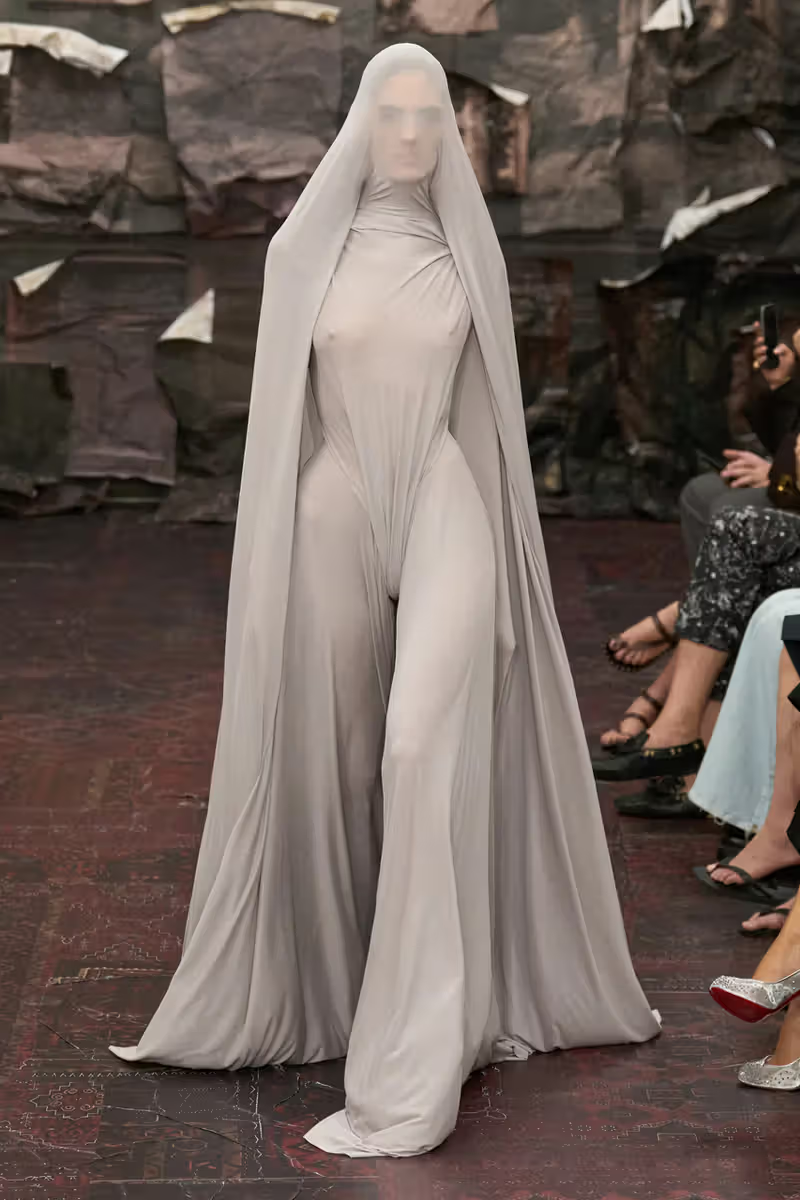
Glenn Martens raided the crypts of Maison Margiela and reanimated everything he found there. In chambers lined with peeling wallpaper and mismatched furniture, models emerged like Silent Hill nurses wearing wasp nest masks, wrapped in what appeared to be the contents of a Flemish manor house estate sale curated by crafty ghosts. Figures draped in metallic duchess satin moved like molten church bells over antique embossed wallpaper, their faces hidden behind masks crafted from discarded boxes, battered metal, shattered crystals, sheer organza, and appliqué lace—Martens’s homage to Margiela’s iconic face coverings.
These were gowns that looked like Renaissance tapestries had been photocopied, crumpled, and then lovingly reconstructed into sculptural forms worthy of cathedral altars, each surface a palimpsest of Dutch still-life paintings layered with vintage costume jewelry reliquary. Among them moved ghostly grey spectres sleekly draped in dim muted tones, figures that glided like shadows along ancient parapets and through secret corridors, their forms pared down to pure haunted elegance. Martens conjured an elegantly decaying world where saintly stone figures had raided the attics of crumbling chateaux, emerging with armfuls of tarnished treasures transformed into an unholy hodgepodge of hypnotic drama.
It was quite the sepulchral estate sale séance!
If you enjoy posts like these or if you have ever enjoyed or been inspired by something I have written, and you would like to support this blog, consider buying the author a coffee?
Over the years, I have created and posted on social media silly mashups of words and images that, as they say, “went viral.” People thought they were a hoot and a holler. The public’s pickle was tickled.
If I turned some of the public domain ones into postcards and sold variety packs of, say, three each, would that be something you would purchase from me? And how much would you be willing to pay for it? $12? $15?
In the meantime, I know how the internet is, so please don’t steal my very fun and exciting idea! If I see my little postcards here for sale at some wish.com level Redbubble equivalent, I will be very upset!
I was recently watching something on YouTube with Yvan, something like “What it costs per week to live in the Japanese countryside.” It was a family of four, and the mother was narrating the video. We got to the part where she showed the week’s grocery tally, with the caveat that it wasn’t too much money because “we’re not big eaters.” What! I just wasted 15 minutes of my life on you, lady!
I am absolutely a big eater. I love food. I think about food. I plan meals and eat them and think about the next thing I want to eat before I have even finished. At the beginning of the year, my doctor wanted me to lose 25 pounds to help with my blood pressure, and while I hate that weight loss is the medical go-to, the truth is I haven’t felt comfortable in my body for several years. So here we are.
Twenty-two pounds down, doctor’s appointment in a week. The meal prepping isn’t new, but I’ve gotten more consistent with it. We haven’t had delivery in seven months, which I’m ridiculously proud of. I like to cook anyway, so this has made me more creative and consistent in the kitchen. This current fridge snapshot is full of vegetables that I have pre-chopped for soup or whatever else. There are leftovers from our Sunday family dinner (salmon and corn chowder and sour cream cucumber salad) and a cream of mushroom soup I made last week. There is homemade sauerkraut (!!) and watermelon rind kimchi. So many things! I spend a large portion of my Saturdays puttering around in the kitchen and most of this culinary menagerie is the result of those efforts. P.S. Yvan got me this Masontops fermenting kit, and for about a year it sat around untouched because I was a little scared of it, but I am off and running with it now!
Movement has helped a lot too. I’ve weaponized my pacing. I get between 15-20K steps per day, either starting with a 5am walk around the neighborhood, or if I’m being honest, it’s mostly me marching, trotting, and shuffling around the house for twelve hours. I’ve also started using my 5-pound weights for about five minutes of daily exercises. Plus some traditional Chinese morning exercises—fast arm movements to get energy flowing. I don’t know what to call them exactly, but they showed up on my TikTok as “ancient exercises.”
Anyway, that’s all I want to say about that. Literally everything in the world you could natter on about is better than listening to people talk about weight loss, I get it.
This is an admittedly kind of gross-looking picture, but it seems I haven’t taken many photos lately, and maybe I have just forgotten how. I’m realizing I mostly view things through a lens when I am trying to come up with an idea for social media, and I haven’t been on social media since early June, so I haven’t even thought about it.
Anyway, here’s that saurkraut and the watermelon rind kimchi, along with our breakfast soup. It’s a dashi broth with a little soy sauce, mirin, and sugar, along with the finely chopped cabbage core left over from the saurkraut, some eggplant, shimeji mushrooms, and a bit of egg. I made biscuits yesterday and anytime you do an egg wash on top of a bread before it goes in the oven, you’re only using like 10% of it, and I hate wasting the rest! So I just put it in a little container overnight and drizzled it over the hot soup just before I took it off the burner. It was so, so good. This isn’t a meat soup, per se, but I usually do snip in a tiny bit of marinated pork when I make this, just to add some extra flavor. I am pretty sure this is not how you are meant to use this spicy marinated pork bulgogi, but it works for me.
Anytime I talk about breakfast soup now, I think about this meme that my best good friend sent me, something like “bro goes to Japan one time and won’t shut up about soup.” I don’t even have an excuse, I have never been to Japan! Forgive me. I, too, am a bro who cannot shut up about breakfast soup.
This is a rose that only blooms once a year. I don’t know if that’s how it’s meant to do, but that’s how she does for us. These catch-up posts feel like they’re becoming a bit rarefied and infrequent, too. Anyway.
I finally watched Sinners, and it was as fantastic as everyone said it would be. I loved how it added a little extra something to vampire lore without trying to reinvent the entire wheel. I would have loved more of Remmick’s backstory, but that’s probably a very white audience response that completely misses the point, even if it also feels like a natural story-lover reaction. (But that “Rocky Road to Dublin” scene was pretty incredible.) And so was the scene where Sammy’s song brought all the ancestors together! On a related note, I never did watch Nosferatu. I was pretty rabid to see it, but once I finally got the opportunity, it bored me to tears within 5 minutes. I think it’s because I’d seen the Werner Herzog Nosferatu a few months before and had already made up my mind that anything that came after was going to be redundant and would pale in comparison.
Andrew Michael Hurley is fast becoming one of my favorite authors. If you’ve ever read Robert MacFarlane’s lyrical, deeply researched writing about ancient British landscapes and thought, “what this needs is some creeping dread, ghostly presence, and unexplained rural menace,” then you’ve found your writer. I just finished Devil’s Day, and this story about a Lancashire farming community’s annual sheep gathering and the folk rituals that keep ancient boundaries intact could have been co-written by MacFarlane with all of the quietly beautiful prose about bleak moorland, bitter winds, and wild, brutal landscapes. I don’t want to diminish either writer’s unique voice with comparisons, but they both capture how landscape becomes character.
Speaking of books, I’m about halfway through writing my newest one! Three books in, and I still don’t know the rules about what to share before official announcements. Or even when to make those announcements, hahaha. At any rate, if you’ve been into my explorations of art’s stranger territories, this one continues that tradition.
In other news, a friend told me people think Labubu dolls are cursed, and hearing that just made me feel ancient. For those equally out of the loop, these are collectible devil-grinned, rabbit-eared toys that became a massive trend, and now people are claiming they’re haunted. It all feels stupid and garbagey – I can’t explain it better than that, but I have zero patience for manufactured spookiness around what are basically expensive bag accessories.
I bought carnivorous plants – a tiny pitcher plant and a small venus fly trap – and have somehow kept them alive on the back porch for a whole month. They like it boggy and bright, and apparently don’t actually need to eat bugs if they get enough sun, which seems like cheating but whatever works. Somewhat related: I have never seen Little Shop of Horrors. I know someone is going to ask.
I am equally out of the loop because of this summer social media break, and it feels exactly like elementary school summer vacation. The relief from shedding obligations that were completely imaginary in the first place is indescribable. I never want to go back. I mean, I probably will. But as of right now, if social media all broke down and went away forever, I would not shed a single tear.
That said, I’m planning on getting my blood pressure situation sorted and becoming an immortal blogging vampire though, so rest assured, you can always find me here.
If you enjoy posts like these or if you have ever enjoyed or been inspired by something I have written, and you would like to support this blog, consider buying the author a coffee?