I knew Poison for the Fairies was about two little girls playing at witchcraft and spinning dark fantasies, but I wasn’t prepared for the exquisite, macabre dreamscape Carlos Enrique Taboada creates. Set in the golden afternoon light of 1965 Mexico City, the film feels like a Charlie Brown cartoon reimagined by a gothic fairy tale witch, where adult faces are almost entirely absent, glimpsed only in death, and fragmented, shadowy moments.
Veronica, an orphaned girl raised on supernatural stories by her caretaker, befriends Flavia, a privileged new student. . Their relationship is a weird, intense, shapeshifting thing; Veronica manipulating, Flavia getting pulled deeper into her invented world. And their clothes! They change outfits constantly, like they’re performing different versions of themselves with each scene. Their costumes shift like mood rings, each outfit a new character in their strange ritual.
This isn’t horror, exactly. It’s not even pure fantasy. It’s something more complicated: a story about how kids use imagination to survive loneliness. Veronica has invented this entire witch persona as a way to have power, to be something more than just a kid without parents, something powerful and mysterious. Flavia becomes her reluctant participant, her almost-unwilling apprentice, caught between fascination and fear.
The cinematography is remarkable in its deliberate simplicity. The camera stays perpetually at child height, making the adult world feel distant and irrelevant. Everything looks like a memory, hazy light filtering through dusty windows, deep shadows in corners, each frame composed like a folk tale illustration, tableau vivants of childhood’s darker impulses.
What emerges is less a supernatural narrative and more an exploration of how young girls might reclaim power through storytelling. Veronica transforms herself from lonely orphan to potential witch, creating a mythology that gives her more than the real world offers. It’s about imagination, invention, and survival.
If you enjoy posts like these or if you have ever enjoyed or been inspired by something I have written, and you would like to support this blog, consider buying the author a coffee?
With cover art by Alex Eckman-Lawn, whose darkly playful, wondrously unsettling collage work also graces my own book of macabre art, I was predisposed to love One Yellow Eye before I even read the first page. Eckman-Lawn’s work has this quality of being simultaneously horrifying and oddly comforting, like a postcard from the void that shows up just when you need it most, with your own skull peeking out to say hello. Turns out the cover is a perfect match for what’s inside: a heartbreaking, obsessive love story dressed up in zombie apocalypse trappings.
British scientist Kesta Shelley has always been more comfortable peering through microscopes than navigating human relationships, until she met Tim – her cheerleader, her best friend, her absolute everything. When a devastating virus sweeps through London in its final days, Tim becomes one of the last infected. While the government rounds up and destroys all the zombies, Kesta manages to keep her husband hidden and sedated in their spare bedroom, handcuffed to the radiator, pumped full of drugs while she desperately searches for a cure. Kesta is reckless, selfish, making spectacularly dangerous decisions that put everyone around her at risk. She treats her colleagues and best friend like shit, using them as means to an end. And somehow Radford made it all believable, and empathetic and human to me.
I loved Kesta’s devotion to Tim, to science, to her singular, self-sacrificial quest. Yes, she’s infuriating and arguably torturing Tim by keeping him alive in this state. Yes, the science might be questionable (or maybe meticulously researched, I genuinely don’t know), and the security around this supposed top-secret government lab is laughably lax. But watching her mark anniversaries and birthdays with Tim’s yellow eyes staring listlessly back at her, telling him stories from their past while he’s chained up and barely conscious, it’s devastating. I could have read a book twice as long. The daily routines with Tim, the dense technical details about virus origins and research, Kesta’s completely neglected self-care, her interactions with lab mates, the way she keeps blowing off Jess, all of it fascinated me. The repetition that some readers found tedious worked for me because that’s what obsession looks like. It adds realism to Kesta’s desperation, making the science feel grounded even when her choices spiral into absolute madness.
I wish we’d gotten more of Tim when he was actually Tim, more concrete reasons to understand what made their relationship so special, beyond people telling us it was. Some plot threads (what happened to that journalist storyline?) just disappear. But none of that bothered me. The ending raises haunting questions about choice and agency: what does the virus want versus what’s left of the person trapped inside it? Can you separate the two? This is less about zombie survival logistics and more about grief warping someone beyond recognition, about how far you’d go to save the person you love most, even when “saving” might be the cruelest thing you could do to them.
If you enjoy posts like these or if you have ever enjoyed or been inspired by something I have written, and you would like to support this blog, consider buying the author a coffee?
EDITED TO ADD: Le whoopsie, I hit “publish” instead of “schedule,” so this one is a day early…!
I’ve somehow both managed to completely forget the original version of this story, the book by Florence Engel Randall published in 1976, and also get it mixed up with The Owl Service by Alan Garner, which came almost a decade before in 1967. There’s something about British young adult supernatural fiction from that era, all misty woods and unexplained phenomena, that forever gets all mixed-up/remixed in my head.
I never saw the 1980 Disney adaptation of The Watcher in the Woods, but I have a feeling maybe I should have started there. This seems to be another remake that exists seemingly because someone thought, “Let’s do it again, but worse!”
The story follows an American family summering in the Welsh countryside, with eldest daughter Jan, a standard sulky teenager, immediately sniffing out something unsettling in the local atmosphere. Anjelica Huston is here, which means at least something interesting might happen. She at least looks interesting, all mournful and acid-tongued, dressed in black, wandering around the property and being generally witchy and weird. She plays Mrs. Aylwood, the mysterious manor owner, a woman weighed down by a decades-old loss, her entire existence shaped by the moment her daughter vanished without explanation. Or rather, I think that’s what they are going for. Most of the time Mrs. Aylwood’s spooky claims sound more like the ramblings of a dotty neighbor that you simultaneously indulge and edge away from every time you run into them.
The film introduces a plague doctor backstory that feels like it wandered in from a completely different film. Something about a doctor burned alive after trying to help a nearby village during the Black Plague, now haunting the woods. The town celebrates an annual festival commemorating their “miraculous” survival of the plague – a local tradition that feels more like collective delusion than historical truth. A midnight eclipse hovers at the story’s edges, promising supernatural significance but delivering nothing more than a cheap plot device. There’s a sense the filmmakers are trying to ground the ghost story in historical detail, but instead of creating intrigue, they’ve just made everything feel frustratingly vague and muddled and disconnected. The plot stumbles aimlessly, never finding its bearings or purpose. What could have been a moody, atmospheric exploration of local folklore becomes instead the equivalent of a youth group haunted house or a church basement Halloween party, tepid and toothless.
All of the images in this post are Anjelica Huston-centric because she was literally the only thing I cared about in this dumb enterprise.
If you enjoy posts like these or if you have ever enjoyed or been inspired by something I have written, and you would like to support this blog, consider buying the author a coffee?
I’d somehow never seen Re-Animator until now, which is embarrassing to admit as a horror fan.
Herbert West is a medical student obsessed with reanimating dead tissue using a glowing green serum. He moves in with Dan Cain, another med student, and immediately starts experimenting on Dan’s dead cat. Things go from bad to worse when they try the serum on a human corpse in the morgue. The reanimated corpse kills Megan’s father, Dean Halsey, who then gets reanimated himself. Their professor, Dr. Hill, has been creepily obsessed with Megan Dan’s girlfriend, and tries to steal Herbert’s research. Herbert decapitates him with a shovel and reanimates both the head and body separately. Hill, now a talking severed head with telepathic control over other reanimated corpses, has the zombified Dean Halsey kidnap his own daughter and bring her to the morgue.
I’m not sure what I can say about this that hasn’t been written a thousand times already, so I’m not even going to try. It was a ridiculous romp, and I loved it. Jeffrey Combs (who I already adored! Weyoun!) was perfect as Herbert West, this nebbish, nerdy, abrasive guy who thinks he’s mentally superior to everyone (and probably is) and is extremely driven and crazy with a singular focus. He steals every single scene and stole my heart anew. I have an shameless crush on 1986-Jeffrey Combs.
The practical effects are spectacularly gross, the pacing is relentless, it’s campy and over-the-top and wonderful. Barbara Crampton, whom I also love but have only ever seen in later roles as an already established scream queen, was fabulous. And I loved Dan! His befuddled earnestness as he gets pulled deeper into Herbert’s madness was endearing. I wonder if there’s Herbert West/Dan Cain slash fiction out there. Wait…is that what Bride of Re-Animator is about!? Don’t tell me! I’ll get to that one before the end of the month and report back.
But I also feel strange saying I loved this movie without acknowledging the parts that made me uncomfortable. The cat scene, which I know used a fake cat and is played for absurd laughs, still bothered me. And then there’s the scene in the morgue where Hill’s severed head is placed between Megan’s legs while she’s tied naked to a table. I had to look away, not because of the gore (I can handle gore), but because the idea itself was so disturbing. It’s meant to be outrageous and shocking, probably meant to titillate in that ’80s horror way, but it’s a sexual assault scene.
I’m sure some people are going to think I’m judging a 40-year-old movie through a modern lens, but come on. Being uncomfortable watching something like this isn’t about standards or sensitivity; it’s just being a person with basic empathy. I don’t know how to reconcile loving a film that includes something this explicitly graphic and perverse, in that context. I can appreciate the audacity while also feeling genuinely uncomfortable. Maybe that’s the point? Or maybe I’m overthinking a movie that just wants to spray fake blood everywhere. I loved the film and I loved the experience of watching it. I think it’s immediately one of my all-time favorite horror movies, but I’ll admit, for the aforementioned reasons, it feels a little gross to say that.
But…if I watch it again, I can always skip that scene.
If you enjoy posts like these or if you have ever enjoyed or been inspired by something I have written, and you would like to support this blog, consider buying the author a coffee?
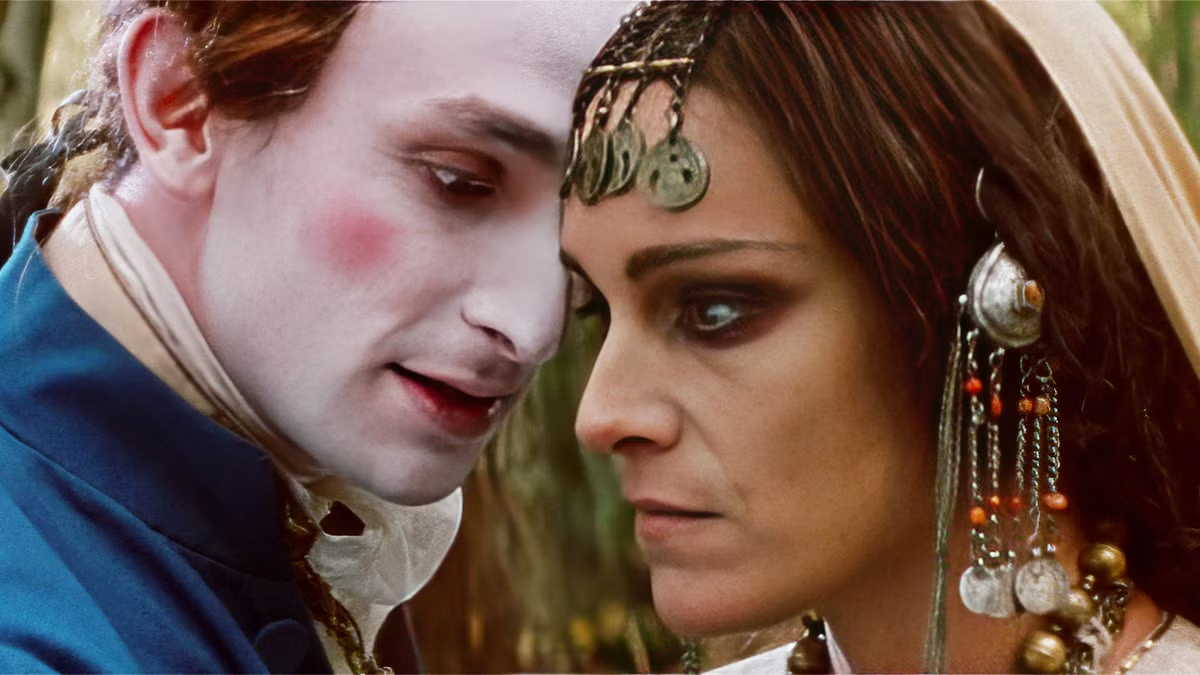
The Vourdalak felt like stumbling across some hazy, grain-heavy Eastern European horror film from the 70s, perhaps like something in the vein of Valerie and Her Week of Wonders, where the atmosphere matters more than narrative clarity and everything has this dreamy, unsettling quality. Except this one seems to have more of a linear story than those films I’m thinking of, so I guess it’s not quite the same thing at all…?
A French nobleman, Marquis d’Urfé, gets stranded in the wilderness and seeks refuge with a family living in an isolated manor. Their patriarch Gorcha has gone off to hunt Turkish bandits, and there’s a warning: if he doesn’t return within six days, don’t let him in. If he does return after that, he’ll be a vourdalak—a vampire creature that feeds on its own family.
Of course, Gorcha returns. And Gorcha is played by a puppet. Not CGI, not heavy prosthetics on an actor, but an actual marionette, skeletal and cadaverous, voiced by the director. I read that some viewers hated this choice and found it broke their immersion entirely. I thought it made the film. The jerky, not-quite-right movement, the way the family has to interact with this thing that clearly isn’t their father anymore, but they’re all pretending (or desperately wanting to believe) that it is. Creepy and campy at the same time, which describes the whole film pretty well.
The Marquis is a bit of a slimy horndog, immediately fixating on Gorcha’s daughter Sdenka and making unwanted advances. She rejects him repeatedly (she’s mourning a lost love and bitter about her circumstances), but he keeps pushing. It’s gross, though I could see how a genuine friendship might have developed between them if he’d been less of a creep.
What I loved were Gorcha’s younger children, Piotr and Sdenka. The Marquis follows them into the woods one day as they’re gathering supplies, garlic flowers, wood for stakes, all the vampire-hunting essentials, and the way they talk about it reminded me so much of the Frog Brothers in The Lost Boys. That matter-of-fact, practical approach to dealing with the undead. “Here’s what we need to kill a vampire, let’s get to work.” No dramatics, just siblings who understand what’s happening and what needs to be done, even if the rest of the family is in denial.
Piotr is also navigating gender identity in this oppressive household, dressing in ways that anger his older brother Jegor but that Sdenka accepts without question. It’s a small detail in the story, but it adds depth to these characters beyond just “vampire victims.”
The film is creepy in an old-school European folk horror way, all the misty woods, candlelit interiors, everyone in period costume behaving strangely. A grainy, textured look that feels genuinely vintage, with pacing is slow, deliberate, atmospheric.
There’s a scene involving the Marquis and Gorcha that’s both gross and darkly funny…I won’t spoil it, but it’s the kind of moment that makes you go “oh god” while also appreciating the audacity. And then the actual final moments are fairly devastating. The Marquis does something selfless for maybe the first time in the film, and the last shot is perfectly ambiguous about whether anyone actually escapes this curse.
If you enjoy posts like these or if you have ever enjoyed or been inspired by something I have written, and you would like to support this blog, consider buying the author a coffee?
Exhuma was more interesting than entertaining, if that makes sense. I enjoyed it, but I’m not sure I’d watch it again. It meandered quite a bit, and I didn’t totally understand all the finer plot details; something about ancestral curses and Japanese occupation and vengeful spirits buried vertically in the ground. But what I really loved was the world it created: this whole network of esoteric service providers working together. Shamans, geomancers, morticians, feng shui experts, all treating the supernatural as casually as plumbers treat leaky pipes. They’re professionals with specialties and billable hours and inside jokes.
The film follows renowned shaman Hwa-rim and her protégé Bong-gil as a wealthy Korean-American family hires them to lift a curse afflicting their newborn son. They trace the problem back to an ancestor’s grave in Korea and bring in geomancer Kim Sang-deok and mortician Yeong-geun to help with the exhumation. What starts as a straightforward curse-lifting gig spirals into something much darker when they discover there’s more buried at that gravesite than they expected.
The friendships between these four characters are the heart of the film. They bicker about money, joke around between rituals, worry about each other when things go wrong. Sang-deok tastes dirt from graves to assess them, which is both gross and sort of funny. Yeong-geun cracks jokes to lighten the mood. They feel like a found family of supernatural professionals who’ve worked together long enough to have real affection for each other. When things get dangerous, you genuinely care whether they survive.
The film is divided into two distinct halves, and I’m still not entirely sure how they connect. The first part deals with the Park family’s ancestral curse—pretty straightforward ghost story territory with creepy possession scenes and elaborate shamanic rituals. Then they discover a second coffin buried vertically beneath the first one, and suddenly we’re dealing with Japanese spirits from the occupation era and historical trauma manifesting as supernatural revenge. It’s maybe too ambitious, and I found myself a bit lost in the mythology. But being lost in a completely unfamiliar belief system was part of what made it fascinating.
The humor is subtle and low-key, which I appreciated. There’s a moment where the three main characters are driving up the mountain to confront the spirit, and they get stopped at a roadblock. A government worker warns them about a bear rampaging the countryside. They all turn to face him, and their faces are covered in calligraphic Buddhist scripture tattoos meant to protect them. The worker is completely taken aback, flabbergasted, and in the car they’re scrambling for an excuse about why they absolutely must proceed down this dangerous road. It’s a small moment, but it made me giggle.
Being immersed in Korean shamanism, feng shui, Buddhist practices, Japanese folklore, all of it so completely different from Western horror traditions, was maybe my favorite part. The rituals are elaborate and beautiful: Hwa-rim dancing with ceremonial blades while Bong-gil drums, pig sacrifices offered to appease spirits, the careful attention to where and how bodies are buried. It’s all taken completely seriously by everyone involved, no skepticism, no characters rolling their eyes at superstition. In this world, the supernatural is just real, and there are professionals who handle it.
The film is gorgeous to look at, with misty mountains, elaborate costumes, and the way spirits manifest as streaking fireballs across night skies. When the big reveal happens in the second half, it’s visually striking even if it’s a bit ridiculous. The ambition of trying to blend historical trauma with monster movie spectacle is worth something, even if it doesn’t entirely work.
But…I think Exhuma suffers from trying to do too much. The plot gets convoluted, the tonal shifts are jarring, and by the end, I wasn’t entirely sure what I’d just watched. But I was never bored. The characters felt real and true, the cultural immersion was fascinating, and those small moments of humor grounded the weirdness. I think it’s worth watching if you’re interested in folk horror that doesn’t follow Western templates, or if you want to see a horror film that takes its supernatural elements completely seriously while still finding room for friendship and occasional levity.
If you enjoy posts like these or if you have ever enjoyed or been inspired by something I have written, and you would like to support this blog, consider buying the author a coffee?
It was a very long day. I was tired, Amazon suggested The Ward, and I thought, ok, sure Amazon, why not. John Carpenter, a psychiatric hospital in 1966, a ghost haunting the patients; it seemed like a probably-maybe-okay way to spend ninety minutes before bed.
It initially seemed promising: Kristen (Amber Heard, about whom I have heard a lot of things, but I have never actually seen her act) is committed after burning down a farmhouse and finds herself in a ward with four other young women, all being terrorized by the ghost of a former patient. The ghost itself is oddly physical for a ghost…you can punch it, push it around, fight it off in ways that feel odd for a supernatural entity. The other patients are all broad-stroke archetypes: the baby, the artist, the sexy one, the prankster. Nobody feels like an actual person with any depth. The acting across the board is pretty flat, with all the characters being one-note and not quite landing. The guy who plays Mycroft Holmes seems to be slumming it here as the head psychiatrist.
This didn’t feel much like the John Carpenter I’m familiar with. Where’s the atmosphere? The dread? Until I got to the ending, I kept thinking this would have worked better as a book. But then there’s a twist that recontextualizes everything, and I’m not sure how you’d pull that off on the page. I’m also not sure the twist makes the movie better, exactly, but it does make certain choices make more sense in retrospect. Maybe I’m cutting it too much slack here, but the weirdness of the ghost being so physical, the cardboard cutout characters, I think there was actually a reason for all of that. I can’t say what without spoiling it, but once you know, you understand why things feel off. But whether that understanding improves the experience is debatable.
What I can’t get past, though, is Amber Heard’s perfectly maintained bright blonde roots. For someone who’s supposedly been on the run and then locked in a psychiatric hospital, her hair looks remarkably salon-fresh.
It’s not terrible. It’s just not particularly memorable either. A neat idea that doesn’t quite come together, even with the twist doing some heavy lifting at the end.
If you enjoy posts like these or if you have ever enjoyed or been inspired by something I have written, and you would like to support this blog, consider buying the author a coffee?
My recent Ghoul Next Door column in the current Halloween issue of Rue Morgue Magazine may well be my favorite thing that I have ever written.
This began as a blog post in 2015, but I never knew where to go with it, so it’s been languishing in my drafts for the past decade! It all came together for me last spring: the past few years have given us The Substance, vampire facials as self-care, and a realization that Helen Sharp and Madeline Ashton weren’t cautionary tales…they were freaking prophets.
Ývan: “What are you doing with my caulking gun and bow saw!?”
Here’s a wee snippet…!
I peer into my bathroom mirror each morning, arranging the implements of my beauty routine like a surgeon preparing for operation. Like Asami’s meticulous torture kit in Audition, my implements are arranged with clinical precision—though supposedly for beautification rather than revenge. My chemical exfoliants—glycolic acid, mandelic acid, salicylic acid—don’t just promise to “reveal your natural glow.” They’re dissolving the uppermost layer of my epidermis, a controlled chemical burn happening in slow motion, like Poltergeist’s face-melting sequence but with better packaging.
My dermaroller is a Lament Configuration for the face. Hundreds of tiny needles I willingly drag across my skin, creating thousands of micro-injuries because some study somewhere promised increased collagen production. Blood beads up in tiny pinpricks as I think, “This is fine,” while the rational part of my brain mocks me mercilessly: “You have $500 in your IRA, you fucking ding dong. Maybe worry about that instead of your nasolabial folds, whatever those even are.” I persist in this masochistic ritual with the fervor of a Cenobite acolyte, imagining Pinhead nodding in solemn approval. “Your suffering will be legendary, but your pores will be invisible.”
I discovered The Gorgon through Jack’s piece last year in A Morbid Scholar’s Treasury of Euro Gothic Cinema, where he enthuses about this Hammer Horror film that replaces the usual vampires and werewolves with a snake-headed gorgon. And while he prepared me for the schlocky thrills, I wasn’t prepared for how absolutely sumptuous this movie looks. Every single frame could be framed and hung on a wall. This might be the most visually gorgeous film I’ve watched all month. Maybe all year.
The bohemian chaos of the Heitz chateau with its cluttered artist’s studio, canvases stacked against walls, paint-splattered furniture, creative disorder that feels both lived-in and romantic. Dr. Namaroff’s laboratory is also a feast for the eyes: walls completely lined with apothecary bottles in amber and green glass, anatomical posters covering every available surface, brass instruments catching the light, a densely layered scientific atmosphere that makes you want to spend hours just examining the background. The ruined castle everyone keeps wandering into any time they step outside for a stroll, with its crumbling stone archways, cobwebs thick as curtains, moonlight streaming through broken windows, atmospheric shadows pooling in corners. Those autumn forests with leaves perpetually blowing through them, carpeting the ground somber pools of shadows.
The color palette alone! Deep burgundies and forest greens, golden lamplight glowing against dark wood paneling, the rich jewel tones of Victorian clothing against all that Gothic architecture. Even the outdoor scenes at dusk have this painterly quality, all purple shadows and orange-pink skies.
In the early 1900s Vandorf, folks keep turning up dead. Turned to stone, specifically. When young artist Bruno Heitz dies under mysterious circumstances, along with his pregnant girlfriend, his father arrives to investigate and also gets petrified (or, “gorgonized,” as one of the characters says later.) Then Bruno’s brother Paul shows up, immediately falls for the beautiful Carla Hoffman in a record time of about twenty seconds, and gets caught up in the mystery himself.
There’s a possessive doctor (Peter Cushing, playing it cold and calculating), a corrupt police inspector (Patrick Troughton, about whom I couldn’t stop thinking he looked like Jason Isaacs even though Isaacs would have only been one year old when this was made), and eventually Christopher Lee shows up as a disheveled professor with overgrown facial hair who barges into the investigation.
The monster is beside the point. You barely see Megaera (not Medusa, but one of her sisters, although the movie gets its mythology muddled, calling her by the name of one of the Furies). When you do glimpse her, it’s in shadows or reflections, and the final reveal of the full creature makeup it’s…not great. But that doesn’t matter because the film isn’t really about the gorgon. It’s about Carla, who suffers memory lapses during full moons and doesn’t know what’s happening to her. It’s about Dr. Namaroff, who clearly knows more than he’s saying and is desperately trying to protect someone. It’s about Paul falling for a woman who may be inhabited by an ancient curse. The romantic tension and the gothic atmosphere are what this movie is.
Barbara Shelley is luminous as Carla, playing her with dignity, confusion, and a mounting sense of doom. It’s tragic watching her realize something is very off and wrong, but not understanding what. Cushing gets to be unsympathetic and lustful and kinda gross, and Lee, arriving late in the film looking completely unkempt (the wig! the mustache!), provides a weird energy, he’s almost comic relief despite playing the Van Helsing role, throwing his physical presence around to intimidate everyone. When he jumps out a window to escape arrest, it’s genuinely amusing to watch his tall, lanky frame squeeze through.
I loved everything about this: the gorgeous autumnal cinematography, the rich color saturation, the way every scene felt like a painting come to life. The methodical, atmospheric pacing. The moody romantic melodrama where the monster is more psychological threat than physical presence. It’s a sumptuous supernatural soap opera of a good time.
If you enjoy posts like these or if you have ever enjoyed or been inspired by something I have written, and you would like to support this blog, consider buying the author a coffee?
With each new book I read from Cassandra Khaw, I fall more in love with their visceral irreverence. Here, they’ve taken dark academia tropes and soaked them in gore and body horror. The Hellebore Technical Institute for the Gifted is a school for the dangerously gifted, the Anti-Christs and Ragnaroks, the world-eaters and apocalypse-makers. These aren’t students who blithely levitate pencils or conjure a bit of fire. They’re capable of ending civilizations. One can tear reality apart with their voice. Another transforms into something with too many teeth and mouths and eyes and hunger that can’t be satisfied. One might be the son of the literal devil. Also, one of them has something to do with cicadas. It’s a lot!
When Alessa Li gets kidnapped and forcibly enrolled, she’s promised redemption and a normal life after graduation. Instead, on graduation day, the faculty goes on a ravenous rampage and devours the student body. Alessa and a handful of classmates barricade themselves in the library, where they discover they must offer a human sacrifice or the faculty will break down the door and finish what they started.
The narrative jumps between “Before” (Alessa’s time at Hellebore leading up to graduation) and “Days…” (the nightmare of being trapped in the library), which was initially disorienting but that temporal whiplash adds to the nightmarish quality, keeping you off-balance and uncertain about what’s coming. The body horror is relentless and genuinely disturbing; intestines hanging from ceilings, grotesque transformations, unholy, unspeakable violence but actually described in such visceral detail that you feel it all the way down to your toes. Khaw doesn’t flinch away from the gore, and neither should you if you’re going to read this.
The characters are monsters in every sense, literally (they have apocalyptic powers) and figuratively (they’re all varying degrees of morally bankrupt). Alessa herself is an unreliable narrator who presents horrors with this weird mix of disgust and casual coolness that somehow works. None of these people are especially likable, but they’re compelling, and watching them navigate impossible choices while trapped together creates a dreadful trainwreck of claustrophobic intensity that doesn’t let up. I’ve seen reviewers complain about Khaw’s vocabulary—words like “abattoir,” “haruspicy,” “chelicerae,” and “etiolated” — as if having to reach for a dictionary is some kind of personal attack. If encountering unfamiliar words makes you feel stupid, that’s a you problem, not a writing problem. Grow up. Khaw uses language precisely, choosing words that create specific atmospheric effects rather than settling for easier synonyms. The ornate vocabulary isn’t pretentious flourish; it’s deliberate craft that deepens the otherworldly, nightmarish quality of Hellebore itself.
The worldbuilding stays intentionally vague; the magic system has no clear rules, the school’s curriculum barely gets explored, and I think that haziness serves the story perfectly. Not getting bogged down in the mechanics puts the focus on immediacy and urgency. This isn’t about understanding how Hellebore works… it’s about surviving it. The lack of clear rules makes everything more unsettling, more dreamlike, and horrifically unpredictable. After all the butchery and bloodshed, the ending caught me completely off guard, brutal and bold and perfectly fitting for all the chaotic carnage that came before it. This is dark academia cranked to maximum midnight void-darkness and then splattered with heaps of globby entrails (and the impish devilry of those big, hard-to-pronounce words!), and I’m here for every gruesome moment.
ALSO LOOK AT THAT FREAKING GORGEOUS BOOK COVER! I did a bit of digging and I found that the artist for the illustration is Zoë van Dijk. I don’t know about you, but if I see a beautiful book cover, I want to know who created it!
If you enjoy posts like these or if you have ever enjoyed or been inspired by something I have written, and you would like to support this blog, consider buying the author a coffee?