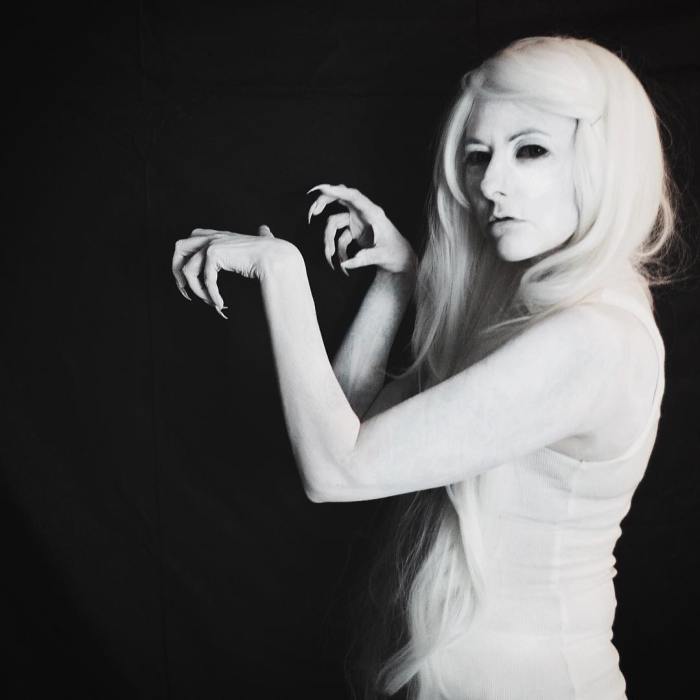
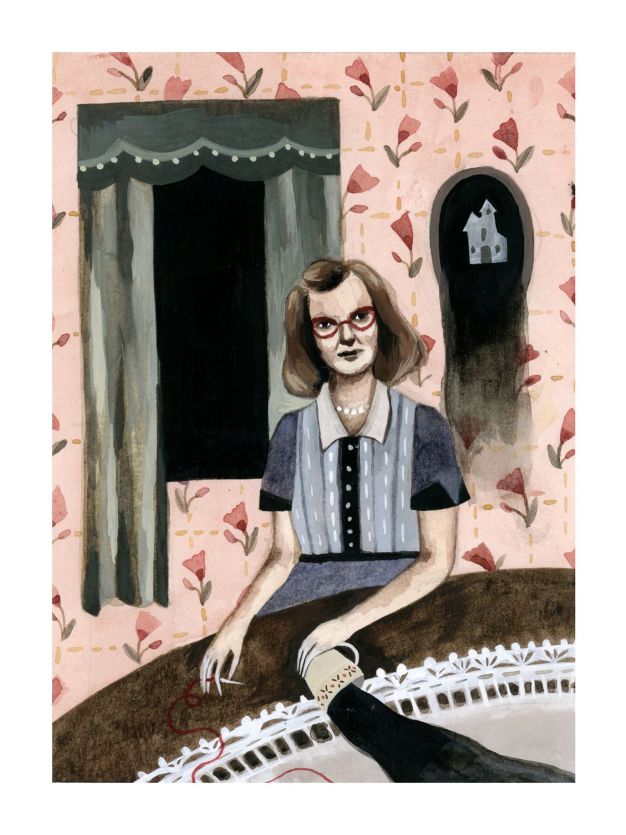
When perusing Alice Rogers’ portfolio, or perhaps scrolling through her Instagram account, you get the sense that she wants to frighten you, just a bit. But this isn’t some sort of jump scare, shock-value fright – no, there is a sense of intent here.
Rogers, through her explorations of dark themes on canvas and photography and in sculpture, invites – nay, demands – the viewer to do the same as well. It’s not the stark horrors of fearsome wolves, menacing swords, or lean, beckoning claws of hungry spirits that are the threat here.
As you peer more closely closer at Rogers’ work – despite yourself – you also begin looking inward. Your own shadows, secrets, devils, and darkness are brought to light. Rogers’ works reflects both the damage we do to ourselves and the scars of those old hurts inflicted by others, and at its heart, it is about the vulnerable magic in making something beautiful from these wounds – and the balance achieved in doing so.
I recently caught up with Alice Rogers about her works, these painful yet ultimately cathartic worlds she creates, and the magic and manifestation, power and purification that is part of the process.
S. Elizabeth: Tell us a little about your artistic background – What were your first inclinations that you had a strong creative instinct? Can you pinpoint the moment you decided you wanted to become an artist?
Alice Rogers: I loved drawing from the time I was a small child. My family and teachers encouraged me to keep at it, so I painted murals and designed the school t-shirts and all that sort of stuff. I actually went through a period where I rebelled and said, “Maybe I don’t want to be an artist!” and decided I was going to study forensic science instead, but I ended up double-majoring in fine art and English in college, anyway. I was never able to choose between those two things – art and writing – and I still try to organize my life so that I don’t have to.
You are a writer, photographer, illustrator, and sculptor – within so much of your work you show us liminal worlds and stories within these worlds, and it’s all just brimming with what seems to be intensely personal symbolism. In what medium are you happiest working, when creating these worlds?
I think of all various mediums and forms of expression as tools. Some tools are more appropriate for certain projects or ideas than others. I find that drawing is the most immediate way for me to express something, so even though I’m also a writer, I tend to draw instead of journaling. Occasionally a phrase or sort of poem will come to me before I start a drawing and I work around that. I can’t always communicate everything I want to get across in a drawing, and that’s where the three-dimensional stuff comes in.
I wouldn’t call myself a photographer. I’m certainly not skilled, technically, in that area, but I’m having fun exploring the idea of creating little worlds in three-dimensional space and capturing them in still images or short films. Sometimes I’m just drawn to one medium more than another; for three years I didn’t create anything visual at all and only wrote, and then it sort of flipped. Having all of those tools available keeps me creatively stimulated so I if I get burned out doing one thing, I move on to the next for a while.
From photos of your studio, it is difficult to tell where the altars end and the workspace begins. This idea/philosophy of “art as magic” – can you speak to that? And along those lines, in your Instagram, I came across the term “Seiðr,” which I found to be an old Norse form of sorcery sometimes associated with the goddess Freyja. Do you consider what you do, the art that you create, a form of Seiðr?
Last December, I was thinking a lot about manifestation. I sort of ride the line between intellectual curiosity and belief when it comes to magic and the occult, and I interpret most of it as a system for refining and manifesting intent. You have to determine what you want and why, then make all sorts of small changes in your life that add up to make it real. Magic isn’t just about manipulating energy; it’s finding power in knowing yourself in a really intimate way. At the time, I was preoccupied with negative patterns that were repeating themselves in my relationships and I drew out what I wanted to manifest, which was a deep connection with a person possessing certain qualities. That drawing turned into several more, and sort of ushered in a new phase of creative expression for me.
Symbols are just such potent visual shorthand, and joining them together can give them even more power. They can say so much with just a few strokes of a pen or brush. The symbols I prefer to use mostly originate from Western occult traditions and Germanic paganism, and in this way I draw upon my own ancestral heritage and the knowledge and power of so many people who have come before me. So even though I’m incorporating these symbols and ideas into my art in a way that’s intensely personal for me, others can look at what I create with it and find something that resonates for them in a totally different way, or so I’ve been told.
In the end, it’s not about what other people find nice to look at. It’s not even about the final product. It’s the meditative, half-conscious, magical act of translating emotions and abstract concepts into visual form, which is therapeutic for me. It’s a deep analysis of self, relationships with others, and how I interact with the world that’s really for no one’s benefit but my own, but everyone is on their own particular version of the same journey.
You write of your fascination with the line between the scientific and the supernatural, and that you “reside in the balance between reason and belief.” I find myself marveling at the stark contrasts in your work, the extreme juxtaposition of dark and light, of shadow and exposure… and yet it all speaks to a sort of balance, if I am not mistaken. Tell us about the value and meaning of balance in your work.
When I really started paying attention to the themes that were popping up in my life over and over again, the idea of balance really stood out. I’m not sure why exactly, just that it seems like the universe is constantly reminding me that it’s part of my life’s work, along with a search for truths that a lot of people might find scary or uncomfortable (which is what draws me to the occult). There’s no light without darkness, and without pain, we could never fully appreciate beauty. That might sound clichéd, but it’s true. I don’t necessarily see things in black and white – there’s an awful lot of gray in the world – but for me, the starkness of monochrome is sort of a way of creating order out of chaos, even in my wardrobe or my personal space. It fosters a sense of harmony and continuity.
The motifs in your art and photography vary wildly from sacred geometry to Twin Peaks to yokai – what would you say is the underlying theme in these inspirations? What can you tell us about your current obsessions and fascinations, and how they may be finding their way into something you are working on right now?
Almost all of my creative inspiration comes to me in half-sleep. I have a sleep disorder that keeps me in the hypnagogic and hypnapompic sleep stages much longer than most people (the “falling asleep” and “waking up” phases where you’re sort of dreaming, but still partially conscious). With that comes sleepwalking and hallucinations, but mostly a trance-like state that enables you to access the deep reaches of your subconscious, or other spiritual planes. So almost every night, I wake up with an idea or three. I write them down if I’m conscious enough. Sometimes I remember them in the morning, and sometimes they slip away.
Like last week, when I woke up with the words “ars moriendi” in my head – I couldn’t recall ever actually hearing that phrase, and I looked it up, and it roughly translates to “the art of dying.” Since I tend to work intuitively, sometimes my symbolism is very purposeful and sometimes it feels like a mystery even to me.
But I do have a preoccupation with atmosphere and mood, especially when it feels really primal, which is why I’m drawn to David Lynch, and “Butoh” Japanese performance art, and music by artists like Pharmakon. I think it’s very powerful when art is disturbing, but not in a cheap way, not in a way that relies on gore or shock value. It’s like strumming an instrument and finding a note that vibrates through your entire being. For me it all goes back to the junction of psychology and mysticism. Is it all brain chemistry; are we nothing more than sentient sacks of meat? Is it a means of accessing universal energies that we can’t fully process in the physical world? That’s the essential mystery and that’s what fascinates me.
Earlier this year you had a piece in Sticks & Stones’ Rock ‘n’ Roll Camp for Girls – can you tell us a bit about the venue and the pieces that you chose (or created) for it? Is your work showing anywhere right now?
I actually haven’t shown my work very much at all. For a long time, I worked in oils, and then everything I created over a period of fifteen years or so was destroyed by mold after a flooding incident. Ultimately, I see that as a positive development because it forced me to detach myself from each piece as a finished product, so the emphasis is on the act of creating.
The Sticks & Stones’ show, which was a benefit for a local nonprofit called Rock ‘n’ Roll Camp for Girls, was the first time I put up any of my black and white drawings. I’d love to show that work again somewhere, or the drawings I’ve produced since then, but I’m also shifting focus a little bit to larger sculpture, photography, and film.
I’m also planning a collaborative show with my friend, Angela Thornton, who’s a knitwear designer and art director. We’re still in the early stages, but ultimately it will be an experiment in combining visual art and design with performance, so we’re excited about that.
Another powerful project you are involved in is Ask Me About My Abortion, “a safe space for people to share their stories, and read about the experiences of others, with zero judgment, pressure, or bullshit.” Can I ask how the creation of this safe space came to be and why it is important to you?
Ask Me About My Abortion came about because my best friend, Laura Slack, wanted to help anyone searching for information about abortion online find actual first-hand experiences, instead of religious propaganda. So many people we know have had abortions – straight, queer, religious people, atheists, people with female reproductive systems who don’t identify as female. It’s far more common than a lot of people realize, and the culture war in our society over this issue relies on a sense of shame and guilt to silence the voices of anyone who believes we should have agency over our own bodies and when or whether we become parents. It’s a passion project for her, and as a feminist it’s an important issue to me, too.
The controversy over attempts to defund Planned Parenthood has ignited similar projects recently, like #ShoutYourAbortion, which we think is great. We’re hoping that we can ultimately provide a searchable database full of a broad range of experiences from all sorts of people, whether they feel great about it or had difficulty. We’re not censoring any of the stories; we’re just not accepting any anti-choice perspectives. We want to reflect reality. So please, everyone, send us your stories!
Textile artist and knitwear designer Caitlin Ffrench is an incredible inspiration for me and such a lovely human, as well. I am thrilled that our interview is up over at Haute Macabre this week, and I can’t wait for you to read it (You don’t even have to be a knitter to fall under her spell!)
Bonus material and behind the scenes peeks: In preparation for this piece I did a great deal of research…in the form of knitting up several of Caitlin’s patterns. What! That’s totally research, and I won’t hear differently. Each one of them worked up simply and smoothly, with no issues, but with enough detail to keep me interested and engaged. I can recommend her patterns without hesitation (and as I matter of fact, I am knitting another one right now!) I have included links to each of the ravelry pages if you are interested in creating any of these gorgeous knits yourself.
What a treat it was to interview and get to know this wonderful, brilliant woman! Listening to her recount her marvelous experiences at Lily Dale while recording for this exciting project was truly one of the highlights of my year. I hope you’ll enjoy read her stories as much I did hearing them, and translating them for the page.
Today I am happy to share: a magical celebration of visionary female writers Taisia Kitaiskaia and Katy Horan‘s Literary Witches! I can’t believe that I’ve been excited about this book for over a year now, and it was finally released yesterday!
I’ve never been one for book clubs (I’m not much of a joiner, I’m afraid), but if I were, Taisia Kitaiskaia and Katy Horan‘s witchy gem, Literary Witches, released into the world yesterday, October 10th, is certainly a title I’d want at the very top of the roster. Incidentally, the few book clubs I have attended focused on best-selling titles I had no interest in reading, and there was more gossipy chatter than book-related conversation, so perhaps book clubs just aren’t for me. (And don’t get me wrong, I do love the gossips, but if I’ve consented to leave the house for a reason, I want that reason to hold true to its intended promises! Especially where books are concerned.)
Literary Witches is a celebration of magical woman writers, a “mystic dossier” sprung from the heads of two women, magical in their own right, and accessing the spirits of the titular Literary Witches through their own respective mediums–Taisia Kitaiskaia, who channels the book’s fanciful, enigmatic prose, and Katy Horan, the conjurer of its enchanting and intimate illustrations. Together Katy and Taisia draw a connection between witches and visionary writers, and through their poetic portraits and imaginative vignettes, they honor the formidable creativity, empowerment, and general badassery of well-known and obscure authors alike, including Virginia Woolf, Mira Bai, Toni Morrison, Emily Dickinson, Octavia E. Butler, Sandra Cisneros, and many more.
I had the good fortune to chat with Katy, who Katy graciously indulged my questions about this curious compendium in our illuminating Q&A, (and I like to think that Taisia was there in spirit, too.) Thanks to them both for conjuring these connections, channeling these women, and creating this wonderfully special, utterly splendid book.
See below for our interview wherein we chat about what, exactly, is a “literary witch”; a potent handful of Katy and Taisia’s favorite authors from within this lettered coven, and how to best approach this dazzling tribute of a grimoire. We did not, however, discuss how the grand work that is Literary Witches might fit into the agenda of your next book club’s discussion …but no doubt you will have more than a few strange and splendid ideas after you’ve finished the last page of this singular creation. Come back and let us know, and in the meantime, read on!
S. Elizabeth: How did Literary Witches come about? What sparked the idea of connections between the ultimate mystical female archetype of the witch, and visionary writers, these conjurers of words and worlds?
Katy Horan: Literary Witches came directly from its genius writer, Taisia Kitaiskaia. At first, her idea was to make a sort of Tarot deck, with the writers as the various characters and figures of the Tarot. We let that idea go, though, as we further conceptualized the project. However, it still influenced the visual language I used in the illustrations.
As for the actual origin of Literary Witches, Taisia says she made the connection “…because witches and literature are two of my most treasured subjects, the idea came to me as an obvious connection. One day, I concluded that all of my favorite writers are witches.”
Your art, with its focus on feminine folkloric magic, seems perfectly suited to Taisia Kitaiskaia’s luminous language, and the mystic fragments of text that accompany each portrait. Can you share how you came to work together on this curious compendium?
Taisia contacted me late in 2014. She was looking for someone to illustrate her “Ask Baba Yaga” series. There was an agent interested, but as I was working on the sketches, they dropped out. We realized we both lived in Austin, and knew that we needed to get together and discuss other possible collaborations. When we met, she told me her idea for Literary Witches, and I took to it right away. I was in a career lull, having just had a baby and was in dire need of a project. We set out to work on the first 5 and pretty quickly got word that Electric Literature wanted to put those five online, so the project had direction and purpose pretty much from the start.
As we were working on the original five, we talked about how it would be an awesome book, and once Electric Literature published it and received the response it did, we started thinking it might have a shot. We were talking about putting together a proposal when our agent, Adriann Ranta of Foundry Media, found us. With her help, we got our deal with Seal Press. We owe so much to her.
AND! Ask Baba Yaga found a publisher too and is out now with lovely illustrations by Brenna Thummler, so It was all meant to be.
Can you define for us, in your own words, what is a Literary Witch, and identify the criteria you used to choose the Literary Witches you celebrate in the book? Do you have a favorite literary heroine amongst those featured?
To me, a Literary Witch writes with her own voice regardless of what is expected of her. Her work has originality and weight to it. She isn’t afraid to be dark, moody, challenging or funny. Her work is fearless and boldly her own. In the end, her writing feels like something channelled or conjured. For me personally, Shirley Jackson and Toni Morrison were favorites before the project, so I was incredibly honored to do their portraits.
As a further, among the thirty Literary Witches in the book, you reference “a matter of seniority”, that “long-practicing Witches must be noted before newly initiated Witches”; I’m curious–if time and space had allowed for the inclusion of authors one might consider novices and initiates, who would you like to have included, and why?
I would add Maya Angelou, Louisa May Alcott, Margaret Atwood, Joyce Carol Oates and Alice Walker. All of these were on the table at one point but were removed to make space for older (even ancient) writers, foreign writers and some much lesser known writers that we wanted to shine a light on, like Yumiko Kurahashi. Even though I love those writers I mentioned, I am completely happy with the 30 we chose.
Taisia has a great list of who she would add. She says, “There are lots of daring, magical writers out there who have Literary Witch written all over them. Here are a few who come to mind: Helen Oyeyemi, Carmen Maria Machado, Lesley Nneka Arimah, Valeria Luiselli, Rivers Solomon, Han Kang”
In the book’s forward, Pam Grossman has a fabulous approach to tackling this tome; as an act of bibliomancy, flipping pages at random and following where the wit, wonder, and wisdom of the selected Literary Witch leads. Early reviewers laud it as an enjoyable illustrated almanac of fun facts to bone up on your favorite literary heroine’s superpowers, and suggests that not only will it inspire readers to dig further into transportive works of fiction and poetry, but allow access to their inner creatix. As one half of the creative team responsible for Literary Witches, how would you advise of the book’s purpose, and the best way to read it?
All of that sounds good to me. I think it depends on the reader. If you are methodical and enjoy order, then start from the beginning and move through it page by page. If you want a more organic experience, find a random place and consider what the witch you land on is trying to tell you. No matter how you approach it, though, I hope you get lost in Taisia’s bewitching and beautiful words and enjoy deciphering all the symbols and hidden meanings I put in my illustrations. Most of all though, I hope you discover a new writer, put down our book and go get lost in their magick.
To continue spotlighting creators who give a damn, today on Friday Fripperies: Resistance Edition, we are featuring Cat Coven’s “Neo-Nazis Not Welcome” designs, which you can wear proudly emblazoned across your chest on a fantastically fierce red on black tee shirt, or, if you prefer, the same fearsome design in the form of a portable patch to decorate and designate your bags or jackets as a FUCK OFF NAZI SCUM zone.
100% of profits from this design are donated to Make the Road New York (MRNY), which is a grassroots organization in NYC that fights for Latino and working class communities, including: “workers’ rights, tenant rights, LGBTQ justice, youth power and policing, public schools and education justice and immigration justice.” Learn more at www.maketheroadny.org
“I created this design in response to the white supremacist rally in Charlottesville, VA. I was so angry – it’s 2017 and Nazis are still alive and well in America. Since Trump’s election, bigots have felt safer voicing their hate. I’m fortunate enough to live in a liberal NYC bubble, which protects me from much of this direct rhetoric. However, I wanted to acknowledge this horrible phenomenon in the best way I know how: drawing about it.”
My previous charity designs have focused on love and healing, but I wanted this one to express my rage. The imagery of the cat attacking the snake paired with the phrase “Neo-Nazis Not Welcome” shows anger while still cultivating a safe space. I hope it inspires and empowers others to speak up against ignorance and hate.
How might one style this powerful statement tee? I have some suggestions for you, below!
As always, click here, or directly on the image for a full listing of the items used in the ensemble. Also included with these selection is Chase and Scout’s Watchful Eye Amulet, featured here, previously.
Are you a creator who gives a damn? Are you aware of artisans or indie businesses speaking up, reaching out, and creating art or goods to express outrage with injustice, promote anti-hatred, or which encourage safe spaces in their communities? Please let me know about them for future Friday Fripperies!
Devoted and cultish readers extol John Allison as “a rare gem in the often hard-to-navigate web comic underbelly.” Though you may not presently be reading John Allison’s current endeavor, Bad Machinery, chances are that you are perhaps already familiar with him through his older works,Scary Go Round (2002-2009) or Bobbins (1998-2002), or as an artist/chum linked to through one or more of his contemporaries.
Marked by clever, peculiar dialogue, absurdist humor, dotty characters (and delightful ladies fashion!), mysterious happenings and hi-jinks, and a dense mythology (though compelling and completely addictive, to which anyone who has begun to peek through his archives can attest) – John Allison’s story-telling genius is unmistakable. And in a medium where visuals are the reason most viewers show up in the first place, the exquisitely charming, highly stylized art is “as big a draw as the comedy”.
Scary Go Round, “Bulgaria”
Described as “postmodern Brit horror”, Allison’s previous comic, Scary Go Round followed the hapless denizens of Tackleford, a fictional British town beset by all manner of supernatural activity including, but not limited to: zombies, space owls, the devil, and portals to other dimensions. Though Scary Go Round ended in 2009 [EDIT: though it periodically picks back up again!] a few of his beloved characters have moved on to Bad Machinery, which picks up in Tackleford 3 years later. The focus is on an entirely new cast of sleuthing schoolchildren attending Griswald’s Grammar School, whose well-intentioned energies may be causing more problems than the mysteries they solve – but they throw themselves into it all with much vigor and aplomb.
Bad Machinery Flyer Art for Thought Bubble
I recently caught up with John Allison about his new endeavor; see below the cut for our Q&A in which John talks about the transition between old stories and new, the state of web comics today, and the meaning behind the monsters.
The artist
UNQUIET THINGS: Right now the “Big Push”, as it were, is your current series, Bad Machinery. When you made the change to become a full time comic-ing man in 2003-ish, was Bad Machinery even a twinkle in your eye at that time, or was it something that evolved over the years from the characters that you developed in Scary Go Round? Has it been almost a year now since Scary Go Round ended? How has the jump from Scary Go Round to Bad Machinery gone? What were your expectations regarding your fans reactions? Were they met, or exceeded? (or neither?)
JOHN ALLISON:I certainly had no notion of creating Bad Machinery when I went full-time back in 2003. That was 7 years ago! It seems like a lifetime. At that point, Scary Go Round was just starting to get on its feet, audience-wise. It had only been running for about 12 months. Last summer I was frustrated with how sprawling Scary Go Round had become, and (not for the first time) I tried to work out what would make a good spin-off. I wanted something with a tight concept, so I couldn’t drift too far off my initial idea. And I wanted something that I could sell to a publisher in good conscience – something that wasn’t a mess!
I had some vague thoughts in my mind, a kind of Nancy Drew/Hardy Boys setup in the Tintin format (having read almost none of the former and admiring rather than loving the latter). I was probably very tired at the time!
The reaction wasn’t great, people loved the Scary Go Round characters. My last year of work on the series had been really spotty and I thought that readers would breathe a huge sigh of relief. And they did – as they stopped reading. Over the first month, half of the old SGR audience went south. It was a very frightening time. It wasn’t helped by what may have been the slowest introduction to a comic ever. Some readers were angry about “having to read about children”. They strongly identified with the old cast and were horrified by the new.
In that first month, while I was trying to find the mood and the tone of the piece, some long and pretty scathing reviews appeared on prominent blogs, the general theme being “by the end Scary Go Round had lost its way, and this is more of the same – but WORSE!” They tended to cite Berke Breathed’s Outland, his follow-up to Bloom County, where all the old characters slowly re-appeared. But for me, bringing back all the fan favourites that, to be honest, I never wanted to see again, made me feel ill. It was a miserable time, I went from believing in this new thing, to quickly doubting everything I did. I was fortunate that many of my friends in comics really supported what I was doing.
After a year, the comic has started to find new readers alongside the ones who stuck around, and it’s extremely gratifying when people write and say that they never read Scary Go Round, but they love Bad Machinery.
Bad Machinery, “The Case of the Good Boy”
While Scary Go Round focused a on group of young adults in their early to mid twenties…and then later in the series you added several high school characters, this new batch for Bad Machinery are little folks, rather young – in grammar school, I believe. What prompted you to go in this direction?
I wanted to write all-ages books, kids’ literature that stands up when you read it today. I loved the Just William books, and I can still read them now, the writing is sophisticated and hilarious. It may be that this is not what the market wants, but as an exercise it was what I wanted to do. It also stops you leaning on lazy attention-getting devices – sudden death, sudden sexy times. You have to be a lot more resourceful as you write.
Scary Go Round, “Time Teapot”
Both your comics are /were quite character driven, but the plots usually revolve around the general strange goings-on in town or the odd beastie du jour. .. previously we’ve seen zombies, vampires, dimensional portals etc., but I imagine writing about children presents the opportunity to introduce all kind of imaginative monsters and new bits of wonderful weirdness into the story. Your thoughts?
The idea of Bad Machinery is that the supernatural mysteries are a distraction from the real dangers, which are personal. All through “The Case Of The Good Boy”, the actual manifest danger is how Jack is being victimised through no fault of his own, and he can’t really ask for help. He’s the good boy! No one has spotted this. I’m probably not doing my job very well, am I? I like drawing monsters and beasts, but they’re not real so they lack a certain weight for me.
With regard to “ghoulies and ghosties and long-legged beasties, and things that go bump in the night” – I am keenly interested in hearing about your influences as such things go. From some of the references culled from within the Scary Go Round archive, one might be inclined to think that you’ve had some personal dealings with the Old Deceiver himself, ha! Or perhaps some passing familiarity with esoteric studies of some sort. Or at the very least a subscription to the Fortean Times. Can you tell us from where you draw your inspiration?
I’m an arriviste in this field, a dilletante. I don’t like horror movies and I’m scared of books about ghosts. There was a Dennis Wheatley book in the house when I was a child, with a picture of Satan on the back, I was scared of that too. All my work is a metaphor for actual real life problems. I did a story where a character’s girlfriend is blown up in a caravan and thereafter exists, and is seen sporadically, in the afterlife. That was about long distance relationships. When I tried to do actual mystical stuff, and I say this with no fear of contradiction, it wasn’t all that good. The problem is, when you’re generating a lot of material, it’s easy to lose sight of what you’re doing.
Scary Go Round, “Where the Dumb Things Are”Scary Go Round, “Meddling”
You’ve been doing this for quite a while now, practically when there were dinosaurs on the internet (as opposed to in space) – what are some changes – for the better or the worse – that you’ve seen in that time? Can you tell us briefly about your progression from when you got started to where you are now?
People’s attention spans are knackered. The internet has become a Las Vegas casino, a comfortable, noisy area designed to keep you disorientated and keep you spending money. Good luck trying to find attention with longform work. But I think there’s a sense now that we have to push back in the opposite direction, that people don’t want to read articles surrounded by video ads and animation.
I started in webcomics when almost no one was doing them and occupied a privileged position at the forefront of almost every movement – Keenspot, merchandising, bigger web presence at conventions, when there was less competition. Based on that, I have probably underperformed to an extent! But when people who went on to huge success cite me as an influence, I am enormously proud. I just wish they would put a huge link to my work on their website, next to a giant animated arrow.
Now that we have caught up to present day…can we expect to stick with these characters for awhile, to see them grow and mature as they continue to battle monsters and solve mysteries? Can you give us a peek into what might be in store for our young friends? Or…do you already have something else – something entirely new – brewing?
I’m going to take a month off Bad Machinery to do a mini-series about one of the Scary Go Round characters. It’s kind of a pilot for a series, though if it became a full series I doubt I would have time to draw it myself. I’ve spent months working on the character designs and getting the look and feel of the thing. It gives me a chance to draw adults again, something i do miss. I love drawing fashion and of late have started to feel out of it – there’s only so much of that kind of design work that you can do with 12 year old characters. But I have a thirdBad Machinery story worked out, it’s kind of ludicrous and sad at the same time. Even though it’s been an uphill struggle, post Scary Go Round, I love writing the new comic. If people get that from it, then the difficulties are by and large worth it.
The idea is to do a “case” for each of the three terms of seven years of grammar school. If I get that far, we’ll have been places together. I hope that I get the chance.
*For extra art not seen in the main comic, be sure to check John’s blog, as well as his Flickrstream for doodles and magnificent sketch fiestas, such as this Beardsley-esque Gaga.
If you enjoy posts like these or if you have ever enjoyed or been inspired by something I have written, and you would like to support this blog, consider buying the author a coffee?
Going forward, and for the foreseeable future, for our Friday Fripperies feature here at Unquiet Things, we will be spotlighting creators who give a damn. Today the focus is on Elle Green of Chase & Scout (previously interviewed here) and her Watchful Eye Amulets–proceeds from which will be donated to the Southern Poverty Law Center. The Southern Poverty Law Center actively works at many levels to promote equality, continue the fight for civil rights, reduce prejudice and to expose hate groups and domestic extremists working in America.
“Sometimes the simple act of direct acknowledgement can help to diminish the power of hidden malevolence. We turn on lights to dispel shadows and symbolically banish ghosts, to drive back the things that hide in the dark.”
These pendants are made of sterling silver and natural gemstones, each is handmade and they hearken back to the ancient tradition of wearing a talisman in the shape of a watchful eye to deflect darkness directed by others.
I asked Elle to share with us the impetus of this passion project, and she expressed that personally, “the climate this year has felt like one outrage after another, just so much to process every day. Who ever thought we’d see Nazis marching in the streets literally trying to kill our friends and neighbors? When Charlottesville happened, like everyone, I was stunned and shocked, but then I was angry. I felt frustrated and angry that seemingly nothing I could do on my own would make an impact.
“…like most people, I spend a significant amount of time working and I can’t always lend a voice in person to the causes that mean a lot to me, so I’ve decided to donate proceeds from a small batch of handmade evil eye pendants to the Southern Poverty Law Center, ” Elle concludes.
25% of the profit from each amulet will be donated to the Southern Poverty Law Center to help keep a watchful eye on hate groups and their actions in our communities.
Each amulet is made of sterling silver and is hung on a 20″ dark stainless steel chain, eye measures 1.25″x 1″. You can choose your own stone–amethyst, green agate, garnet, moonstone, onyx, and turquoise–and each is handmade, no two are identical. And, as Elle, notes, these are very specially priced, as this is a passion project and not profit driven.
How might one style this watchful talisman? I have some suggestions for you, below!
As always, click here, or directly on the image for a full listing of the items used in the ensemble.
Are you a creator who gives a damn? Are you aware of artisans or indie businesses speaking up, reaching out, and creating art or goods to express outrage with injustice, promote anti-hatred, or which encourage safe spaces in their communities? Please let me know about them for future Friday Fripperies!
The cauldron has spoken and Vanessa Irena is the winner of a postcard set from Luciana Lupe Vasconcelos. Congratulations, Vanessa! You will be receiving a set of postcards from the artist featuring the image below. Please email me at mlleghoul AT gmail dot com with your address!
Thanks to everyone who read the interview and left a comment, and be sure to peek back here in the upcoming months for more Q&As with fantastical artists and art giveaways!
Discerning seekers of rare or obscure artists will eventually stumble upon John Coulthart’s Feuilleton at some point in their virtual journeys. An artist himself, and a blogger “of some repute”, his site is a veritable Holy Grail treasure collection of luminous paintings, ornate illustrations & woodcuts, and salty vintage photographs that run the gamut from fin de siecle European art magazines to antique occult bookplates to queer themed eye candy from a bygone era for which to titillate our salacious modern sensibilities. One with an interest in such things could literally lose hours perusing his archives. It is with the striking of a dazed and dreamy midnight hour, head filled with inspiration and amazing discoveries, that one realizes where the time has gone.
John is perhaps best known for his own striking and complex “genre-defying” artistry; working with various styles and media in his singular, chimeric aesthetic, he is a successful graphic designer for a variety of mediums including album covers, book covers comic books and graphic novels.
“As a comic artist John produced the Lord Horror series Reverbstorm with David Britton for Savoy Books, and received the dubious accolade of having an earlier Savoy title, Hard Core Horror 5, declared obscene in a British court of law. … His collection of HP Lovecraft adaptations and illustrations, The Haunter of the Dark and Other Grotesque Visions, was republished in 2006 by Creation Oneiros.
As a book designer and illustrator John continues to work for Savoy Books, and in 2003 designed the acclaimed Thackery T Lambshead Pocket Guide to Eccentric and Discredited Diseases edited by Jeff VanderMeer and Mark Roberts.
John’s work has been showcased via Rapid Eye, Critical Vision, Clive Barker’s A-Z of Horror, EsoTerra, CNN.com and the Channel 4 television series Banned in the UK.”
See below for our Q&A in which John discusses fleeting fascinations, enduring enthusiasms, how the mystical and macabre manifests itself in his projects, and the mercurial nature of design.
The Thackery T Lambshead Pocket Guide to Eccentric and Discredited Diseases
Both the mention in your website bio, and the description in your personal blog, Feuilleton, refers to your cataloging of “interests, obsessions and passing enthusiasms.” What might those encompass right now?
JOHN COULTHART : I watched Visconti’s film Ludwig (about King Ludwig II of Bavaria) recently and was following up that viewing with some web research into his eccentric life. I usually disapprove of monarchs, especially our own dismal royals, but Ludwig is a fascinating and ultimately tragic character. A few months ago I ordered a lot of out-of-print books by the French writer and illustrator Philippe Jullian who wrote one of my absolute cult books, Dreamers of Decadence, a major study of Symbolist painting first published in English in 1971. Jullian was also something of an eccentric who wrote a number of biographies and art books, produced many Ronald Searle-like illustrations and also penned a few novels. Both Ludwig II and Jullian were homosexual and queer culture is an abiding fascination, not least because much of it prior to the 1960s remains little-known or discussed.
I find I spend a lot of time at the moment trawling library sites for interesting pictures. Many of the world’s important libraries now have browsable archives which give access to rare books and magazines. The best of the discoveries recently was the magazine archive at Heidelberg University which has scans of the early issues of Jugend and the entire run of Pan, two German periodicals which did much to promulgate the Art Nouveau style.
Blogging has turned out to be useful for the way it makes you realise you were more interested in something than you previously suspected. When that happens it can provide an element which may feed back into your work. An example of this occurred when I started collecting pictures from different sources and eras; I hadn’t noticed before that the peacock as a symbol connects three areas of interest: medieval alchemy (where its feathers represent a process of iridescence), fin de siècle art, and poster art of the psychedelic era which recycled many 19th century motifs. That’s probably a good example of a passing enthusiasm turning into an obsession.
Dodgem Logic #4Psychedelic Wonderland
How often do these themes will their way into the projects that you are working on? Or do you try to “live in a bubble” while you are working on a piece? For example both your artwork for Alan Moore’s Dodgem Logic Issue #4 and 2010 Psychedelic Wonderland Calendar (which, by the way, I would love to see somehow expanded into a tarot deck) are possessed of a trippy, hallucinogenic brilliance – was that due in part to a “passing enthusiasm”, or just well, part of the specs for the project?
Well the peacocks were a good example of the enthusiasm affecting the work as I put a lot of peacocks on the Dodgem Logic cover. But generally it depends on the work at hand how much of your own interests feed it. As well as illustrative commissions I’m also employed a lot as a graphic designer and very often the brief for design projects is a strict one with no room required for deviation. In that case you just concentrate on working within the limits.
The calendar came about after I’d spent a summer listening to the British end of the psychedelic music produced in the late 60s. Everyone knows Jefferson Airplane’s White Rabbit is based on the Alice books but so too were a large number of obscure UK songs from around the same time. There’s an enormous amount of Alice-derived illustration out there but I hadn’t seen anyone take quite this approach visually. When a story has been worked over so many times it becomes a challenge to do something distinctive with it, in illustration terms it’s like adapting Shakespeare for the stage. So in this case it was an enthusiasm for the music which became the key to doing something visually. I’m still intending on making the calendar pages into a poster series when I find the time.
The Dodgem Logic cover came along when Alan Moore asked me to do something psychedelic in style for their summer issue. Aside from that vague description I had free reign. Butterflies were the other theme there. If I’d have had more time I maybe would have put some peacock butterflies into the design as well.
There is undoubtedly a vein of the weird and fantastical that runs throughout all of your projects. I am thinking of the Lovecraftian inspired The Haunter of the Dark book in particular, but it seems that great deal of your book cover art falls into the fantasy/horror genre…and then, there is of course, the work that you have done with Alan Moore. Did you start out looking for these types of projects? Or did they just somehow find you? Where does this attraction to the bizarre and lurid stem from? Have you always felt an affinity to the outré and uncanny? Or have your preferences and your style evolved to keep up with what’s required from your art?
I’ve always been interested in the fantastical and grotesque so it’s inevitable this will manifest in the work I produce. It’s never been an indiscriminate interest, however, I always seem to have been very choosy and opinionated. This goes back to an early age. When I was 10 I was reading a lot of Victorian ghost stories in Puffin Books reprints and I quickly became used to a 19th century prose style. A year later I was reading through HG Wells collected short stories and The War of the Worlds. When I started picking up later science fiction novels many of them I found impossible to read on account of what I snootily perceived as poor writing. Arthur C Clarke was fine but many of his “classic” contemporaries I found shockingly bad. It was a relief to find the so-called New Wave sf writers who were trying to do something more with the medium than create futuristic engineering manuals. More than anything I seem to like hybrid works, anything that mixes genres or styles in an interesting or surprising manner. Borders are where new styles emerge and the most stimulating juxtapositions take place. Where these core interests come from I couldn’t possibly say; they’re obviously innate but not something shared by anyone else in my family.
My work often seems to evolve to a certain point then I switch course in a new direction, mostly when I feel I’ve explored one area thoroughly. I spent most of the 1990s doing a lot of very dense, very dark black-and-white line drawing, a lot of which is so extreme in terms of content it became very difficult to push any further. The recent psychedelic-oriented work goes in an opposite direction and it’s one I’m liable to continue for a while since I feel there’s more to be explored in that area. It’s not a case of rejecting one style for another, it’s more that these are equal poles of interest that just happen to be diametrically opposed. This mercurial approach is probably a bad idea when you’re trying to cultivate an audience, people tend to prefer that you do the same thing indefinitely.
The Haunter of the Dark
Illustration and graphic arts appears to be your primary medium, although I understand you do some writing as well. Are there any areas of artistic expression in which you wish to dabble or to dive?
On the writing front, I have thirty or so films reviews and a couple of essays in ‘Horror!: 333 Films to Scare you to Death’ which Carlton Books are publishing this September. I’ve been writing stories and the beginnings of novels since I was a teenager, and much of that early work was done with greater seriousness than any of the drawing or painting I was doing at the time. The drawing and painting came to the fore when I started to get my work in print but if I didn’t have that additional creative outlet I would have concentrated fully on writing. I’ve gone back to writing fiction as a means of mapping out a new area of personal work which can evolve in several directions, including art and design.
This goes back ten years to when The Haunter of the Dark was published and I felt a line had been drawn (so to speak) under that phase of horror illustration. At the same time I’d finished the Lord Horror comic series I was creating with David Britton and wanted to start something original that was also completely my own. That intention has evolved into a long-term project which now comprises one-and-a-half novels and also an idea for a third book which will combine writing, graphic design and illustration in a manner that I’ve barely begun to consider for the moment. One of the inspirations for this was the Obscure Cities created by artist François Schuiten and writer Benoît Peeters, a multi-media creation which ranges across many books and comic strips (and which, I should note, remains criminally underrated in the English-speaking world). I’ve been crafting an imaginary world of my own where I can do anything I wanted in any medium. For the moment the written fiction is charting the territory, and I don’t want to illustrate this too much–the words are the illustration–but it’s a very open project into which anything I do in the future could easily be integrated. Few people are aware that all the blogging I’ve been doing for the past four years is (among other things) the R&D area of this project, the place where I can follow areas of interest and bookmark things which may feed into something later.
Filmmaking used to be an attraction and I have done a couple of things in that direction, mostly abstract stuff like a 45-minute accompaniment for one of Alan Moore’s readings in 2001. I have a friend who’s directed a feature-length documentary and a number of shorts and I’ve seen how difficult he finds it chasing finance all the time. One of the things I like about creating books is that they’re relatively cheap to produce and you consequently have far more control over the end result.
What are your ideal/dream/pie-in-the sky collaborations? What are some future projects coming up on the horizon that you are excited to be a part of?
One of the reasons I forced myself to address my own work again was because I’d grown tired of collaborations! I’ve been very fortunate to work with the people I have, and collaborations have the value of creating that synergy that William Burroughs and Brion Gysin called “the Third Mind”, something that’s beyond the work either of you might create on your own. But I felt I’d done rather a lot of that and needed to concentrate more fully on my own ideas. Just now I’ll be happy if I can finish the long and ambitious novel I’m writing which has been in progress for the past four years. I have an agent touting the first novel at the moment so I’m obviously keen to see that published.
Coming up there’s a lot of steampunk-related things due to appear. I’ve contributed to The Steampunk Bible, a big glossy guide which Selena Chambers and Jeff VanderMeer have put together for Abrams; I’m currently finishing the design for Steampunk Reloaded, a fiction anthology from Tachyon edited by Ann and Jeff VanderMeer, and I also have some steampunk cover designs on the go. Further down the line there’s another VanderMeer project, The Thackery T. Lambshead Cabinet of Curiosities, which I’ll be helping illustrate. I’m still on board for the guide to the occult arts which Alan Moore and Steve Moore (no relation) have been writing. And in the next month or so I’ll be doing another Alice calendar, based on Through the Looking-Glass this time. This last one I’m looking forward to a great deal.
It’s difficult to recall now, with which facet of the incredible force of nature that is Karyn Crisis that I first became familiar. Was it her voice? Oscillating passionately between infernal hisses and howls and seraphic coos and incantations, her searing vocals are both unmistakable and unforgettable. Perhaps it was her art: once you’ve seen any of her original oil paintings, boldly and beautifully imbued with magick, empowerment, and ritual, you’re forever haunted by their fiercely transformative energies. And as intensely spiritual as she is artistically inclined, Karyn is also a Shaman, Seeker, Witch, and Healer who is highly sought-after for classes, workshops, private readings, and public demonstrations.
Does it really matter, then, where I heard of her first? Nah, I’ve racked my brains and I’ve got no answer for that now. The important thing is that the universe, in its infinite wisdom, made me aware of her, and I’ve been fascinated by her many-layered presence in this world ever since. Isn’t it funny, the places that life takes you? Four years ago I was posting her eldritch imagery on my tumblr blog, and now I am beyond pleased to share with you our recent interview, here.
Haute Macabre: Shaman, Seeker, Witch, Healer–in addition to all of these things, you are a musician, an artist, and a writer as well– truly an interdisciplinary artist! Amongst all of these practices, with which do you feel that your true heart lies?
Karyn Crisis: Truly, all those forms of creative expression you mentioned “take turns” occupying various amounts of time and energy in my life. The central part of my life is my connection to the Spirit world. From this point of co-creative “meeting of the minds,” everything else radiates…and often according to plans that are not in my control! Having a “soul agreement” is what dictates the way energy ebbs and flows through my life. In order to be in alignment with this, I listen to the silence, and there…do I see a painting? Hear a song? Sense a workshop in-the -making? Research to be done? I listen and feel and then I follow the suggestion.
I don’t consider myself an artist or musician in the traditional sense. Most artists and musicians I know dedicate and devote much of their time to listening to music of others, researching equipment, practicing their gifts and talents, writing and recording songs…or sketching, sculpting, exploring new media, drawing, and painting. In contrast, I spend absolutely no time doing this “preparatory” part of these arts. I make art and music, but not regularly. I’m a channeler, but I don’t always get to choose which creative avenue I’ll be channeling through.
I constantly feel unprepared for what I’m doing if I think about it…and that’s the key: thinking is the limiting factor: feeling, sensing, and expressing are where the magic lies and unfolds.
With regard to writing, I know you are currently working on your forthcoming book, Italy’s Witches and Medicine Woman— can you tell us a little bit about the book and the journey that led you to write it?
My book was an unexpected project! I suppose it began in 2009 when I lived in Italy for a period and stayed in a little house in the middle of olive fields. There was a spirit in the house who introduced herself to me as an Italian witch, and who began to teach me for two hours a day. I would write down things she told me, mostly about healing techniques, but also some things about Italy’s history and how to work with nature. Later, I would find out the things she told me were true. She became my daily spirit guide, you could say, coming with me when I returned to California. She pushed me to train as a Spiritualist Medium, which I thought at the time was odd. I assumed she’d teach me spells and rituals, which she did, but she seemed very unimpressed by them. I began to train under a licensed Spiritualist Medium associated with Lily Dale by charter, and I quickly learned how to gather evidential information from passed-on relatives, loved-ones, and friends of people still living on earth. This was a way to scientifically “prove” that life continues on after death of the physical body, and this is what my guide wanted.
Then, Goddesses began appearing to me in the same way spirit people like relatives did…and the Goddesses were telling me historical things about Italy that seemed odd to me: mixes of cultures and different types of groups of people doing healing and magic. I wrote it all down, and found out around the time that GOTW began recording that all this was also true. (My Italian husband went to visit his mother at this time in Italy, and they went to visit her family in Caserta. She revealed to him she’s from a lineage there, and she told him some of the things she learned of a magical nature, which incidentally I had been doing because I learned them from my Italian spirit guide). He bought me two books in Benevento that he and I ended up translating together…where I found all that I’d been shown by the Goddesses was historically true!
So this began a journey for me of historical recovery. I realized that we don’t need to feel “cut-off” from our personal lineages and histories when we can still communicate with our ancestors in the spirit world and re-learn our traditions before the church got to them and usurped the symbols and practices. This was just a personal passion at the start. However, it was a passion that got me up early in the day, devoting my early hours to researching…along with my spiritual “think tank group,” you could call them, who magically got materials and people and opportunities to come my way that added significantly to my research.
Then, it was time for me to return to Italy. I’d planned to just go live there for 3 months near Benevento, after meeting up with Carlo Napolitano, an author form Naples of one of the books that I received from Italy. Instead, I contacted a friend near Genoa who invited me to start my journey there because the Inquisition had in fact begun there…and then suddenly doors opened and people began to reach out to me: I interviewed 23 people this time, while I lived among locals in the mountains, took cures from Italian lineage healers on mountaintops (that aren’t even on the map), spent time in medieval villages having “il malocchio” (the evil eye) released from me with oil and water, learned from biodynamic herbalists, met local authors and museum directors and folklore experts and etymologists, got to touch 2,000 year old temples like Diana’s Temple at Nemi (and I buried peoples’ prayers there) as well as pre-pagan structures devoted to Goddesses, and I met with Paolo Portone, a Roman author who’s dedicated 30 years of his life to reclaiming Inquisition documents and writing about the true history of Italy’s witches (and is also the Science director of the new MES: Museum of Ethnohistorical Witchcraft in Triora). Author Carlo Napolitano took me to sacred sites where legend has it the Goddess physically manifested herself and which are nor protected by apotropaic magic, and more. I met with a secret group called “Benandanti,” and I met young witches and old, female and male. I really got to know some of Italy’s history and magic from the inside-out. I lived among locals instead of staying in hotels. I also learned a healing technique there that I’ve begun demonstrating at my book lectures and workshops. The book has become “Volume 1,” which means I’ll have to return to explore regions that I haven’t yet made it to, to be fair to Italy herself. I’ve already got invitations waiting…so I’m trying to get this book completed. In the meanwhile, I have started a newsletter to keep people informed of my progress, and I’m traveling around taking my lectures with video footage and photos to different states. The research focuses on the miraculous curing traditions of peasant women and their world, versus the idea of the “witch” that the church created.
Your last album, Salem’s Wounds, was released in 2015– Can you tell us about the experience of creating that album, and do you have plans to create/release more music?
Davide Tiso wrote the music for Salem’s Wounds and all the songs prior to this album that we experimented with for over 5 years. He’s a prolific composer, but I move much more slowly. During that time, his musical style became more emotional, and my vocal style softened, and my vision (atmosphere I wanted to convey, lyrics, storytelling) became focused on the magic that I learned in Italy and the continued spiritual experiences I was having related to Italy. Basically, all my parts of the album (visual concepts, lyrics, vocals) were channeled while I was jogging alone at 5am in the forest, or at the ocean under the stars, and even during mundane train rides to work. It was a wild time, full of synchronicities, psychic phenomena, and myths come to life! This period was also when my Italian research and recovery of ancient history began, so aspects of this research were woven into the album whose songs were charged with energy from these historical spiritual practices. Yes, there are plans for more, but as to when…see my first answer
Your artwork is so incredibly powerful, and packs a tremendous emotional wallop–I can look at the faces of the beings you create and I am sure I can feel in my bones their fury and their fear and their wonder and awe. I have to wonder about the experience of painting these pieces and the emotional work that goes into them?
Well thank you so much! It’s really wonderful to know you connect with them in an emotional way. It’s true I make art for my own emotional expression and also for devotional reasons, and I really pour my inner world into them… but I feel like art isn’t truly alive if it’s not finding a way to connect with people…or at least the eyes of others!
Also, as relates to your artistic process, on your blog I read that your paintings are given to you in image form, clairvoyantly, complete and with details and colors–that’s very interesting! Was that just for that particular series on mediumship or is this how it works for you all the time? Can you tell us a little more about how you work with these clairvoyant images?
After I lived in Tuscany, life took another radical shift. My husband rented me a painting studio and gave me time to just paint. I was working on portraiture, painstakingly, and I wasn’t really enjoying it. One afternoon he took me to linch and said “You don’t really look happy painting. What do you want to paint really? What if you really painted what you wanted to ?” Those questions made our lunch an existential one, because I realized it was true at that time I wasn’t feeling I was painting what I wanted.
Until then, my paintings really came with inspiration rather than a decision to paint. For example, I went from not painting for 10 years to painting an entire series of large scale paintings in 2006. I’d just paint when the visions were there when I received inspiration. But when I’d try to make a daily effort to paint, it was different, and the process felt less magical and more technical. That’s not a bad thing at all, I had wanted to improve my technique in the first place so I could paint in a different way, but I was unable to make a lot of technical improvements, and the search for that left me feeling creatively uninspired.
So I thought about what my husband had said and I asked my daily spirit guide to work with me on my paintings, and I devoted them at that moment to expressing shamanism, witchery, and healing and magic. I decided to make each one count-no wasted canvases or efforts.
But I didn’t think I could do this alone, so I asked my guide to help me. We began to work together: the best way I can describe it is I’d receive a “flash” of an image, in my style, but already complete with colors and details. It was as if she was sending me a polaroid snapshot of a painting already finished. I didn’t have to do any re-arranging. Next, I’d have to figure out how to get it on the canvas to look the way it did in the “flash” impression I’d see. I can reference that flash in my mind’s eye at any time. It doesn’t fade until the painting is completed. Many of the things in the paintings I see in the “flashes” are above my technical skill level. So, when we first began to work this way, my guide said “just keep painting, we’ll work out the rest,” referring to her and my other guides who help me paint. I just have to make some physical effort, and then I go into a light trance of sensations, colors, and feelings, and it’s as if the paintings paint themselves. I think all artists of every type feel this to some extent when they are feeling inspired…I do it intentionally each time.
It seems like you throw your entire being, everything that you are, into every project you undertake. Where does this tremendous drive come from? And when you are not creating (I’m assuming you take breaks!) how do you relax and recover?
Life is very short. I’ve already died once. While naturally a hermit, I’ve been pushing myself to explore more, and with exploration comes this drive to share what I’ve discovered. I’m a passionate researcher. But research, for me, is not just about information, it’s about getting to know what’s behind the research through the unfoldment process of experiences. I’ve come to learn my life is all about experiences (rather than to settle down)…and the older I get, the more I have to have a backpack ready-to-go attitude to follow those experiences and journeys..and I move back and forth from mountain paths to city jobs, back in and out…physical world, spirit world, ancient world, modern world. Part of me always prefers to hide away, and part of me is being pushed to explore! Whenever I notice I’m falling out of love with life, I try to fall back in love with it, which is not always easy. Passionate exploration gets me there.
I don’t have a regular social life. My idea of being social, currently, is to pick a city I want to visit and find a way to teach a class or a workshop there . In the past, my way of being social was to go on tour, or present my art in a gallery show. I’m a nomad and I don’t belong anywhere other than inside experiences, and I’m always happy to meet people there, in the experience. Time is important to me: time on earth is a rare commodity, so I want, I demand to spend it doing something that has meaning to me. Relaxing and recovering is important, because I push myself so hard and also because I spend a good amount of time in the spirit world. So, for me, there’s also plenty of quiet time, where I go for walks or into nature or I just find some quiet place to sit outside and do nothing but just receive. I recharge myself with meditations and gemstones. I need to keep myself as a clear channel, so I can hear the quietest whisper of inspiration in the noisiest of environments.
I live largely like a nun, devoting my time to my work and connecting with the spirit world privately and then plugging into interesting jobs, teaching classes publicly. This wasn’t really my choice, but it’s where my life has moved me to with the advent of Gospel Of The Witches and Italian research.
I dont sleep a lot, but I sleep well.
Quiet mornings alone in nature are very important to me, even if the only nature I have accessible is an outdoor breeze and sky view while drinking espresso.
I listen to my body: I know when I’m not taking good care of myself physically, and this affects my mind and my clarity. Depending on what I’m working with or dealing with in spirit world, there may be minerals that go missing from my body and I haveto find ways of replenishing them energetically and physically.
Do you have any upcoming workshops/lectures/appearances/exhibits that you might like our readers to know about?
I just returned from NY, having given “Italy’s Witches and Medicine Women” lecture part II with a demonstration of a healing technique I learned in the south of Italy. I’m currently planning another trip back to NY (Brooklyn and Cornwall) in late September, with my sights set on Portland, Massachusetts, and Oakland too. Please keep an eye on my website and sign up for my newsletter for coming events: www.karyncrisisheals.com.