Every May, social media fills with mermaid art as artists participate in MerMay – the month-long challenge to draw mermaids daily. I wonder if everyone’s still doing that? It’s cute, it’s popular, and it got me thinking about the mermaids and water spirits featured in my book The Art of Fantasy:A Visual Sourcebook of All That is Unreal. Because honestly, my own mermaid obsession runs embarrassingly deep.
Did you watch Darryl Hannah in Splash at a young age and dream for the next decade of diving into the ocean and magically becoming a mermaid with a sparkly orange tail? I spent hours in the pool trying to perfect the dolphin kick, convinced that with enough practice, my legs might just fuse together. When that inevitable disappointment set in, I moved operations to the bathtub with the SeaWees toys from the early 1980s—those pastel-haired creatures with their tiny combs and mirrors. I’ve been obsessed with mermaids ever since. I could have included a whole chapter on them in my book, hell, I could have written an entire volume dedicated to nothing but these aquatic enchantresses.
What is it about mermaids that makes us lose our collective minds? They’re the ultimate shapeshifters, navigating between worlds with the kind of effortless grace most of us can only dream of achieving on dry land. They embody transformation, freedom, and that eternal mystery of what’s really going on beneath the surface—which is probably far cooler than the shitshow unfolding up here on this godforsaken dirt hole.
Here are some of the fishy folk (mermaids and “mermaid-adjacent”) that were included in my book…
A Mermaid, John William Waterhouse
In this captivating image of quiet vulnerability, a mermaid combs her lustrous abundance of hair as she rests on a sprawl of seaweed-strewn rocks in an isolated cove, the shimmering strength of her tail curled beneath her. An abalone shell scattered with pearls and the tears of dead sailors beside her, she wistfully gazes into the distance, unheeding of our eyes intruding upon her moment of reflection. Or do our eyes deceive us? Is this moment of enigmatic melancholia something else entirely? Perhaps a calculated move on the siren’s part when, perceiving our gaze, she notes our hunger for magic and miracles, and in feigning unawareness of our presence, it is all the easier to lure us to our watery doom? John William Waterhouse’s (1849–1917) fascination with the darker aspects of the mermaid’s mythology as both a tragic figure and enchantress drives this work, and with it, he invites us to dive into the mystery and discover her intentions for ourselves.
Water Nymphs, Gaston Bussière
French painter and illustrator Gaston Bussière (1862–1928/29) studied at the Académie des Beaux-Arts in Lyon and both worked with and was greatly influenced by his contemporaries, Gustave Moreau and also the Czech painter Alphonse Mucha. His works were visual poems of Symbolist inspiration, glowing and full of vivid embellishments and often evoked the heroes and heroines of the epic mythology. He also painted many depictions of nymphs, nereids and fairies scantily dressed and showing a typical Art Nouveau ideal of beauty, such as this frolicking trio.
Mermaid, Edvard Munch
Edvard Munch’s (1863–1944) mermaid looks like she is desperately looking for an excuse not to show up for that thing she promised to attend, a month ago, when she was maybe feeling deceptively energetic and probably all hopped up on those tricksy endorphins after a vigorous ocean swim. Now she’s having regrets because she’s a midnight introvert and probably just wants to stay in her grotto, chill out and look at her collection of gadgets and gizmos aplenty. She definitely does not want to be where the people are. Or maybe she’s a manifestation of Munch’s preoccupation with loneliness and anxiety – in the form of a fish-woman painted by the artist as part of a commission from a Norwegian industrialist for a large-scale decorative work during an extended stay in Paris in 1896–97. Fantasy is only limited by our imaginations, and anxious people’s (and anxious mermaids’) imaginations no doubt work overtime!
Sunfish, Boris Vallejo
Renowned Peruvian–American painter Boris Vallejo is universally considered to be one of the masters of modern fantasy illustration. His instantly recognizable, lavishly hyper-realistic-to- the-point-of-surreality paintings have appeared on the covers of numerous science fiction and fantasy fiction novels, trading cards and posters, with subjects encompassing heroes from myth and legend, fearsome prehistoric creatures and the cosmic serenity of ocean life. From epic sword-and-sorcery battles to the strange flora, fauna, and denizens of extraterrestrial landscapes, Vallejo has painted boldly fantastical visions of almost every major fantasy figure that we know and love . . . and showed us some stunning fantasies we’d never even dreamed up!
Jeune Naiade, Paul Émile Chabas
Celebrated French artist Paul Émile Chabas (1869–1937) was a member of the Académie des Beaux-Arts and a painter of nudes, portraits, and seascapes. They loved him in Europe; he first exhibited at the Paris Salon in 1890, and received a number of awards and accolades over the next several decades. Sentiments elsewhere, however, were not as flattering, and reproductions of his most (in)famous painting, depicting a lakeside scene of an unclad young woman protecting her bare skin against a cool breeze in the autumn morning sun, caused controversy and scandal in the United States. A similar painting in a literal sense – a watery scene, its subject au naturel – Chabas’ darkly luminous glimpse of a naiad idling in a crystalline cove leans more into the fantastic, but the expression on her face is pure, jaded realism. ‘Calm down,’ she seems to say, ‘it’s just a bit of skin.’
Nøkken (The Water Sprite), Theodor Kittelsen
Theodor Severin Kittelsen (1857– 1914) was a Norwegian artist, one of the most popular in Norway. Famous for his illustrations of fairy tales and legends, and eerie Nordic folklore, Kittelsen’s dreamlike canvases, rendered in muted tones depicting mountaintop troll magic down to sea ghosts deep in the bogs, reveal his melancholic longing for his countryside. During a stay in Munich, the artist is noted to have opined, ‘What appeals to me are the mysterious, romantic, and magnificent aspects of our scenery . . . it is becoming clearer and clearer to me what I have to do, and I have had more ideas – but I must, I must get home, otherwise it won’t work.’
Vodyanoi, the Water Sprite, Ivan Bilibin
Peerless illustrator of Russian folklore, Ivan Bilibin (1876–1942) was a graphic artist and stage/costume designer who was largely influenced by Art Nouveau and whose work is commonly associated with Russian fairy tales – to the extent that we could say his work very much defines our perceptions today of what Russian folklore art looks like. Seen here is Bilibin’s depiction of a waterdwelling demonic creature found in the mythology and lore of Eastern Europe – the Vodyanoi. A bloated, cranky frog-faced old water spirit, who, when angered, breaks dams, washes down water mills and drowns people and animals – the surest way to rile the Vodyanoi is to upset the natural balance of his watery habitat. Although according to legend, he can be appeased with a knob of butter. That seems fairly relatable.
Space constraints and the permissions and whatnot meant leaving behind some treasures. Here are a handful I wish I could have included!
The Mermaid, Howard Pyle
The Quiet Moonlit Sea, Annie Stegg Gerard
Mermaids, Gustav Klimt
The Little Mermaid and the Sea Witch by Harry Clarke
The Little Mermaid, Nadezhda Illarionova
Mermaids, Emanuel Oberhauser
The Little Mermaid, Arthur Rackham
The Mermaid, Edmund Dulac
Donato Giancola, The Golden Rose
Mermaid, Elisabeth Jerichau-Baumann
Sea Witch, Frank Frazetta (not quite a mermaid, but I could have made it work!)
I also would have liked to include whatever is going on here in this 1938 Weird Tales artwork by Virgil Finlay
If you enjoy posts like these or if you have ever enjoyed or been inspired by something I have written, and you would like to support this blog, consider buying the author a coffee?
Original cover art by Richard Bober of Stories To Be Read With The Lights On
Ever since we solved the mystery of the Wrinkle in Time cover artist, I’ve been itching to share more of Richard Bober’s work here. His art pulses with an otherworldly luminescence – sometimes veiled by murk and shadow, sometimes blazing in full ethereal splendor.
In his horror work, this shimmer peers through layers of gloom: take his cover for an Alfred Hitchcock collection, where the master of suspense sits at his desk in an eerily shadowed room. The exquisitely blown glass lamps and lanterns suspended from the ceiling cast their glow through a heavy atmospheric haze, while behind him, the stark silhouette of an upraised arm clutching a knife cuts through all that diffused glitter – a perfect contrast of light and shadow, sparkle and threat.
Richard Bober, ” Belly Up to the Bar”
Richard Bober, Mustapha and His Wise Dog
Richard Bober, Portrait of an Orc
This radiance struggles through a different kind of murk in his pulpy sci-fi pieces, wading through cosmic morass and alien atmospheres. But in his more fantastical works, that same light breaks free entirely – illuminating visions of impossible beauty. Take this utterly bizarre bar scene: at first glance, it’s teeming with aliens of every imaginable variety, but look closer, and you’ll find it’s set in what appears to be an old-world gentleman’s club, all dark polished wood and traditional elegance, complete with a figure in a powdered wig – yet overhead hangs a disco ball, transforming this stately space into some kind of interdimensional nightspot.
On the cover of Esther M. Friesner’s Mustapha and His Wise Dog, a dragon is emerging from what can only be described as a posh fantasy spa-castle-pagoda onto a balcony where regal figures blithely recline in a hot tub overlooking an iridescent sea.I have never read the book, and I don’t know what it’s about, so there’s no doubt that my description bears not one iota of relevance to the actual plot!!
Anyway, even his portrait of an orc – traditionally the most brutish of fantasy creatures – finds a balance between that shadowy murk and shimmering dignity. Ugly but make it fashion, as they say.
Richard Bober, “Lady Vampire”
A Wrinkle In Time by Madeleine L’Engle with cover art by Richard Bober
I discovered these pieces in reverse, really. First came his portrait of an aristocratic vampire lady while I was researching The Art of Darkness – a piece so captivating I desperately tried to include it in the book. Then there was that infamous 1976 Dell/Laurel Leaf paperback cover of A Wrinkle in Time, with its red-eyed specter and improbable winged centaur. That cover had lived in my memory since childhood, and when I began work on The Art of Fantasy, I knew I wanted to include this piece of beautiful nightmare fuel.
But I’d been down this road before – previous searches for the artist’s identity had led only to dead ends. By the time my hunt began again in earnest, my book was already at the printer’s, and my blog post about the mysterious cover artist had exploded across social media.
Richard Bober, A Hangman’s Dozen (the executioner is actually a self-portrait of Bober!)
Richard Bober, 12 Stories for Late at Night
Richard Bober, Stories Not For The Nervous
I had no idea then that the two pieces that had independently captured my imagination – the elegant vampire and the cosmic horror of the Wrinkle cover – sprang from the same artistic wellspring. Amid the avalanche of suggestions and theories that poured in during the investigation, there were these quiet, prescient hints – my friend Keith mentioned Bober’s name in my Facebook comments, and on Twitter, Wallace Polsom pointed out those distinctive sickly greens in Bober’s Hitchcock covers.
Adam Rowe of 70’s Sci-Fi Art, whose expertise in this era of illustration is unmatched, lent his considerable knowledge to the investigation. When Endless Thread took up the mystery (a whole story unto itself), their investigation would eventually prove these subtle clues significant, unraveling the threads that connected these works I’d loved for such different reasons.
Richard Bober, Alive and Screaming
Richard Bober, 12 Stories They Wouldn’t Let Me Do on TV
While most of Bober’s work focused on the fantastical and the eerie, he occasionally turned his eye to still-life compositions with delightfully macabre results. The cover for 12 Stories They Wouldn’t Let Me Do on TV showcases a gleefully sinister collection – a bundle of dynamite, a bullet, a scorpion, a bottle of poison, some sort of firearm (a musket? I don’t know guns, okay?), and a skull with a lone eyeball rolling grotesquely in its socket.
It’s a vignette that, as it turns out, hints at an artistic legacy carried forward by his nephew.
Matthew Bober, Performance 4
Matthew Bober, Wanderer
Matthew Bober, Requiem
Matthew Bober, Wind-Up Cat
As noted in the Endless Thread interview, Richard’s nephew Matthew remembers the Wrinkle in Time cover as the first book he had read that his uncle did the cover for, talking about it in school. He would later spend time in his uncle’s basement, where paintings were stored around a pool table, and eventually helped digitize Richard’s slides – an informal archive of work photographed on 35mm film.
But most meaningful were the countless nights spent watching his uncle work: “He would always let me sit there and watch him paint. So, many, many, many, many nights, I got to sit there and just watch him work on a cover or whatever he was working on. So I learned an incredible lot from that — to see the profession, what it meant to be a professional, you know, and just watch that. It’s… I can’t even describe what that meant to me.”
Matthew is an artist himself, and scrolling through his Instagram sends me into absolute paroxysms of demented glee. His hyper-realistic still lifes feel like the most perfect gatherings of misfit treasures – think of those sad little ceramic creatures you sometimes find in thrift stores, the ones with slight chips or haunting expressions that make other people pass them by, the forgotten mechanical toys and vacant-eyed dolls that seem to be asking for someone to take them home and give them new life.
In Matthew’s paintings, these precious oddities come together in the extraordinary gatherings. Porcelain doll heads with empty, searching eyes commune with clay skulls, while owls, bunnies, elephants and the most beautifully unsettling clowns gather for what feels like the coziest of strange tea parties. Wind-up alligators and other odd little mechanical toys peek out from the edges, each one seeming curious and somehow alive, as if caught in the middle of their own secret adventures. He captures every worn edge and chipped surface with such loving attention, transforming these overlooked treasures into something magical through sheer technical precision and an absolutely infectious sense of joy.
Every time I look at one of his pieces, I discover some new detail that makes my greedy little goblin heart do shriekingly clumsy cartwheels of delight.
Richard Bober, Happy Deathday
Bober was famously private and perhaps a bit of a technophobe – he had no cell phone, no computer, not even long-distance phone service. His agent, Jane Frank, called him a recluse; in nearly 30 years of representing him, she only met him once, often accepting awards on his behalf at conventions while assuring people he wasn’t merely a figment of her imagination.
For a fascinating deep dive into Bober’s artistic philosophy and his complex relationship with tradition and modernity, I highly recommend this illuminating profile from the summer before his passing: Richard Bober: Gift of the Old Masters.
Bober, With Fiends Like These
Richard Bober, Woman in Black Dress
Richard Bober, Phantom of the Opera Study
What truly enchants me about Bober’s work is its shimmering, glittering quality – a sort of luminous magic that infuses even his darkest artworks. Looking at these pieces, I want to gather up all of Bober’s paintings and stitch them into the most extraordinary ballgown – imagine the sweep of that skirt, each panel flickering between horror and beauty, between the mundane and the cosmic.
The bodice would be crafted from his Hitchcock covers, all those sickly greens and oceanic blues swirling together. The full skirt would be a phantasmagoria of his fantasy works – that hot tub dragon scene forming a shimmering border, while aliens and orcs and vampire aristocrats dance across the fabric.
And there, right at the heart of it, that nightmarish Wrinkle in Time centaur would spread its rainbow wings across the waist, its companion’s red eyes glowing like rubies in the folds of fabric. It would be a gown for a masquerade at the end of the universe, where all of Bober’s creations could finally meet and mingle.
Richard Bober, Hathor Egyptian goddess of love
Richard Bober, College of Magics
Richard Bober, No Body
Richard Bober- Wizard in Purple
I harbor this slightly ridiculous dream: that someday, The Art of Fantasy might go into a tenth-anniversary edition. Let’s be real – my books about weird, dark art are probably far too niche (and, I suspect, so far under the radar as to be subterranean) to ever be bestsellers, but wouldn’t it be something if that haunting Wrinkle in Time cover could land among its pages?
Not that it matters much – Bober’s art is out there now, inspiring new generations of readers and artists, no longer anonymous but celebrated for the strange and shimmering legacy it is. Still… a ghoul can dream!
If you enjoy posts like these or if you have ever enjoyed or been inspired by something I have written, and you would like to support this blog, consider buying the author a coffee?
When I was curating images for my book The Art of Fantasy: A Visual Sourcebook Of All That Is Unreal, I found myself drawn to the peculiar charm of Max Frey’s undersea tableau not because it featured an obviously fantastical creature like a dragon or unicorn, but because it captured something equally magical: the strange poetry of a human figure astride a sea slug, as casual as if riding a horse through city streets.
Frey’s fascination with undersea subjects emerged during a time when the natural world was capturing the imagination of both scientists and artists alike. The late 19th and early 20th centuries saw an explosion of interest in marine biology, with publications like Ernst Haeckel’s “Art Forms in Nature” bringing the strange beauty of sea creatures to the public eye. This was an era when the depths of the ocean still held countless mysteries, and every new scientific expedition might reveal creatures that seemed as fantastical as any medieval bestiary.
Max Frey, Poseidon und Tochter
Max Frey, Amazone und einhörniges Seepferd
Frey wasn’t alone in finding artistic potential in marine life. Odilon Redon transformed deep-sea creatures into mystical floating eyes and otherworldly blossoms. Jean Painlevé’s early underwater photography and films of seahorses and octopi revealed an underwater ballet so strange it influenced the Surrealists.
What sets Frey’s approach apart is how he places humans in direct interaction with these creatures. His figure atop the sea slug brings to mind the way Symbolist artist Arnold Böcklin placed classical figures among realistic Mediterranean landscapes. But where Böcklin’s work often leans into myth and melancholy, Frey’s sea slug rider maintains a wonderfully deadpan quality. The subject’s imperious expression suggests they see nothing unusual about their choice of vehicle – it’s everyone else who’s making it weird.
Max Frey, Wasserfee und Prinz
Max Frey, Lichtspenderin
Max Frey, Das Prinzesslein
This wasn’t a one-off flight of fancy for Frey. His work reveals a whole series of these marine mounts, each more fantastic than the last. Some glide through the water with sleek, silvery bodies that wouldn’t look out of place on a pulp magazine cover. Others sport mohawk-like manes or crown-like fins atop their heads. Yet their riders maintain that same air of perfect nonchalance, as if commuting to some underwater office on their sea-slug steeds.
In ‘”Das Prinzesslein” (The Little Princess), Frey gives us a humanless scene – though perhaps not entirely. The central creature’s expression suggests a strange mix of concern, bewilderment, and haughty bearing as she surveys her underwater domain of muddy anemones and eels. A gross, leering, crab-like beast lurks nearby, barnacles and tentacles sprouting from it like some strange mutation. One can’t help but suspect we’re witnessing the aftermath of a curse, the little princess transformed but still maintaining her royal demeanor among these unsettling depths.
Max Frey, Das Wunder
In “Das Wunder” (The Wonder), Frey takes us deeper still, into a dim underwater grotto where a serpentine creature – or possibly two creatures, it’s difficult to tell if we’re seeing a two-headed being or a pair – gawps at what appears to be a human figure encased in a glowing egg. The murky illumination from this strange cocoon creates the kind of scene you might expect in a deep-sea expedition’s fever dream.
Max Frey, Das Wunder
Finally emerging onto land, we find “Tier und Mensch” (Animal and Human), where a hybrid of giraffe, llama, and dinosaur appears with pinky-beige hide and doleful expression, its wiggly ears and sad face giving it an almost apologetic air. A figure kneels beside this bizarre beast in an enigmatic vision that raises more questions than it answers. Like his undersea riders, Frey presents this unlikely encounter as if it were the most natural thing in the world, leaving us to puzzle over whether it’s the scene that’s strange, or merely our perception of it.
While New Objectivity and Symbolism appear frequently in descriptions of Frey’s work, these pieces suggest an artist operating in a territory entirely his own, where grand sea wyrms serve as commuter transport and sad-eyed hybrid beasts receive mysterious visitors. Each piece is presented with the calm assurance of someone who has witnessed something deeply weird and is simply waiting for the rest of us to catch up.
If you enjoy posts like these or if you have ever enjoyed or been inspired by something I have written, and you would like to support this blog, consider buying the author a coffee?
I don’t recall when I first stumbled upon the artwork of Iris Compiet, but I can find evidence that I shared some of it over on my Tumblr way back in 2015, in the form of an elegant cat lady with two equally elegant skull-faced Sphinx felines cozied up on her lap. Yet, despite being able to pinpoint this specific encounter, I feel as if I have always known her work. Compiet’s creatures inhabit a corner of my mind that feels as ancient and familiar as childhood memories, as if they’ve been whispering their secrets to me all my life.
There’s a timeless quality to her art that transcends the moment of discovery. Her faeries, spirits, and otherworldly beings seem to exist in a realm just adjacent to our own, one that we’ve always known about but somehow forgot. It’s as though Compiet’s brush doesn’t create these entities so much as reveal them, pulling back the veil on a world that’s been there all along, patiently waiting for us to remember how to see it.
I am always thrilled to spot a familiar name in the artist’s credits for a Magic: The Gathering card, but when Iris Compiet’s name appeared on a handful of cards in a recent expansion, my heart performed a gleeful, flooping little pirouette. In the mystical realm of Valley, where fur and feathers pulse with arcane energy, Compiet’s brush evokes a world where the extraordinary and the endearing intertwine. Her Valley Flood Caller, an otter wizard resplendent in ceremonial garb wielding a staff of eldritch light, captures the whimsical gravitas of this imperiled animal kingdom. For those of us who’ve whiled away countless hours reverently sleeving our precious cardboard spells, Compiet’s art feels like stumbling upon a homecoming in a place we’ve only visited in dreams.
MtG entered my life in my 36th year, a gift from my then-new paramour, Yvan (13 years later, now my spouse!) It became our shared language, a perfect conduit for two introverts to connect. While I may never have fully grasped the game’s intricacies, I fell deeply in love – with the art, the worlds, and the person who introduced me to them. Many years later, my recent hair color is actually a Golgarian/Witherbloom ode! Seeing Iris Compiet’s art grace these cards feels like a beautiful convergence of passions, both old and new.
Faeries of the Faultlines by Iris Compiet. My photo.
Faeries of the Faultlines by Iris Compiet
Interior spread of Faeries of the Faultlines by Iris Compiet. My photo
Interior spread of Faeries of the Faultlines by Iris Compiet. My photo
But to pigeonhole Compiet as merely a collectible trading card game illustrator would be to do a grave disservice to the extraordinary realms she explores and documents. For in truth, Iris Compiet isn’t just an artist – she’s a dreamer of the extraordinary, a chronicler of beings that exist in the misty realms between knowing and believing.
In Compiet’s ethereal renderings, fantastical entities materialize like visions from a waking dream. Her work invites us to become unwitting travelers in realms beyond our own, stumbling upon magical creatures and forgotten spirits with the wide-eyed wonder of an accidental explorer. The beings she portrays possess a gossamer quality that embraces their impossible nature. Each creation, whether fae, a forest spirit, or something entirely unclassifiable, is imbued with a haunting beauty and an air of mystery; you can almost see the mists of imagination swirling around them. This ability to capture the elusive, dreamlike quality of myth and legend is the hallmark of Compiet’s art. She creates beings that resonate with ancient whispers while feeling as fleeting and intangible as morning mist, as if they might fade back into the realm of dreams at any moment.
It is in her magnum opus, Faeries of the Faultlines, that Compiet’s dreamy visions find their fullest expression. This book is not merely a collection of artwork; it’s an explorer’s journal, a naturalist’s field guide to a world that exists in the periphery of our vision, in the spaces between heartbeats. The Faultlines, as Compiet reveals, are the gossamer-thin boundaries where our mundane world whispers secrets to realms unknown. These are the spaces where the veil between the human world and the fairy realm wears thin, allowing us to step into a reality that is at once familiar and utterly alien.
Through her paintings, sketches, and narrative notions, Compiet invites us to peer through rainbow-hued droplets, to trust that prickle at the back of our necks when we feel unseen eyes upon us. The veil, she assures us, is omnipresent – above, below, around, and even within us. We need only learn to look, to regain our Sight – that innate ability we all possessed as children to perceive the magical world that exists alongside our own.
A mysterious entity from Faeries of the FaultlinesA common wood faery, or forest pizky, as seen in Faeries of the Faultlines
Compiet’s faeries challenge conventional expectations, embodying nature’s capricious magic – as diverse, complex, and sometimes unsettling as the natural world itself. They can be eerily alluring, mischievous, melancholic, or utterly alien – but never predictable, never trite. These are not the sanitized sprites of Victorian fancy, but complex beings as varied as nature itself. They belong to neither the Seelie nor Unseelie courts exclusively, instead embodying a state of All – an encompassing existence that transcends our limited notions of good and evil. These are creatures of raw, wild magic, beautiful and dangerous in equal measure, their morality as alien to us as their forms are wondrous.
Mandrake from Faeries of the Faultlines
A greenman, as seen in Faeries of the Faultlines
As we venture deeper into the Faultlines, Compiet introduces us to a mesmerizing menagerie of otherworldly beings. Here, we encounter the rooty, bulbous mandrake faeries, often mistaken for mere ugly tubers but possessing a blissful hallucinogenic magic of startling potency. We marvel at the magnificent green men, those benevolent forest guardians tasked with tending to all that grows, their bark-like skin a testament to their deep connection with the natural world. In murky bogs, swamps, and near thundering waterfalls, we glimpse creatures that seem born of water and shadow, while overhead, feathered beings of surpassing beauty soar on silent wings.
A faun, from Faeries of the Faultlines
A Nykr, or water spirit, from Faeries of the Fault Lines
Shapeshifting witches flit at the edges of our vision, keepers of a precarious balance, their power to bestow dreams, nightmares, and health – whether boon or bane – a reminder of the capricious nature of fairy gifts. The many species of flesh-eating trolls lumber through this magical landscape, their presence a thrilling hint of danger. And everywhere, darting between roots and stones, we spot the countless varieties of small, hairy, mischievous gnomes, brownies, and hobgoblins, their antics a constant source of both delight and exasperation to their fairy kin.
Sylkies, from Faeries of the Fault Lines
Faery of the Leaves Fallen from Faeries of the Fault Lines
In Compiet’s hands, each of these beings comes alive with a vivid specificity that makes them feel less like flights of fancy and more like subjects of an esoteric field guide, creatures as real and varied as any found in our own natural world. As we leaf through the pages of Faeries of the Faultlines, we’re invited to abandon our preconceptions and linear thinking, to flit from one fairy to another, immersing ourselves fully in this world that exists just beyond the corner of our eye. Compiet’s art becomes a key, unlocking the dormant ability within us to See – truly See – the magic that has always surrounded us, waiting patiently for us to remember how to look.
Morrigan, Iris Compiet
I feel immensely privileged to feature Compiet’s work in my book, The Art of Fantasy: A Visual Sourcebook Of All That Is Unreal. Her contribution offers readers a mesmerizing glimpse into the artistry that has made her a renowned figure in the world of fantastical imagery. The piece we included, a striking rendition of the Morrigan, perfectly encapsulates Compiet’s unique vision and skill.
In this powerful portrayal of the fearsome Celtic goddess of war, death, and fate, Compiet’s mastery is on full display. The deity’s face bears a grim yet wry expression, a subtle nod to the complexities of her nature. Shadowy, crow-like elements hint at the Morrigan’s shapeshifting abilities, adding layers of depth to the portrayal. With sober brilliance, Compiet captures the essence of this mythical being, creating an image that resonates with ancient power while feeling startlingly immediate.
This single work embodies the raw, untamed magic that courses through all of Compiet’s art. Drawing deep from the wells of European folklore, dark fairy tales, and spectral stories, Compiet’s creation gives form to half-remembered dreams and whispered myths, conjuring creatures and beings that feel as if they’ve drifted in from the edges of our consciousness. The Morrigan, as rendered by Compiet, is at once beautiful and terrible, alluring and intimidating – a being who defies easy categorization or moral simplification. Through this masterful illustration, we’re invited to confront the beautiful and terrible complexity of the otherworldly, to embrace a more primal sense of wonder that acknowledges both the allure and the danger of these liminal realms.
Iris Compiet’s The Dark Crystal Bestiary. Photo by me.
Iris Compiet’s The Dark Crystal Bestiary. Photo by me.
Compiet’s talent for bringing fantastical creatures to vivid life extends far beyond the Faultlines. Her artistic explorations have led her to document the denizens of other beloved magical realms as well. In The Dark Crystal Bestiary: The Definitive Guide to the Creatures of Thra, Compiet’s masterful renderings breathe new life into the rich world of Thra. Her interpretation of Aughra, in particular, is nothing short of magnificent, capturing the ancient sage’s wisdom, power, and otherworldly nature with stunning clarity. This work stands as a testament to Compiet’s ability to honor and enhance even the most iconic fantasy creations. Similarly, in Jim Henson’s Labyrinth: Bestiary: A Definitive Guide to the Creatures of the Goblin King’s Realm, Compiet’s brush infuses the weird and wonderful inhabitants of this cult classic world with her own ethereal style. Her explorations extend even to a galaxy far, far away in Star Wars Bestiary, Vol. 1: Creatures of the Galaxy, where her unique perspective transforms the exotic into the hauntingly familiar, making alien beings feel like half-remembered dreams from our own world. In each of these works, Compiet proves herself not just an artist, but a visual storyteller and worldbuilder, capable of enriching and expanding even the most well-established fantastical universes with her unique vision.
Darach the Greenman (Iris scupts too! WOW!)
When she’s not chronicling the ways of the fae or breathing life into beloved fantasy realms, Compiet invites kindred spirits to join her on Patreon, where she shares secret glimpses of a world beyond our own. There, fellow dreamers might just find the key to unlocking their own Sight, allowing them to peer a little deeper into the misty realms that exist just beyond the corner of our eye.
And I will close out this blog post with a few secrets that Iris recently whispered to me, shared here with her blessing. The enchanted realms of the Faultlines are expanding their borders and are soon to be released in Germany, inviting a whole new audience to peer through the veil. For those already enchanted by the Faultlines, there’s more magic on the horizon. Iris is currently working on the next installment of Faeries of the Faultlines, and it promises to be something truly special – an oracle deck! Imagine holding the wisdom of the fae in your hands, each card a portal to hidden truths and ancient mysteries. Lastly, for readers familiar with my olfactory obsessions, you might be delighted to know that Iris and I share a fondness for enigmatic scents. When asked about her favorite fragrances, she revealed herself to be a big fan of the mysterious indie perfumers For Strange Women. These little glimpses into Iris’s world and work only deepen the mystery and allure of her art, leaving us eager for whatever magic she conjures next.
If you enjoy posts like these or if you have ever enjoyed or been inspired by something I have written, and you would like to support this blog, consider buying the author a coffee?
A mysterious rider leans forward on a horse seemingly formed of living shadow, their posture speaking of urgency and a mission that cannot wait. Hair streams behind them, merging with the horse’s mane like a mesmerizing Rorschach test in motion, challenging us to decipher where intention ends and instinct begins. This breathtaking scene unfolds against a backdrop of lurid red – perhaps velvet curtains, a blood-tinged sunset, or the very gates of hell yawning open.
Conjured forth by contemporary artist Tristan Elwell in the cover art for Ashling by Isobelle Carmody, it encapsulates the spirit of high fantasy with an undercurrent of delicious menace. It speaks of quests undertaken in realms where the natural and supernatural coexist, evoking a world where untamed spirits race against looming shadows.
Fantastical, brooding imagery leaps from the covers of countless tomes, beckoning readers into realms of fantasy, young adult adventures, and thought-provoking editorials. Elwell’s darkly whimsical visions serve as portals, each image a visual distillation of complex narratives into single, compelling moments frozen in time. His art is like a tarot deck for the modern age, each image a card that tells a story of possible futures and hidden truths.
Beyond book covers, this artistic vision spills onto Magic: The Gathering cards; whether you’re cycling with Merfolk Looter or summoning a horde with Elvish Piper, Elwell’s contributions to this beloved bastion of nerdery transforms players’ hands into galleries of miniature masterpieces amidst their fantastical battles.
Curses, Inc., Tristan Elwell
In this evocative scene featured in my book The Art of Fantasy: A Visual Sourcebook Of All That Is Unreal, we spy a levitating witch-like character slyly peeking over her shoulder to catch us in the act of observing her. Her wild grey hair billows in an unseen ethereal current, adding to her mystical allure. Below, a cat cleverly bats at an unseen ‘mouse,’ while a circle of arcane symbols swirls on the floor. An incongruous on/off button in the foreground adds a surprising modern touch to this magical scene. The image is bathed in the warm glow of a trio of pillar candles held aloft by wrought iron stands, illuminating this instance of the arcane and the contemporary.
A visual paradox where ancient sorcery and modern technology coexist in a single, mesmerizing moment, it’s an intriguing fusion that invites viewers to ponder the intersection of mystical arts and technological advancement, each complex in its own right. The image bears a whimsical resemblance to a somewhat archaic ad for witchy helpdesk support in PC Plus magazine, but it’s the captivating illustration adorning the cover of Curses, Inc. and Other Stories by Vivian Vande Velde.
Witch Way To Murder, Tristan Elwell
Starter Villain, Tristan Elwell
Midnight in a graveyard, a sleek black cat paces at a crossroads, its presence both ominous and intriguing. Headstones thrust up from shaggy, unkempt grass, casting long shadows across the scene. The dampness of overgrown blades is almost palpable, their imagined rustle carried on a chill breeze. This haunting imagery for Witch Way to Murder by Shirley Damsgaard weaves a visual story of mystery and magic that entices the viewer to peer deeper into its shadows. I am totally judging a book by its cover here, but you can count me among the viewers enticed to peek! (I’m looking for a copy at the library as we speak!)
A domestic longhair cat, resplendent in a business suit, regards us with an expression of cunning professionalism. Its eyes glint with intelligence and a hint of mischief, suggesting playful yet potentially nefarious schemes. This clever and cute image, with its undercurrent of menacing shenanigans, graces the cover of John Scalzi’s Starter Villain and becomes a charming yet unsettling visual ambassador for Scalzi’s satirical exploration of corporate ethics and modern villainy.
The brilliance of this cover becomes even more apparent when considered alongside the book’s premise (which unlike a few above, I have actually read!) In Starter Villain, Charlie, a recently divorced substitute teacher, inherits his estranged uncle’s unconventional business: supervillainy. Thrust into a world of lasers, talking cats, and unionized dolphins, Charlie embarks on a journey of self-discovery amidst the absurdity, where humor and intrigue simmer –dangerously, delightfully!–beneath the surface of a dormant volcano in a remote island lair. Elwell’s suited cat perfectly serves as an ideal visual ambassador for Scalzi’s satirical exploration of corporate ethics and modern villainy.
Personal works reveal a deep appreciation for the gothic and dramatic. In “Isolation,” a striking figure perches high on a wire, defying gravity and convention. Adorned in a long black Victorian-style frock, complete with lace collar and cameo, the figure’s playful space buns add a touch of youthful spirit to the somber attire. An umbrella clutched in hand leaves us wondering: is it to ward off sun or rain? Four crows share the wire, a fifth ascending to join this curious gathering, regarding their human companion with interest but without malice, as if recognizing a kindred spirit in this darkly clad figure who has ventured into their domain.
“Inversion,” which just yesterday won First Place for Digital Art in the Beautiful Bizarre Magazine Art Prize (many sincere congratulations, Tristan!!) mirrors this scene but diverges dramatically. A nude woman hangs upside down from a wire, her body a study in grace and control. The tension in her form evokes a ballet dancer practicing passé relevés variations, every muscle defined, every line carefully considered. She shares her precarious perch with a quartet of bats, their expressions a mixture of fascination and bewilderment at this topsy-turvy human interloper. Behind them, the sky transitions to evening, wisps of clouds texturing the horizon as a distant flock of bats passes by.
These two pieces form a captivating diptych: from gothic Victorian aesthetic to an almost balletic nude, recurring motifs of solitary figures, wire perches, and avian companions create thematic links that invite contemplation on isolation, inversion, and the strange companions we find in lonely places. These works are like visual kōans, paradoxical vignettes that invite meditation on the nature of solitude and perspective.
Salome, Tristan Elwell
Escrimeuse, Tristan Elwell
Instagram sketches reveal a gallery of iconic figures: Elsa Lanchester’s Bride of Frankenstein, sultry silent film star Theda Bara, the hauntingly beautiful Peter Steele, and delightfully macabre Lily Munster. The artistic gaze extends beyond pure gothic to embrace a wider range of dramatic personalities: Nick Cave broods alongside Tom Waits, while the surreal world of David Lynch’s Eraserhead neighbors a classically melodramatic depiction of Salome offering John the Baptist’s head. His Instagram becomes a cabinet of curiosities, each sketch a specimen of pop culture preserved in the formaldehyde of Elwell’s distinctive style.
A particularly striking image captures an Edwardian lady in fencing attire, a red heart embroidered on her dress breast. It’s a masterful blend of historical aesthetics and symbolic elements, both beautiful and poignant.
YA cover for Magellan Verlag (Germany), Tristan Elwell
While Elwell’s work has graced an impressive array of book covers spanning YA fantasy to cozy mystery and beyond, one can’t help but imagine the striking impact his art could have on gothic romance novels. Picture a cover where a graceful figure in a meticulously rendered Regency gown stands before a fog-shrouded manor, her hair tousled by an unseen wind. A sleek black cat winds around her ankles, its eyes gleaming with otherworldly intelligence, while a colony of bats silently wheels against the brooding sky.
Another scene might capture a moonlit balcony: a corseted Victorian beauty leans precariously over the railing, her lace-gloved hand outstretched toward a shadowy figure astride a powerful, dark horse in the garden below. The intricate detailing of her dress would be a testament to Elwell’s keen eye, while the play of light and shadow could hint at the passion and danger lurking within the pages. Or envision a windswept moor at twilight, where a lone rider on a ghostly pale horse gallops past ancient standing stones. In the foreground, crimson roses entwine with thorny vines, their blooms stark against the misty landscape.
Such covers would perfectly capture the genre’s signature blend of desire and dread, all while showcasing the motifs that make Elwell’s work so distinctively captivating. Elwell’s hypothetical gothic romance covers would be like Victorian valentines dipped in the blood of midnight ink – ornate, passionate, with just a touch of sly diablerie.
Tristan Elwell
And finally, here is a Halloween cow. A bovine celebration of the most wonderful time of the year! Because beyond the artist’s keen eye for detail and all their technical wizardry and all those years of honing and refining their skills, we know the thing that truly counts is recognizing that animal + Halloween costume = pure, unadulterated gold. I’m not even joking. It is true! (You have no idea how much I love this cow!)
But seriously folks! Elwell’s portfolio is a cocktail of the macabre, the whimsical, and fantastical, shaken vigorously and served with a twist of sardonic wit. These works, from fully realized paintings to quick sketches, reveal an artist with an uncanny ability to capture the essence of his subjects, and his images act as windows to realms where magic, mystery, and wonder are tangible, ever-present forces. Infused with a dreamy darkness and a subtle but distinctive thread of mordant humor, these works captivate and inspire. They invite us to imagine worlds where a midnight ride on a shadow steed is possible, where a feline might stand guard at a haunted crossroads, or where a talking cat in a business suit could be plotting world domination.
Speaking of how these works captivate and inspire, it was that very cat at that very crossroads that caught my eye back in 2010 when it was rampantly reblogged all over Tumblr sans credit or context. Searching out the artist responsible for it was how I first discovered Tristan’s body of work, which I have been following ever since. It feels like a very full-circle moment to have been able to include Tristan’s work in my book. What a weird, wild, wonderful world! And how glad I am to share it with artists like Tristan Elwell.
Charmed To Death, Tristan Elwell
Lady of Sorrows, Tristan Elwell
Nightmare Room 10, Tristan ElwellInterior illustration for the Subterranean Press edition of A Mirror Mended
Morgana, detail, Tristan Elwell
If you enjoy posts like these or if you have ever enjoyed or been inspired by something I have written, and you would like to support this blog, consider buying the author a coffee?
Art in the Margins book trio photographed by Maika
Happy birthday to my three beloved art books, published in Septembers 2020, 2022, and 2023!
Let’s take a moment to appreciate these visual feasts that explore the mystical, the dark, and the fantastical.
The Art of the Occult contents pages, art by John William Waterhouse
✨ The Art of the Occult: A Visual Sourcebook For The Modern Mystic (2020)
A journey through the esoteric and spiritual in art, from theosophy to sacred geometry. This book showcases how artists have been drawn to the mystical, creating works that transcend time and place.
“The Art of the Occult crosses mystical spheres in a bid to inspire and delight, acting as a light introduction to the art of mysticism.”
The Art of Darkness contents pages, art by Leonora Carrington
✨ The Art of Darkness: A Treasury Of The Morbid, Melancholic & Macabre (2022)
Dive into the shadows with this exploration of how artists have grappled with the darker aspects of the human condition. From the haunting to the horrifying, this book asks: what comfort can be found in facing our demons?
“We deny our inner darkness at our own peril. This book invites us to sit for a while with these shadows – from the safety of our armchairs.”
The Art of Fantasy contents pages, art by Alphonse Mucha
✨ The Art of Fantasy: A Visual Sourcebook Of All That Is Unreal (2023)
Embark on a magical journey through the realms of imagination. From mermaids to mythical creatures, this book celebrates the fantastical visions that have captivated artists throughout history.
“Our most madcap adventures and extraordinary flights of fancy – this is the fabulous realm of fantasy, and the spectrum of fantastic art is an abundant, richly diverse wonderland to explore.”
These books are more than just curations of art – they’re gateways to other worlds, invitations to explore the depths of human creativity and imagination. Whether you’re drawn to the mystical, the macabre, or the magical, there’s a book in this trio for you. Find them here or grab a signed copy hereand join me in celebrating these weird little art goblins and the windows they open into extraordinary realms!
Ever get lost in a book that speaks to your deepest curiosities? The Art of the Occult, The Art of Darkness, and The Art of Fantasy are back in stock at Unquiet Things and are ready to ignite your imagination and quench your thirst for the extraordinary!
These visual sourcebooks are brimming with inspiration, whether you crave a guide to the occult, a glimpse into the beauty of darkness, or an escape into fabulous, fantastical realms.
Before they all disappear, grab a signed copy and add a personal touch to your exploration of the unseen! **Shipping within US only.**
Art in the Margins trio photographed by Maika
Whether you’re a budding mystic, a connoisseur of the macabre, or an escape artist into fantastical worlds, these visual sourcebooks have something for you.
𖤓 Craving a visual guide to the occult?The Art of the Occult is a treasure trove for the enthusiasts of the esoteric and arcane.
𖤓 Want to delve into the beauty of darkness?The Art of Darkness is a visual feast for those who find solace in shadows.
𖤓 Yearning to escape into fantastical realms?The Art of Fantasy is your portal to worlds unseen.
Bonus content! I’m too much of a shy weirdo to ever do any book tours or public book signings or anything like that, so public appearances were not part of my marketing plan for my books. (“Plan.” Ha!) Do you know what I did instead? I made little fantasy outfits for each title. Yep.
When I was writing The Art of Fantasy, the final chapter presented a bit of a problem for me. It was becoming a real pain, to tell you the truth.
I’d covered art inspired by fantastical beasts and mythical creatures, powerful witches, wizards and incredible feats of magic, alternate histories, parallel dimensions, and otherworldly realms—but it begged the question as to who’s out there doing the heavy lifting of saving these worlds and their inhabitants from all the things they need saving from?
From realms at risk from wicked usurpers and maniacal overlords to worlds overrun by extraterrestrial aliens, ancient prophecies, and evil plots–cataclysms, calamities, and catastrophes abound, and it’s do-or-die against overwhelming odds! And, of course, artists in every culture have been capturing the essence of the idealized humans performing extraordinary feats…so I obviously needed a hero! A whole chapter of them!
But not a bunch of joyless, muscle-bound idiots swinging swords. Come on!
A Melody of Silence and Joy, Tino Rodriguez
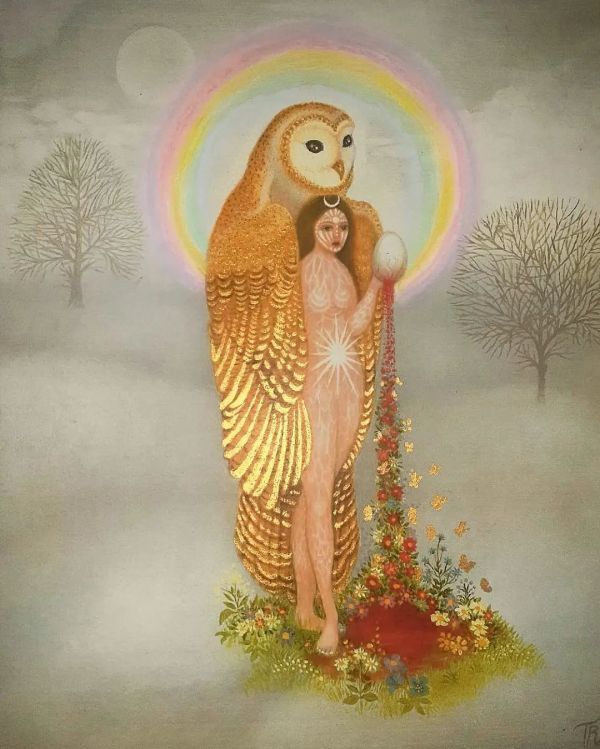
Enter Tino Rodriguez. Tino’s art wasn’t about the steely-eyed warriors or the brooding ironclad crusaders and grizzled berserkers. Instead, it brimmed with tenderness and offered an expansive glimmer of something hopeful, a reminder that even the gentlest souls can rise to the challenge in a world teetering on the edge. It was exactly the kind of inspiration–and hero–that I needed for my final chapter.
Up until this realization, this had been a project wherein I questioned just about every word I’d struggled to get on paper, but once I experienced the artwork below, it became one of the easiest things I’d ever written.
The Wounded Healer’s Blood Nourishes the Earth That Gives Birth to Radiant Flowers, Tino Rodriguez
Infused with the captivating allure of celestial beings and Catholic saints, the whimsical charm of European fairytales, the otherworldly magic of Celtic fables, the vibrant energy of Mexican myths, and the timeless wisdom of Native American legends, and inspired by the wonder and magic of music, dreams, and childhood stories, Tino’s canvases are jubilant celebrations of ecstatic divinity, colorful butterfly-fluttered paradises, and brilliant floral explosions – sanctuaries for explorations of creative consciousness that transcend borders and language.
Personal transformation and universal connectedness are themes that tumble throughout Tino’s work, like so many spring blossoms on a sweet, laughing breeze: reminders that a hero’s work – this whole business of saving the world – often starts small, internally even, one precious human petal at a time.
The humble work of healing oneself is quiet and invisible, and it frequently doesn’t look – or feel – very good. Sometimes, it feels like ripping an arrow right out of your heart and fertilizing the ground with your blood. But you know what we call that? It’s an origin story. And it’s a great place to start.
Daydream Murmurations, Tino Rodriguez
The First Breath of Spring, Tino Rodriguez
But Tino’s art isn’t just a technicolor feast of kaleidoscopic opulence and psychedelic blooms; they are spaces of quiet revolution for creative spirits and gentle warriors of the heart, boundless realms where dreams take flight, transformation takes place, and where the questions that we carry with us are a beautiful, integral part of our complex and multilayered existence.
With regard to questions and answers and logic and reasoning, Tino says the following, and I love this sentiment so much:
“My work does not offer concrete answers. Instead, the poetic essence of my paintings questions literal and rational meanings. I am not interested in answers because I do not think there are absolute ones. Most questions are enigmas that we carry within ourselves, and they are part of our multilayered, complex existence. Novalis said: “Poetry heals the wounds inflicted by reason.” I think the same of my paintings, which I consider visual poetry.”
Below is a gallery of my favorite visual poetics from this extraordinary artist, a testament to the idea that beauty can indeed save the world, one tender hero at a time.
If you enjoy these art-related writings, or if you have ever enjoyed or been inspired by something I have written, and you would like to support this blog, consider buying the author a coffee?
In the weird, woodland magics of of Brett Manning’s art, one will find a labyrinth of moss-covered pathways and mushroom-dotted clearings, where one might imagine hearing the whispers of faeries and the footsteps of forest spirits.
Whimsy dances hand in hand with shadows and decay, creating a thicket of contrasts that defies simple categorization. While her creations exude a playful charm, there’s an underlying hint of shadow that adds depth and complexity to her work. Think Beatrix Potter goes to the Goblin Market, told via the forested strangeness of a gloomy Twin Peaksian folklore, tinged with the cryptic mystery and intrigue of the X-Files; channel that through an impish imagination, a flair for visual storytelling, and an eye for the uncanny, and you begin to grasp the enigmatic allure of Manning’s realms.
Basically what I am trying to say here is that Brett Manning’s artworks embrace the wild and the wondrous, they are the artistic equalivalent of the unhinged urge to disappear from society and rewild as a feral forest goblin, and embody the idea of a gnome riding on the back of a possom, rolling up to you in a little car made of autumnal forest detritus and saying, “get in losers, we’re gonna admire moss and mushrooms in the forest.”
Faerie Music, Brett Manning, 2021, ink.
Faerie Music in The Art of Fantasy
Faerie Music caption, Korean to English translation
Here is the caption I wrote for it and which you will find included in the book:
“Fiddling, strumming and tootling through the twilight while lounging about on cosy toadstools, the faerie folk musicians by contemporary artist Brett Manning are a captivating blend of dainty and earthy, and seem envisioned from both ancient books of forest folklore and your favourite well-thumbed local woodland cryptid guide. A maker who wears many hats (probably woven by gnomes with spider silk and beetle wings), Manning’s whimsical, magic creations take the form of illustrations as well as cavorting and capering all over the clothing that she designs.”
The second image is a photo of Brett’s artwork in the Korean language edition of The Art of Fantasy, and the third photo is from where I ran the Korean caption through a translator, and it gave me back an English version. I don’t think this is actually how it reads in Korean, but …I also kind of hope so?
“Modern painter Brett Manning sat on a cosy poisonous mushroom, in the twilight, played the violin, ripped the harp, drew fairy flute musicians, capturing the elegant earthy nature. In this paining, we can think of both ancient folk tales and our favourite guides to unidentified creatures in our woods and our neighborhood. Manning’s quirky and magical creation, which mainly uses a hat (like a fairy in the ground woven with spider’s webs and beetle wings), is not only embodied in illustrations, but also plays cheerfully in the clothes she designs.”
I love the idea of Brett sitting on a mushroom, playing a violin and ripping a harp, and using a hat to create! Honestly, that may have been better than what I wrote.
Bauchan, Brett ManningSpringtime, Brett Maning
Through her art, Manning invites us to peek into hidden nooks and corners where we can almost hear the lilting melodies played on instruments of nature, a secret serenade echoing through the twilight woods, performed by faeries, cryptids, spirits, and other strange entities that exist on the fringes and in the peripheries. So next time you find yourself wandering through a sun-dappled sylvan setting, keep an ear out. Perhaps you’ll catch a glimpse of Manning’s whimsical creations, their music weaving a spell of wonder and enchantment, their whispers urging you to get lost in the woods and never to be seen again.
As you contemplate trading modern trappings for the untamed beauty of fanciful forest realms, and perhaps even become one with moss and bugs, indulge in daydreams of the things between and unseen.
Below, a gallery awaits, showcasing my favorites among Manning’s works, inviting you to embark on your own journey through her weird woodland worlds.
Artwork by Brett ManningArtwork by Brett Manning
Artwork by Brett ManningSnarly Yow, A West Virginia Cryptid
If you enjoy these art-related writings, or if you have ever enjoyed or been inspired by something I have written, and you would like to support this blog, consider buying the author a coffee?
I have been meaning for several months (maybe almost a year now? Le whoopsie!) to continue my “spotlight” series on the incredible contemporary artists that have allowed me to include their gorgeous creations in my books.
Today celebrates a return to that practice and delivering on that promise to myself with a further look the languid dreams and unsettling poetry of Jason Mowry’s artworks. Jason’s splendid watercolor and gouache canvas, “The Sphinx, the Substance and the Dreamer,” can be seen in The Art of Fantasy: A Visual Sourcebook Of All That Is Unreal.
The Sphinx, the substance and the dreamer, Jason Mowry (as seen in The Art of Fantasy)
Expressed in the languid dream of a somber, sumptuous palette and resplendent with atmosphere and emotion, the work of Jason Mowry trembles in a thrillingly familiar way, caught between the border of formal and fantastic. We may not know who these subjects are or what they’re up to, but from the monstrous figures to the human characters that look just like us, there is something in their story that we recognize nonetheless.
These strange, sentimental visions combine myth and legend, personal narrative and symbolic imagery in a visual language that speaks a timeless spell. Mowry’s artistic alchemy bypasses the modern viewer’s analytical safeguards and sings to something ancient and ancestral in the blood. It’s a captivating push-pull quiver between violence and stillness, simplicity and opulence, the familiar and the fantastical.
The Instrument and the Fading Roar, Jason Mowry
Amabie, Jason Mowry
Jason Mowry’s artistic vision draws from a rich tapestry of influences from the Golden Age of fairy tale illustration and its giants like Rackham and Dulac to the dark beauty and natural poetry of Grimms’ Fairy Tales, simmering with primal truths that speak to our fears and desires.
We can feel the shape of this interplay between the fantastical worlds and unsettling narratives in the light and shadows of Mowry’s paintings, and though we may not grasp the entire plot, the emotional undercurrents resonate deeply.
Blessings from the maw, Jason Mowry
Cloaked, Jason Mowry
Raised between the hushed halls of art museums and the vibrant chaos of comic book shops, Mowry’s artistic heritage is a fascinating paradox, embuing the figures he coaxes onto the canvas a captivating duality. They flirt with a formality that reveals classical training, yet their surreal, elongated forms and expressive poses hint at a wildness and wonder born from years spent devouring comic panels.
This tension fuels Mowry’s storytelling. Each piece feels like a glimpse into a larger narrative, a dream told by a dreamer still in the midst of a dream; fraught and frozen, a moment of drama and crisis preserved in amber for one hundred years; each an oracular murmur of impending psychic annihilation–or a trilling song of complete rebirth.
We are left to wonder, are these figures facing oblivion, or a magnificent metamorphosis? And in connecting to that deep wellspring of grace and thrumming vulnerability within ourselves, what, then, are we capable of?
Fabled Monarch, Jason Mowry
Flora Persona, Jason Mowry
Her teeming coronation, Jason Mowry
Artemis and the Bear, Jason Mowry
Becoming Tears and Hunger, Jason Mowry
Clutch and Catcher, Jason Mowry
Glitter Afresh Forever, Jason Mowry
The Instrument and the Fading Roar, Jason Mowry
The Princess and the Trolls, Jason Mowry
If you enjoy these artsy-fartsy musings, or if you have ever enjoyed or been inspired by something I have written, and you would like to support this blog, consider buying the author a coffee?