2025

Last week I was having a conversation with a friend about actors we’d love to see in vampire films. I mentioned Christopher Walken, not realizing he had already been in one (and weirdly, I also want to see Jon Hamm as a vampire!) When I discovered that Walken was in Abel Ferrara’s 1995 black-and-white vampire film, The Addiction, it immediately moved to the top of my watch list. Which worked well for me, because I have been wanting to watch this for years anyway!

Lili Taylor is a Kathleen, a philosophy grad student in New York who gets attacked by an elegant woman in an alley one evening after class. The woman drags her into the shadows and bites her neck, whispering, “Tell me to go away,” before disappearing into the evening. Kathleen goes to the hospital, but they find nothing wrong. Except she starts feeling different. Hungry. Specifically hungry for blood.

What follows is Kathleen’s descent into vampirism, which the film treats explicitly as addiction. She doesn’t grow fangs or burst into flames in sunlight. She just needs blood, constantly, and she uses philosophy to justify what she’s doing. Every conversation becomes an intellectual exercise in whether people who do evil things are inherently evil, or if doing evil things makes you evil. She quotes Kierkegaard and Nietzsche while attacking people. She uses her studies to rationalize her violence.
The film is shot in gorgeous black and white. The contrast is severe, deep shadows that swallow entire portions of the frame, harsh light that bleaches faces into stark relief, compositions that feel pulled from German Expressionism. New York streets at night become labyrinths of shadow. Faces emerge from darkness only partially, half-lit, always slightly obscured. It’s beautiful in a way that feels deliberate and considered, every frame composed like a photograph.
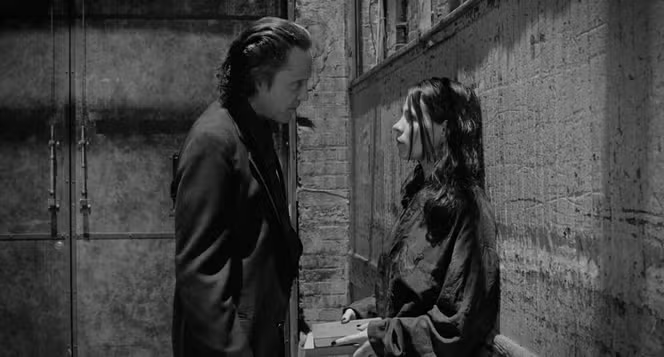
The film is also deeply pretentious. It’s all very serious, very intellectual, very self-aware about being serious and intellectual. Every character speaks in philosophy quotes and dense theoretical language. There are images of Holocaust victims interspersed throughout. Christopher Walken shows up for about ten minutes as an older vampire who’s learned to control his urges, and he pontificates beautifully about sin and willpower before disappearing again.
It feels very much like the time it was made. The mid-90s are all over this. Kathleen walks past a storefront with a Smashing Pumpkins shirt in the window, everyone’s dressed in that particular downtown NYC way. There’s Edie Falco (Carmela Soprano!) as one of her philosophy classmates. Michael Imperioli gets prominent billing in the opening credits, but only appears for about thirty seconds as a religious guy handing out flyers. It’s interesting how in this scene, he tells Kathleen to go away, and she does. The “tell me to go away” line that her attacker used on her actually functions with someone who has faith (maybe?)

There’s a line Kathleen utters that immediately struck me: “Essence is revealed through praxis.” What you are is shown through what you do. Not what you think, not what you intend, not what you believe about yourself, but what you actually do. Your actions are the truth of you.
In the context of the movie, Kathleen keeps trying to philosophize her way out of accountability. She’s killing people, turning them into vampires, spreading her addiction. But she frames it as intellectual inquiry. She’s not bad, she’s just exploring the nature of evil. Except her essence—what she actually is—is being revealed through her praxis. Through her actions. She is what she does, and what she does is monstrous.
I think about this outside of vampire movies, too. How easy it is to think of yourself as a certain kind of person while your actual behavior tells a completely different story. You can believe you’re kind while being cruel. You can believe you’re generous while being selfish. Essence is revealed through praxis. You are what you do, not what you wish you were.


The film ends with Kathleen overdosing on her own vampirism at a party where she’s turned the entire philosophy department. That party scene is WILD and probably worth the price of admission (which in this case is a 90-minute slow burn of your time.)
I can’t say I loved it. The philosophical dialogue is dense to the point of being exhausting, it occasionally feels like it’s trying too hard to be profound, and it’s not always clear what Ferrara wants us to take away from it. But I’m glad I finally watched it.
Looking for more 31 Days of Horror? Day Seven 2024 | Day Seven 2023 | Day Seven 2022 | Or check my 31 Days of Horror category for more!
If you enjoy posts like these or if you have ever enjoyed or been inspired by something I have written, and you would like to support this blog, consider buying the author a coffee?

Grim says
This is the flick that made Lily Taylor one of my favorite actors. I haven't seen this since the mid 90s, but I think it's time for a revisit. I also love Walken. Thanks for this reminder.
Kendall Morgan says
You should check out Nadja…same time frame!
S. Elizabeth says
WHOA WHOA WHOA HOLD UP! I have never even heard of this one! I am so incredibly intrigued, thank you for mentioning it!
Someone says
Jon Hamm would absolutely nail the role as a vampire! It needs to happen