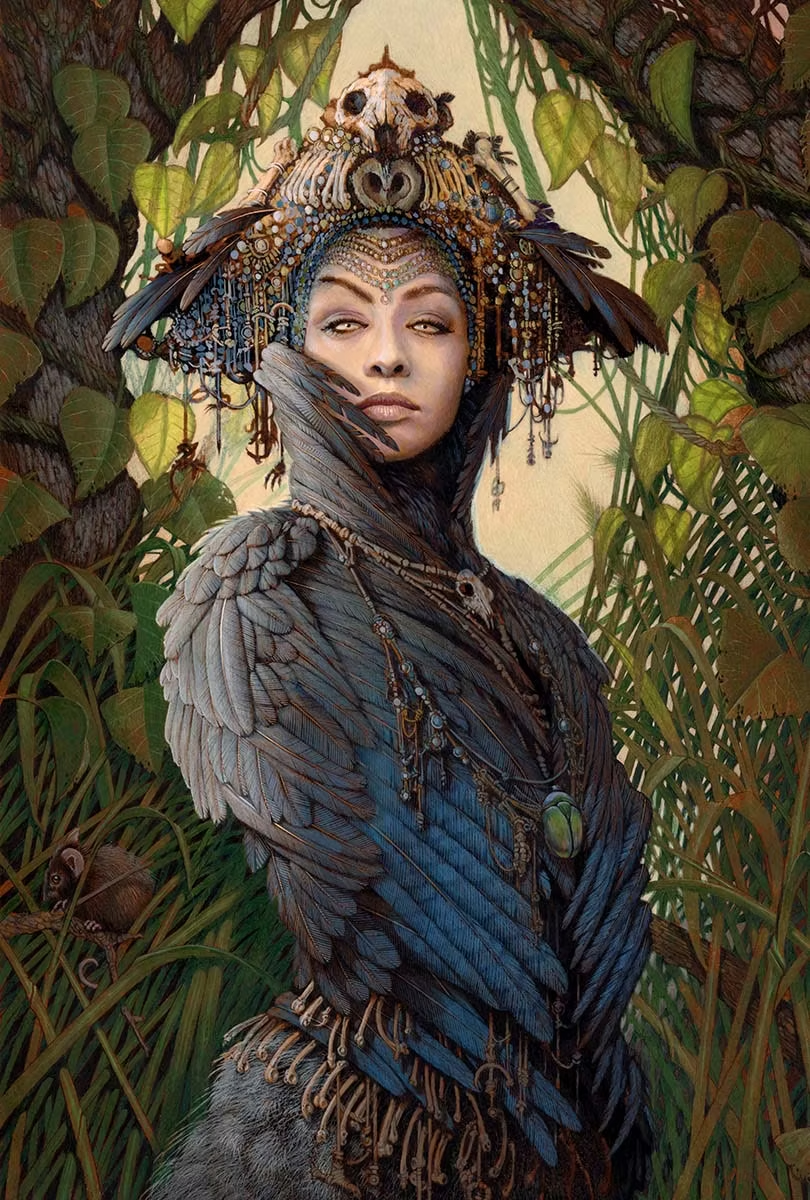
Corvid Priestess, Ed Binkley (as seen featured in the pages of The Art of Fantasy)
Have you ever had that feeling that someone is watching you from just beyond the tree line? That prickling sensation on the back of your neck while wandering a misty forest path? Perhaps it was Ed Binkley, sketchbook in hand, documenting your encounter with his meticulously detailed woodland denizens before you even realized they were there.
Binkley’s art feels less created and more… discovered, as if he’s somehow gained access to a hidden archive of supernatural field notes. His faeries, shamans, and assorted cryptid curiosities peer from the pages with such specificity that one suspects he must keep have recruited them as sources and informants, feeding him scraps of imagination and starlight so that he may best capture their likenesses in exquisite detail. There’s a sense of authenticity to these beings—they seem to exist with complete lives beyond the boundaries of the page, carrying personalities, histories, and perhaps even opinions about which mushrooms make the best rooftops.
“Corvid Priestess” peers from the pages of my book, The Art of Fantasy: A Visual Sourcebook Of All That Is Unrealwith a gaze that suggests ancient knowledge and ritual importance. Her avian elements aren’t fancy accessories selected on a whim—they’re integral to her identity as a being who bridges worlds. The remarkable fusion of human and bird creates something wholly original, a priestess whose connection to corvid energy manifests through both spirit and form. One imagines her presiding over moonlit ceremonies, communicating in languages both human and avian, serving as translator between realms.
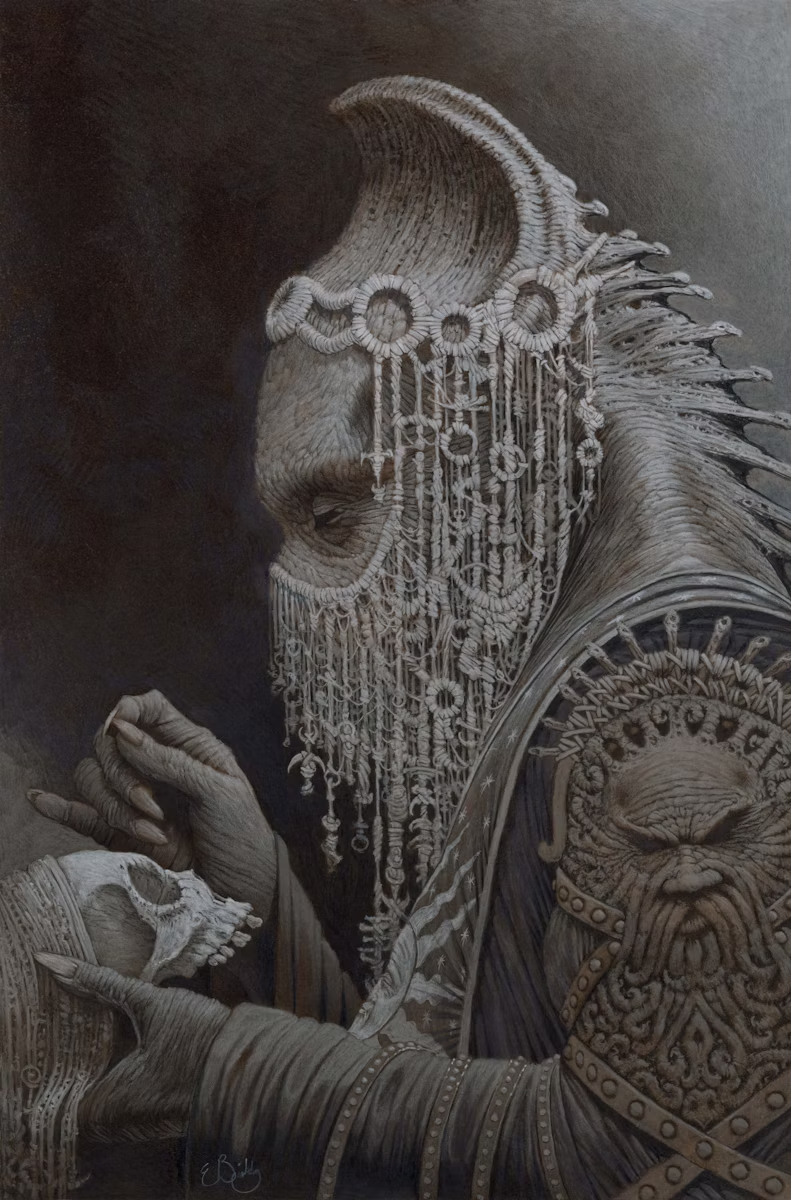
Soul Whisperer, Ed Binkley
Binkley’s worlds exist next door to our own, like that neighbor’s house you’re pretty sure hosts something freaky every full moon but can never quite catch in the act. In “Soul Whisperer,” a veiled figure guides spirits to their next existence with all the calm efficiency of a supernatural TSA agent. Their veil—adorned with beads and tiny bones—makes music “like tiny wind chimes, inaudible to the rest of us,” which is just as well because the last thing you want when crossing to the afterlife is a jangly soundtrack announcing your arrival.
The textures in Binkley’s work invite closer inspection and are so tactile you’ll find yourself absently trying to pet your computer screen. Every feather, strand of moss-like beard, and antler-etched rune is rendered with precision that transforms flat images into seemingly tangible beings. His technique marries digital sketching with traditional colored pencil in a harmonious artistic union that preserves the warmth of handcrafted art while embracing technological possibilities. The result feels both ancient and immediate—beings documented in their natural habitat rather than merely imagined.
Scout, Ed Binkley
“Scout” embodies youthful vigilance and has all the hallmarks of that kid in the neighborhood who somehow always knows everybody’s business before they do. This watchful entity seems caught mid-reconnaissance, probably reporting back to some elder woodland power about the shitty humans who keep leaving energy bar wrappers in the sacred grove. The slight head tilt practically broadcasts, “I saw what you did last summer solstice.”
Binkley’s figures inhabit a rich tapestry of folklore and fantasy literature, from high-fantasy to horror to dreamscapes. These beings explore varied emotional territories while maintaining the distinctive thread that connects all his creations—a sense that these beings belong to coherent, complex societies with their own rules, rituals, and relationships.
Mantis, Ed Binkley
In “Mantis,” we meet another hybrid being, one who has embraced the full mantis lifestyle. Its elongated limbs and complex garments suggest a society with fashion magazines, designer labels, and possibly a “What Not to Wear (When Decapitating And Eating Your Mate”) reality show. The figure has perfected that quintessential mantis vibe, that stillness unique to mantids—an unnerving quality of absolute presence that makes you wonder if you’re being sized up as prey or simply observed with alien curiosity.
Ed Binkley, Chrysalis
“Chrysalis” showcases our fascination with transformation, and who among us hasn’t experienced an awkward transitional phase where we’re neither fully one thing nor another? (Minus the literal exoskeleton and carapace detritus, presumably.)
The figure exists in that universal state of becoming that feels simultaneously exciting and mortifying, the human equivalent of butterfly soup, that vulnerable yet wildly potential state where you’ve committed to shedding your old self but haven’t quite figured out what your wings look like. Like three chapters into writing a book with no clear ending in sight, and you haven’t fully worked out exactly what it is you’re writing about yet or how any of it relates to anything else at all, and actually, I don’t even know if that example relates to this artwork in the slightest, but that’s where I am at mentally right now!
Ed Binkley, Listener
“Listener” depicts a being tuned to incomprehensible eldritch frequencies. The meditative pose suggests active reception of cosmic broadcasts—picking up everything from tree gossip to star conversations to the subtextual grumblings of tectonic plates. Would such sensitivity be a gift or a curse? Would the constant chatter of atoms and echoes of ancient sounds drive one to madness? Or would it connect one to the universe in deliriously strange and wonderful ways?
Ed Binkley, Long-Tailed House-Imp, with Embroidered Suit
I’ve developed a particular affection for Binkley’s goblins—those delightful domestic prankers who, I’m convinced, live in my own home. What else explains the earring that vanished from my bathroom counter, only to materialize six months later inside the House of Psychotic Women tote bag I hadn’t used since last winter? Or the specific creak my hallway floorboard makes at 3:17 AM with metronomic consistency?
Just last week, I set my coffee mug down while checking email, only to find it had migrated to the top of my bookshelf when I turned back around. The mug, notably, had a Terry Pratchett quote about magic on it—clearly my resident goblin has a flair for the ironic. Binkley’s illustrations give these mischief-makers faces and forms, validating my suspicions that I share my living space with creatures whose entertainment comes at the expense of my sanity and organizational systems.
That’s okay, goblins; I love your crazy ways!
Ed Binkley, Moon Prayer
In our world of increasingly mass-produced, algorithm-approved visual pablum, Ed Binkley’s intricately artful fantasies feel like stumbling upon a secret garden where the plants talk back and have opinions, the bugs have human faces and agendas, and there are secret societies teeming beneath your feet, just below the range of hearing, and beyond the range of sight… but surrounding us constantly.
His creatures and beings communicate the stance of those who have traveled far, possibly through dangerous terrain, to seek admission to mysteries beyond our perception. The gravitas in their bearing suggests responsibilities beyond mortal comprehension—perhaps they maintain boundaries between dimensions or ensure that certain ancient entities remain slumbering. And yet their fusion of hybrid features with expressive humanity suggests perceptions which, though must differ wildly from our own, lurks a consciousness with recognizable emotions and thoughts that experience the universal mixture of awe and terror, hope and uncertainty, the willingness to be transformed by what comes next, that comes from merely being alive, from existing.
Each Binkley piece carries that uncanny feeling of recognition – not because you’ve met these specific beings before but because some ancient part of your brain has always known they’re out there, watching, waiting, and occasionally borrowing your good stork-handled stitch-snipping scissors without asking. His art whispers: the world is weirder, wilder, and more wonderful than they (you know, THEY) would ever have you believe.
Who are you going to believe? Them? Or Ed Binkley? I believe you, Ed.
Ed Binkley, Evening Ascending
Ed Binkley, The Firefly’s Advice
Ed Binkley, Changeling-Favorite Things
Ed Binkley, The Snail’s Story
Ed Binkley, Firefly Queen
If you enjoy posts like these or if you have ever enjoyed or been inspired by something I have written, and you would like to support this blog, consider buying the author a coffee?
[Note: This piece was initially developed for other purposes, but I’ve adapted it for my blog—balancing information for longtime readers familiar with this story while exploring the deeper connections between horror and healing for new readers…who might happen to be horror fans.]
Most longtime readers know the basics of how Skeletor is Love began: a moment of personal crisis, a nostalgic YouTube suggestion, and the absurd inspiration to pair screenshots of my childhood nemesis with self-help affirmations. How this silly project would eventually reach hundreds of thousands of people. Or that I would receive messages from followers telling me that my ridiculous mash-up of a skull-faced villain and positive affirmations had helped them with their depression, addiction recovery, and self-harm. Or that Skeletor is Love would become a tiny, weird community of people finding comfort in the most unlikely of places.
What I’ve rarely discussed, however, is why this particular, preposterous character might have resonated so deeply as a vessel for healing, and how this project seemed to share some interesting parallels with how we experience and process horror. As a lifelong horror enthusiast, I can’t help but wonder if there’s something about Skeletor’s particular brand of dorky darkness that speaks to the same part of us that finds catharsis in ghost stories and monster movies and things that generally freak us out and scare the crap out of us.
As a child, I was terrified of everything. The dark, thunderstorms, the pool filter, mysterious noises…and especially the villains of my Saturday morning cartoons. Chief among these nightmare-inducers was Skeletor, with his purple hood and grinning skull face, his high-pitched cackle echoing through our living room as he plotted the downfall of Eternia. I was simultaneously terrified and fascinated.
With his perpetual rage and thwarted ambitions, Skeletor embodies a primal form of darkness different from sophisticated villains like Hannibal Lecter or cosmic horrors from Lovecraft. He’s emotional frustration in periwinkle, swollen-muscled cartoon form. His plans always fail. His minions disappoint. His existence is defined by perpetual dissatisfaction and disillusionment—the human condition distilled into primary colors and dramatic posturing.
I’ve often wondered if there’s something about juxtaposition that makes both horror and my Skeletor project resonate. Think about it: a suburban home invaded by supernatural forces, a picturesque small town harboring unspeakable secrets, a birthday party interrupted by masked killers, a peaceful summer camp stalked by an unstoppable force. Something about placing the terrifying within the every day creates this unsettling cognitive dissonance that keeps us coming back for more.
Skeletor is Love plays with this same contrast by placing gentle affirmations alongside images of cartoon villainy, but I think it creates a different kind of dissonance—one that opens something up rather than closes it down. That fear response somehow transforms into something unexpected: laughter, recognition, and comfort.
There’s something about that gap between Skeletor pompously declaring “I WILL DESTROY YOU ALL” while text overlay suggests “I deserve love and acceptance” that creates a strange space where healing might sneak in, almost accidentally, disguised as a joke. I wonder if it’s not so different from how we sometimes find ourselves laughing during a horror movie—that sudden release of tension that reminds us we’re still human, still alive, still processing.
What surprised me most about the response to Skeletor is Love was how quickly it formed a community. Some came for the nostalgia, others for the humor, and a surprising number because they genuinely found comfort in these messages. I probably should have anticipated this community-building effect, considering how horror fans tend to find each other.
There’s something about that shared willingness to look into darkness that creates instant connection, isn’t there? Whether it’s spotting someone’s Freddy Kruger tattoo at a coffee shop or bonding over a shared childhood trauma from accidentally watching Burnt Offerings too young, horror enthusiasts recognize each other through our willingness to face what frightens us.
The Skeletor is Love project seemed to tap into that same energy, creating a space where people could acknowledge their darker feelings through the protective shield of irony and nostalgia. It became a sort of ritual where the frightening transforms into something celebratory through shared experience.
I found it telling which images resonated most. Among the hundreds of memes I created, the most shared weren’t the funniest or most absurd, but those featuring Skeletor at his most vulnerable: raging at the sky, crying out in frustration, or alone in his sanctum. In these moments, the villain becomes a mirror, reflecting our own moments of impotent rage against circumstances beyond our control.
This mirror effect seems similar to what draws many of us to horror. Whether it’s the grief-stricken madness of The Babadook, the suffocating paranoia of Rosemary’s Baby, or the inherited family trauma of Hereditary—these stories reflect our inner turmoil through external monstrosities, giving tangible form to intangible suffering.
By pairing Skeletor’s emotions with gentle encouragement rather than judgment, these memes validated feelings many struggle to acknowledge. The character’s exaggerated expressions made it safe to recognize similar emotions in ourselves. This combination of ridiculous cartoon villainy, earnest self-compassion, and painfully earnest self-help affirmations provided the perfect silly contrast for therapeutic laughter – a coping mechanism humans have relied on since time immemorial.
Dark humor has always been humanity’s response to the unthinkable. War veterans joke about death. Emergency room staff develop gallows humor that would shock civilians. Bereaved families sometimes laugh more than they cry at wakes. (My sister and I have a funny story about when our mother was Baker-Acted. Hilarious!) There’s something about confronting the horrific through laughter that creates just enough distance to process our fears without being consumed by them.
Horror often thrives in this space, from Evil Dead‘s slapstick gore to Shaun of the Dead‘s zombie comedy to Cabin in the Woods‘ meta-deconstruction of the entire genre. These stories understand that laughter doesn’t diminish fear, it contextualizes it, making it manageable without removing its power. The sudden shift from tension to release reminds us that we contain multitudes—fear and courage, darkness and light, trauma and healing, all coexisting within the same frame. These moments of absurd humor amid existential predicaments are precisely what make horror such a cathartic experience.
Skeletor is Love worked on this principle. It transformed not just my personal relationship with childhood fear but created a space where thousands could perform the same alchemy with their own darkness. Like the best horror-comedies, it found the absurd humor in our darkest moments without diminishing their emotional impact.
I never intended it to become a mental health resource. I’m not a therapist. My only qualifications, as I often joked, came from “living in a family full of depressed alcoholics.” And yet, there I was, inadvertently creating content that people incorporated into their healing journeys.
I’ve come to think there’s something inherently frightening about the healing process itself—the vulnerability, the uncertainty, the fear that confronting our wounds might destroy rather than repair us. We often approach emotional health with the same trepidation as the protagonist entering the basement in a horror film. We know something waits in the darkness. We’re not sure we want to see it.
Maybe horror fans understand that sometimes you have to go down those stairs. You have to open that door. You have to follow the strange noise in the attic, venture into the abandoned hospital wing, or check out what’s making that scratching sound in the basement. You have to face whatever waits, even when every instinct screams to run. The genre has taught us to face fears rather than flee them.
Skeletor is Love provided a strange guide for this journey, a grinning skull-faced Virgil holding a lantern, leading followers not deeper into hell but gradually toward light. The absurdity made the journey less frightening. If we could laugh at Skeletor’s existential rage while recognizing our own reflection, perhaps our inner darkness wasn’t so terrifying after all.
In the end, isn’t this what horror at its best might be doing? Giving shape to shapeless dread. Naming unnameable fears. Transforming the unbearable into something we can hold in our hands, examine from all angles, and eventually set aside.
The genres I grew to love as an adult, whether it’s Clive Barker’s fusion of ecstasy and agony, Junji Ito’s inescapable spirals of obsession, or Thomas Ligotti’s philosophical nihilism, helped me process complex emotions that I couldn’t otherwise articulate. They gave form to formless anxiety. Takashi Miike’s unflinching extremity that forces you to look when you want to turn away, Jean Rollin’s dreamlike eroticism where desire and death become almost indistinguishable, George Romero’s unflinching social commentary lurking beneath the zombie apocalypse—each offered a different vocabulary for understanding the darkness within and around us.
And sometimes, in the weirdest twist of all, childhood nightmares transform into unexpected allies, helping us face the real monsters that lurk in the shadows of adulthood: loneliness, despair, and the fear that we aren’t enough. The skull-faced villain becomes not the source of our terror but the companion who helps us navigate it.
Perhaps it’s fitting that Skeletor—a character who never succeeded in his quest for power—finally found his purpose by failing at being frightening and accidentally becoming a conduit for healing instead. Not through some grand design or cosmic purpose, but through the messy, often absurd ways we repurpose our fears.
“Be afraid. Be very afraid,” as Brundle’s doomed girlfriend warns in The Fly. But maybe the wisdom isn’t in avoiding that fear, but in allowing yourself to feel it fully…and sometimes, finding a way to laugh at it too. Who would have thought a ridiculous villain from an 80’s cartoon would end up being a weird little touchstone for people navigating their darkest emotions? Not me, and certainly not this bumbling, skull-faced, blue-skinned sorcerer. If that’s not the strangest hero’s journey of all time, I don’t know what is.
If you enjoy posts like these or if you have ever enjoyed or been inspired by something I have written, and you would like to support this blog, consider buying the author a coffee?
Friends, I have some exciting news to share! My article “She Died As She Lived: Deliciously (Notes From A Death Café)” is published in the current issue of Rue Morgue Magazine, and I’m thrilled to announce that this piece marks the beginning of my new role as a regular columnist for this beloved publication! I’ve been sitting on this news until I could hold a physical copy in my hands, but now it’s here, so I guess it is official!
My journey with Rue Morgue has been a series of is-this-real-life??? moments. First came the thrill of being interviewed about my book The Art of Darkness—seeing my thoughts and work featured in a publication I’d treasured for so long felt surreal. When the opportunity arose to contribute a piece on horror-inspired perfumes for their March/April 2025 issue, I poured my heart into examining how scent artists capture the essence of fear in fragrance. But becoming a regular columnist? That’s a dream I hardly dared to imagine.
My Ghoul Next Door column debuts with an exploration of Death Cafés – those gatherings where strangers meet over tea and cake to discuss mortality. Some longtime readers might remember my blog posts about hosting these events in Orlando from 2014-2016, and I’m excited to revisit the topic for a wider audience. What exactly the column will cover going forward is still evolving, but expect a strange brew of the weird and wonderful things I’ve long been passionate about – a space for exploring oddities and curiosities, weaving together the beautiful and the macabre, the strange and the melancholy. I’m looking forward to sharing these explorations with Rue Morgue’s readers.
The current issue featuring my debut column is now available, and I’d love to hear what you think if you get a chance to read it! Thank you all for supporting my particular brand of weirdness all these years. Here’s to many more adventures in print!
Every May, social media fills with mermaid art as artists participate in MerMay – the month-long challenge to draw mermaids daily. I wonder if everyone’s still doing that? It’s cute, it’s popular, and it got me thinking about the mermaids and water spirits featured in my book The Art of Fantasy:A Visual Sourcebook of All That is Unreal. Because honestly, my own mermaid obsession runs embarrassingly deep.
Did you watch Darryl Hannah in Splash at a young age and dream for the next decade of diving into the ocean and magically becoming a mermaid with a sparkly orange tail? I spent hours in the pool trying to perfect the dolphin kick, convinced that with enough practice, my legs might just fuse together. When that inevitable disappointment set in, I moved operations to the bathtub with the SeaWees toys from the early 1980s—those pastel-haired creatures with their tiny combs and mirrors. I’ve been obsessed with mermaids ever since. I could have included a whole chapter on them in my book, hell, I could have written an entire volume dedicated to nothing but these aquatic enchantresses.
What is it about mermaids that makes us lose our collective minds? They’re the ultimate shapeshifters, navigating between worlds with the kind of effortless grace most of us can only dream of achieving on dry land. They embody transformation, freedom, and that eternal mystery of what’s really going on beneath the surface—which is probably far cooler than the shitshow unfolding up here on this godforsaken dirt hole.
Here are some of the fishy folk (mermaids and “mermaid-adjacent”) that were included in my book…
A Mermaid, John William Waterhouse
In this captivating image of quiet vulnerability, a mermaid combs her lustrous abundance of hair as she rests on a sprawl of seaweed-strewn rocks in an isolated cove, the shimmering strength of her tail curled beneath her. An abalone shell scattered with pearls and the tears of dead sailors beside her, she wistfully gazes into the distance, unheeding of our eyes intruding upon her moment of reflection. Or do our eyes deceive us? Is this moment of enigmatic melancholia something else entirely? Perhaps a calculated move on the siren’s part when, perceiving our gaze, she notes our hunger for magic and miracles, and in feigning unawareness of our presence, it is all the easier to lure us to our watery doom? John William Waterhouse’s (1849–1917) fascination with the darker aspects of the mermaid’s mythology as both a tragic figure and enchantress drives this work, and with it, he invites us to dive into the mystery and discover her intentions for ourselves.
Water Nymphs, Gaston Bussière
French painter and illustrator Gaston Bussière (1862–1928/29) studied at the Académie des Beaux-Arts in Lyon and both worked with and was greatly influenced by his contemporaries, Gustave Moreau and also the Czech painter Alphonse Mucha. His works were visual poems of Symbolist inspiration, glowing and full of vivid embellishments and often evoked the heroes and heroines of the epic mythology. He also painted many depictions of nymphs, nereids and fairies scantily dressed and showing a typical Art Nouveau ideal of beauty, such as this frolicking trio.
Mermaid, Edvard Munch
Edvard Munch’s (1863–1944) mermaid looks like she is desperately looking for an excuse not to show up for that thing she promised to attend, a month ago, when she was maybe feeling deceptively energetic and probably all hopped up on those tricksy endorphins after a vigorous ocean swim. Now she’s having regrets because she’s a midnight introvert and probably just wants to stay in her grotto, chill out and look at her collection of gadgets and gizmos aplenty. She definitely does not want to be where the people are. Or maybe she’s a manifestation of Munch’s preoccupation with loneliness and anxiety – in the form of a fish-woman painted by the artist as part of a commission from a Norwegian industrialist for a large-scale decorative work during an extended stay in Paris in 1896–97. Fantasy is only limited by our imaginations, and anxious people’s (and anxious mermaids’) imaginations no doubt work overtime!
Sunfish, Boris Vallejo
Renowned Peruvian–American painter Boris Vallejo is universally considered to be one of the masters of modern fantasy illustration. His instantly recognizable, lavishly hyper-realistic-to- the-point-of-surreality paintings have appeared on the covers of numerous science fiction and fantasy fiction novels, trading cards and posters, with subjects encompassing heroes from myth and legend, fearsome prehistoric creatures and the cosmic serenity of ocean life. From epic sword-and-sorcery battles to the strange flora, fauna, and denizens of extraterrestrial landscapes, Vallejo has painted boldly fantastical visions of almost every major fantasy figure that we know and love . . . and showed us some stunning fantasies we’d never even dreamed up!
Jeune Naiade, Paul Émile Chabas
Celebrated French artist Paul Émile Chabas (1869–1937) was a member of the Académie des Beaux-Arts and a painter of nudes, portraits, and seascapes. They loved him in Europe; he first exhibited at the Paris Salon in 1890, and received a number of awards and accolades over the next several decades. Sentiments elsewhere, however, were not as flattering, and reproductions of his most (in)famous painting, depicting a lakeside scene of an unclad young woman protecting her bare skin against a cool breeze in the autumn morning sun, caused controversy and scandal in the United States. A similar painting in a literal sense – a watery scene, its subject au naturel – Chabas’ darkly luminous glimpse of a naiad idling in a crystalline cove leans more into the fantastic, but the expression on her face is pure, jaded realism. ‘Calm down,’ she seems to say, ‘it’s just a bit of skin.’
Nøkken (The Water Sprite), Theodor Kittelsen
Theodor Severin Kittelsen (1857– 1914) was a Norwegian artist, one of the most popular in Norway. Famous for his illustrations of fairy tales and legends, and eerie Nordic folklore, Kittelsen’s dreamlike canvases, rendered in muted tones depicting mountaintop troll magic down to sea ghosts deep in the bogs, reveal his melancholic longing for his countryside. During a stay in Munich, the artist is noted to have opined, ‘What appeals to me are the mysterious, romantic, and magnificent aspects of our scenery . . . it is becoming clearer and clearer to me what I have to do, and I have had more ideas – but I must, I must get home, otherwise it won’t work.’
Vodyanoi, the Water Sprite, Ivan Bilibin
Peerless illustrator of Russian folklore, Ivan Bilibin (1876–1942) was a graphic artist and stage/costume designer who was largely influenced by Art Nouveau and whose work is commonly associated with Russian fairy tales – to the extent that we could say his work very much defines our perceptions today of what Russian folklore art looks like. Seen here is Bilibin’s depiction of a waterdwelling demonic creature found in the mythology and lore of Eastern Europe – the Vodyanoi. A bloated, cranky frog-faced old water spirit, who, when angered, breaks dams, washes down water mills and drowns people and animals – the surest way to rile the Vodyanoi is to upset the natural balance of his watery habitat. Although according to legend, he can be appeased with a knob of butter. That seems fairly relatable.
Space constraints and the permissions and whatnot meant leaving behind some treasures. Here are a handful I wish I could have included!
The Mermaid, Howard Pyle
The Quiet Moonlit Sea, Annie Stegg Gerard
Mermaids, Gustav Klimt
The Little Mermaid and the Sea Witch by Harry Clarke
The Little Mermaid, Nadezhda Illarionova
Mermaids, Emanuel Oberhauser
The Little Mermaid, Arthur Rackham
The Mermaid, Edmund Dulac
Donato Giancola, The Golden Rose
Mermaid, Elisabeth Jerichau-Baumann
Sea Witch, Frank Frazetta (not quite a mermaid, but I could have made it work!)
I also would have liked to include whatever is going on here in this 1938 Weird Tales artwork by Virgil Finlay
If you enjoy posts like these or if you have ever enjoyed or been inspired by something I have written, and you would like to support this blog, consider buying the author a coffee?
When I reached out to Asheville Raven & Croneabout carrying signed copies of my book, The Art of the Occult, I had to laugh at myself. What was I going to say? “Hi, I’m an author! My book exists! Want some?” But they said yes, and now here I am, promoting myself as a “kinda sorta local author” to Asheville, which feels both ridiculous and perfectly accurate.
(Still waiting to hear back from Mr. K’s, by the way. Call me, Mr. K’s!)
The truth is, I’m not local to Asheville at all. I live hundreds of miles away and visit maybe once a year when I can manage it. But Mary – my sister – chose this place, built her whimsigoth paradise here among the artists and musicians and people still rebuilding after the hurricane. Through her, I’ve gotten to see how this town works, how it holds space for mystics and weirdos and creative people who’ve found their community.
When I thought about it, that’s what the “kinda sorta” qualifier really captures – the way belonging works when you’re a creative person. It’s not zip codes or voter registration. It’s recognizing something familiar in a place, even when you’re technically just passing through.
The Art of the Occult works the same way. While you can read it cover to cover, you can also – as I would highly suggest – open it anywhere and find what you need. Creative bibliomancy, if you will. Like wandering through an unfamiliar city and stumbling upon exactly the right street, you might flip to a page about Symbolist paintings when you’re feeling stuck, or find yourself drawn to automatic drawings when you need to tap into your unconscious. It’s a book made for drifting through, for discovering what calls to you in the moment. The book was written for the seekers and the dreamers – for people who understand that art and magic share the same impulse: the desire to peer beyond the visible world and uncover hidden knowledge. It’s for readers who draw inspiration from weird Surrealist dream imagery and find meaning in inscrutable ancient symbols, who might spend an afternoon in a metaphysical bookshop and feel like they’re coming home. The book creates space for both art lovers and practitioners to explore these intersections – whether you’re drawn to the spiritualist artworks of Hilma af Klint, the mythical images of the Pre-Raphaelites, or just love getting lost in spiral doodles that might hold sacred shapes.
Those kinds of connections – between person and object, between seeker and what they seek – are what make certain places magical.
I think about those antique shops my sister mentioned, the ones that got washed away in the hurricane, “all the little trinkets floating downstream.” Those were repositories of other people’s kinda sorta belongings – things that mattered enough to someone that they ended up in a shop, waiting for the next person to recognize their value.
Raven & Crone feels like that kind of place. The kind where seekers and dreamers might stumble across exactly what they didn’t know they were looking for, or where your book finds the readers who need it most. The kind of place that makes you think, “Oh, this feels right.” Even if you’re only visiting.
Maybe especially if you’re only visiting. There’s something about being a literary nomad – showing up in bookstores and metaphysical shops across the country with your wares – that teaches you to recognize kinship quickly. You learn to spot the places that understand what you’re trying to do with your work.
So sure, why not! I’m claiming my kinda-sorta local author status. My book is there, my name is on copies sitting on their shelves, and for now, that’s enough geography for me.
If you enjoy posts like these or if you have ever enjoyed or been inspired by something I have written, and you would like to support this blog, consider buying the author a coffee?
For the past few years I was scared I was going to die in my sleep before I turned 49. I made it! (If I croak tonight, I will be very embarrassed about sharing this prematurely, and I will haunt you all about it forever.)
49 has always seemed a weird number to me. But then again, being a human alive in this world is an exceedingly weird thing, no matter how many years your bones have been clattering around on its surface. My bones and innards and flesh bits and all the rest of me have been around for 49 years today. What a thing. My only order of business is to continue keeping it weird.
I was planning on putting together a whole big blog post, not exactly birthday-related, but sharing some routines and rituals and practices and patterns and such that help me get through my day at this stage in life. And I am still planning on doing that! Just not today, I guess. It’s not even noon today, and I have done a lot of stuff, and I still have a lot of things on my list (nothing fun, really; it’s a work day), so I just don’t have time to write the thing, and I don’t want to stress about it. So I won’t! There’s always another day. Hopefully!
Instead, just a record of my face on this day, the day I turned 49 and lived to tell about it!
If you enjoy posts like these or if you have ever enjoyed or been inspired by something I have written, and you would like to support this blog, consider buying the author a coffee?
What causes a piece of art to catch your eye? It will come as a surprise to no one that mine gravitates toward certain irresistible elements—jewelry that catches light in impossible ways, flowers rendered with botanical precision yet somehow more alive than their real counterparts, clothing that drapes with such exquisite attention to fabric’s weight and flow that you can almost hear the rustle of silk against skin. Perhaps most compelling to me is that particular quality of melancholy that hovers at the edges of beauty, reminding us of its inherent fragility.
And yet lately, I find myself drawn to Ernest Biéler’s paintings (1863-1948) for reasons that seem almost contrary to my usual tastes and which I am struggling to articulate. I suspect I will get there by the end of this writing. His approach reminds me of a perfectly balanced conversation—detailed enough to be fascinating but never so technical that it loses its soul. His canvases strike a balance I really appreciate right now: meticulous in execution yet warmly accessible in spirit, offering a quieter beauty that speaks in a lower register (less ostentation? I guess?) than my typical aesthetic/artsy fixations.
Ernest Biéler, The Leaf Gatherer
Born in Switzerland and trained in Paris, Biéler’s artistic journey took him from early Impressionist influences to the elegantly stylized approach he’s best known for. After discovering the Swiss mountain village of Savièse during a summer holiday, he found both his spiritual home and his most enduring subject matter.
My favorite of his works might be “The Leaf Gatherer”—a perfect embodiment of what I mean by a “balanced conversation” in art. The scene depicts a woman outdoors in autumn, gathering fallen leaves into a large white sheet. Dressed in a black top and striped sage green skirt with a blue checked apron over it (and sporting a jauntily vibrant neck kerchief), she bends to her task among rust-colored leaves.
Her neatly braided hair, the carefully placed rake on the ground, the discarded black hat nearby—every element feels precisely observed yet utterly natural. Behind her, houses with blue rooftops and trees in varying autumnal hues complete the scene with the same careful-casual balance. Nothing feels forced despite the clear technical mastery—like someone telling a complex story without constantly checking their notes.
Ernest Biéler, Femme en bleu
This quality extends through all his work. Take Femme en bleu. Against a background of indigo flowers, each petal and leaf rendered with loving precision, stands a woman in a flowing dark blue dress with a fascinating geometric-patterned bodice. The pattern is exquisite but doesn’t feel fussy, while the flowing fabric below reminds me so much of modern lagenlook fashion—that distinctive style with its layered, architectural quality, those loose-fitting, asymmetrical pieces that somehow manage to appear both relaxed and carefully structured, as if someone took your favorite linen pants and gave them secret philosophical meaning. Her calm expression is neither aloof nor overly inviting—she’s just there, existing in her blue dress, clearly not giving a fart about our opinions either way.
Ernest Biéler, Les Tournesols
In Les Tournesols, sunflowers and hydrangeas create what looks at first like a perfectly straightforward garden scene—almost greeting card material in its serene composition. But there’s something about its perfection that creates a strange anxiety, like those Magic Eye pictures that were ubiquitous in every American mall in the 90s. You find yourself almost crossing your eyes, unfocusing your vision, half-expecting something else to emerge from the too-perfect arrangement of blooms. The colors are vivid but somehow contained, as if nature has been asked to behave itself for the portrait session.
Ernest Biéler, Les Bacchantes
Though his Swiss pastoral scenes brought him fame, Biéler’s Les Bacchantes reveals his fascination with mythological themes. Here, Dionysus’s followers spiral across the canvas in saffron and flame-colored dresses, creating a whirlwind of movement that somehow never descends into chaos. Even these women in religious frenzy keep to their marks—it’s divine madness with excellent choreography. I find something oddly satisfying about this: ecstasy that doesn’t spill over the edges. (Anyone else obsessed with the idea of the Bacchantes after reading The Secret History?)
Ernest Biéler, L’eau mysterieuse
L’eau mysterieuse shows women in richly patterned dresses gathered around a circular pond that looks too dark to reflect anything clearly. Are they doing goth laundry or communing with freaky water spirits? The scene doesn’t tell us, and I love that ambiguity. Their clothes—reds, yellows, and purples that practically vibrate against each other—look spectacular against the stone surroundings. The pond itself feels like a black hole at the center of the composition, pulling everything toward it. That low stone wall around it isn’t keeping anyone out; it’s practically daring you to step closer.
Ernest Biéler, Three Young Savièse Girls
Not all of Biéler’s subjects exude dreamy mysticism. The three young women in his 1920 painting of village girls project an entirely different energy—a trio that looks ready to fuck you up, steal your lunch money, and then go milk a cow without breaking stride. Standing hand in hand on a dirt path, their traditional black jackets and differently colored skirts (purple, blue, and white) can’t disguise the intimidating solidarity of their formation. Their expressionless faces reveal nothing, but the way they stand together says everything. I’d cross the street if I saw them coming.
Ernest Biéler, Les Sources
Les Sources presents yet another female collective, with seven women in flowing, translucent green robes gathered around what appears to be a sacred spring. The two central standing figures could be priestesses, while those kneeling at the water’s edge seem lost in whatever they’re seeing in the reflective surface. The fabric looks so light it might float away if anyone moved too suddenly, as if it’s been woven from the mystical pond itself—gossamer silk spun from mystical depths, still carrying the memory of ripples and reflections.
Ernest Biéler, Les Feuilles mortes
Les Feuilles mortes captures an autumn ritual amidst a carpet of golden leaves. A woman in a billowing orange dress raises her arms skyward like branches reaching for light, while earth-toned figures spiral around her in a hypnotic dance. The fallen leaves beneath them seem to tremble with their own secret movements, completing this autumnal dream sequence—beautiful, precise, but slightly uncanny.
Ernest Biéler, The Braiding of Straw
Ernest Biéler, Mother and Child
Ernest Biéle, les Moutons Montorge
You know how sometimes you want ball gowns and castles and a dragon’s hoard of jewels—maximalism dialed up to eleven with the knob broken off? And other times you just want some real simple-life cottagecore shit? I have a lot of stuff. I LOVE my beautiful things. But sometimes I dream of running away into the wilderness and leaving the burden of all that stuff behind. I think Biéler’s art scratches that itch for me.
I just today read these lines from Mary Oliver’s poem, and they resonated profoundly:
Things! Burn them, burn them! Make a beautiful fire! More room in your heart for love, for the trees! For the birds who own
nothing–the reason they can fly.
Perhaps that’s what draws me to Biéler’s work right now—these visions of women gathering leaves, tending ponds, dancing in forests. Women who appear weightless with their lack of possessions, yet somehow more present because of it. Not that I’m about to set fire to my collections (let’s not get carried away), but there’s something about these paintings that speaks to that part of me that occasionally yearns to know what it might feel like to fly. (But I might get held fast by the gravity of my lagenlook layers.)
If you enjoy posts like these or if you have ever enjoyed or been inspired by something I have written, and you would like to support this blog, consider buying the author a coffee?
circa 1905: ‘Gibson Girls’, Miss Carlyle and Miss Clarke take tea
I heard a YouTuber quote Mel Robbins a few years ago: “If you want to change your life, just start acting like the person you want to become. I’m not kidding…it’s called ‘Behavioral Activation Therapy.’ The more you ACT like the person you want to become (even when you don’t feel like that person yet), the quicker you become them.” I still don’t know who Mel Robbins is, but I don’t know that I need to or that I care!
I was thinking about this in January when I had my annual reading with Sister Temperance Tarot, and I remember saying something like “I’d love to be the kind of person who…” and then following up with “I mean, all I have to do is just…be that person, right??” I continue thinking about it on a daily basis, and it feels like some kind of mental alchemy—the notion that embodying behaviors might transform us from the outside in, rather than requiring inner transformation first. Like a strange ritual where donning the mask eventually reshapes the face beneath it. That we become what we repeatedly do, not what we dream of becoming while scrolling through Instagram at 2am, bathed in the pale blue light of infinite possibilities.
The phrase “I’d like to be the kind of person who…” floats through my mind with alarming frequency. Sometimes while brushing my teeth, those little pre-threaded floss picks tucked under the sink muttering about me judgmentally. Sometimes, while pouring a Diet Coke over copious amounts of cracked ice, even as I imagine, instead a delicate cup of Earl Grey loose-leaf tea, hot. Sometimes, while canceling plans with a friend I genuinely want to see, not because I want to stay on the couch, but because I get caught up in all the anxiety that goes into seeing them. Is there parking where I’m going? What if I can’t hold up my end of the conversation? The effort suddenly seems insurmountable.
So here’s my running list of people I’d like to be…
The Everyday Aspirations. The kind of person who…
“…flosses every day.” I have started doing this after a lifetime of not. I am 8 days in, and my gums no longer look like they’re auditioning for a horror film when I do it.
“…wakes up at 5am to walk 4-5 times a week.” I do this 1-2 times, if at all. I love waking up early and I love walking, but somehow detest the act of putting on exercise clothes and actually leaving the house for this specific purpose.
“…starts incorporating yoga into their routine for flexibility.” I don’t need to do a headstand or twist myself into a pretzel. I just want to be able to squat at all with my bad knees.
“…cares enough about something to learn about it before diving in.” I write about perfumes and fashion based on feeling rather than facts. There’s something both liberating and terrifying about this approach—knowing I’m sharing pure impressions rather than expert analysis. But perhaps there’s a world between these extremes I haven’t explored yet.
“…keeps better touch with friends and family.” I can spend three hours looking at strangers’ vacation photos, but I can’t manage a ten-minute phone call to someone I actually love.
“…would prefer a cup of tea over a diet coke, a scone or some shit rather than Cheetos; something nice instead of something garbagey.” There’s a certain elegance in choosing the thing that asks more of you—the steeping, the waiting, the ritual of it. The Diet Coke is immediate, thoughtless. (But so delicious and caustic and crispy!) The tea suggests a life more deliberately lived, even if that deliberateness and mindfulness and what have you makes me roll my eyes at myself sometimes.
The Self-Growth Aspirations. The kind of person who…
“…paints watercolor flowers and creates detailed still lifes of jewelry boxes.” I want to make visual art, but I’m terrified of being bad at it. I knit, but always from someone else’s pattern. I write constantly—for this blog and lots of other places—but writing doesn’t feel like art to me. It’s just something I can’t not do.
“…can confidently belt out a karaoke tune.” Or be brave enough to do it at all. I don’t even set foot in karaoke places to begin with.
“…speaks up in difficult conversations.” When moral toughness is required. When someone needs to be stood up to. When grief and condolences need to be expressed. I fear these moments of necessary confrontation and emotional honesty.
“…watches Ingmar Bergman films.” And other directors that celebrities wax poetic about when visiting the Criterion Closet—Tarkovsky, Kurosawa, Ozu. What kind of person watches these films? Someone more patient than me, certainly. Someone who doesn’t check their phone every seven minutes. Someone who appreciates the profound beauty of a static shot lasting longer than the time it takes to scroll past ten Instagram posts.
“…enjoys the things they already own.” It’s not that I need to stop wanting more—I probably never will. But I have finite time and tons of stuff already. Books unread, perfumes unsprayed, clothes unworn. I need to savor what I already possess instead of constantly accumulating more.
The Wishful Aspirations. The kind of person who…
“…who travels.” Without the anxiety about getting to the airport, through the airport, and all the logistics that seem to overwhelm me. The actual packing part is fine—carelessly done at the last minute.
“…who is more clever and interesting in social situations.” Rather than barely opening my mouth, paralyzed by that fear that reminds me of the quote: “Better to remain silent and be thought a fool than to speak and remove all doubt.”
“…who finally lives in Portland, in their own arts and crafts house.” With built-in bookshelves and those charming little reading nooks in the Pacific Northwest. This despite familial obligations tying us to this area—aging parents and siblings who would deliver guilt trips if we moved across the country.
What if, as Robbins suggests, we’ve been approaching transformation backward all this time? We treat motivation like some rare orchid that must bloom naturally before we can take action. We wait for that perfect crystalline moment of readiness, of feeling aligned with our aspirations, before we make a move.
Perhaps becoming the person we want to be isn’t about waiting for inner transformation. Maybe it’s about small, even mechanical actions, repeated until they form grooves in our lives, paths of least resistance that eventually feel natural. I read somewhere that you should remove the obstacles that make the thing you want to do harder. Perhaps I should literally sleep in my exercise clothes if I want to be the kind of person who walks at 5am.
These selves we aspire to—the daily flosser, the early riser, the brave conversationalist—they aren’t separate entities waiting to replace us. They’re already here, fragments and possibilities tucked within our contradictions. We contain multitudes—practical selves, aspirational selves, wishful selves—all shifting and reshaping as we reach toward what we might become.
All these aspirational selves feel like mirages on a horizon of possibility. When I reach for them and come up short, I wonder if it’s the reaching itself that matters. The tension between who I am and who I’d like to be creates a strange, electric space—a liminal territory where what might be and what cannot be somehow coexist. It’s a realm tingling with impossible probabilities, opportunities, eventualities, but also shimmering with its own wildly improbable magic. Maybe we are all just collections of attempted gestures toward some imagined ideal, forever falling short but beautiful in the attempt. Or maybe we’re just hopeful losers? But we keep trying? I hope?
What versions of yourself linger just beyond your reach? And what small, seemingly insignificant action might begin to call them into being?
If you enjoy posts like these or if you have ever enjoyed or been inspired by something I have written, and you would like to support this blog, consider buying the author a coffee?
I’m obsessed with Cordelia Cupp –and her outfit– on The Residence. The whole ensemble speaks to my love of clothes that somehow exist outside of time – the riding jacket with leather patches, the Fair Isle sweater vest, those perfectly balanced trousers that are neither too slouchy nor too crisp.
It’s not that the clothes themselves are strange; they’re actually deeply practical and beautifully made. But there’s something almost subversively old-fashioned about them in the context of the White House’s contemporary glamour. They’re clothes that prioritize function over fashion, durability over trends. I half-expect to find them in some vintage shop with a mysterious story attached, or in my grandmother’s cedar chest, alongside hiking boots still caked with mud from adventures I never got to hear about.
I love how she moves through the White House completely unconcerned about standing out. She arrives in “a world where how she looked was going to look completely different from everybody else,” and doesn’t seem to give it a second thought. The pants especially. How do they fall just so? I want pants like that – practical enough for crouching to observe birds or suspects, but with enough structure to suggest competence.
I especially appreciate how every bit of her appearance feels deliberate yet completely unprecious. Her leather satchel looks lived-in but purposeful. And her shoes – sturdy, practical hiking sneakers ready for whatever terrain her investigations might lead her across. And those socks with their subtle stripes peeking out between pants and shoes – a tiny touch of whimsy in an otherwise utterly practical outfit.
Her style borders on dandified but it’s not full of vanity. There’s a thoughtfulness to each piece that seems rooted in function rather than fashion. It’s timeless in a way that feels almost jarring amid the White House formality – not because the clothes themselves are strange, but because nobody dresses with such honest practicality anymore, especially not in settings where appearance typically trumps comfort and utility.
If you are wondering about the specifics of the outfit, here is what I have found out…
Banana Republic Brown Wool Riding Jacket with leather patches
Polo Ralph Lauren Brown V-Neck Fair Isle Sweater Vest
Keen Brown Hiking Sneakers
Bed Stu Dark Brown Leather Satchel
Socks??? A mystery!
The title of this post is one of those perfect lines Cordelia delivers with such understated precision. Her humor is written so wonderfully- she’s not trying lighten the mood or entertain, she’s stating observations with remarkable clarity. Throughout the series, her quiet asides often contain more insight than entire monologues from other characters.
There’s something about Cordelia that’s strangely charming despite her eccentricities. Unlike Sherlock Holmes, who can come across as a brilliant asshole, she seems so much more human. She’s methodical and meticulous, but her brilliance feels like it comes from somewhere deeper, more grounded.
I can’t imagine she wears perfume, but if I were to create an imaginary fragrance for her, it wouldn’t be composed of specific notes so much as atmospheres: the quiet scrape of feet over limestone outcroppings, mist rising from forest pools at dawn, wind threading through ancient hawthorns, leaf-litter rustling with small creatures, wild mint glimpsed along a trail, the mineral tang of distant rain clouds gathering over a bird sanctuary, the cool breath of air from a deep ravine where raptors circle.
Are you watching The Residence? Are you obsessed with Cordelia’s style too? Those pants, right??
P.S. do you have a favorite character and is it Sheila???
If you enjoy posts like these or if you have ever enjoyed or been inspired by something I have written, and you would like to support this blog, consider buying the author a coffee?
Armand Point, The Golden Legend, from “L’Estampe Moderne”
Celine Night Clubbing(I actually wrote this last month and forgot to include it, le whoopsie) You might be wondering how a sample of something called Nightclubbing ever even came to be in my possession, but for whatever reason, I have been weirdly intrigued by the idea of it, and serendipitously, an Instagram friend generously offered to send me a sample, so here we are! As a wallflower/homebody, the idea of nightclubbing in any form gives me the willies. And yet, I have somehow found myself on numerous occasions doing a nightclubbing-type thing. This is 100% because I am a people-pleaser and rather than rocking the boat, I just go along with the thing people want to do. When I find myself in these situations, I remind myself that, as a human, it’s good to have “experiences,” and I suppose I go into a bit of a dissociative/fugue state where I am looking at everything through rose-colored glasses, even while things are still presently happening. I call it rose-colored glasses, but I don’t know if that’s quite it. It’s more like “what are the good and lovely things about this unsavory situation that I can mine later for whenI inevitably write about it?” I smell that when I smell this perfume.
It calls to mind an album review I wrote several years ago for HÆLOS’ “Full Circle” – waxing poetic about that surreal stretch at the end of an evening when you’re in the cramped backseat of a car, forehead resting against cool glass, watching palm trees transform into celestial giants as streetlights become stars fading at the edges of your vision. Nightclubbing captures that moment when a beautiful night suddenly crosses to the other side of too late, triggering a nostalgic, aching void that’s perpetually lurking at your experience’s periphery. This is quiet aftermath after doing the thing, whatever the thing is, and it’s also the space between euphoria and melancholy where you’re sitting still, internalizing feelings you don’t yet fully comprehend but somehow recognize you will one day know all too well. It evokes that compulsion to desperately reach for connection in darkness, just to assure yourself that you are okay.
Beneath all this emotional complexity, Nightclubbing ultimately settles into a warm, sandalwood vanilla skin scent – vanilla as the throbbing heartbeat of a hand in your own when you’re no longer alone in the dark, the steady gorgeous thrum of human connection when the music has faded but its echo remains imprinted on your skin, a haunting reminder of the night’s ghostly tenderness.
…however.
That was upon my first sniff. It left me wildly feeling …feelings. Of some sort? It made me want to relisten to that album a thousand times, which I think I have done just in the past week alone. But sadly I can’t seem to recapture the experience of that first wearing of Nightclubbing. Now, every time I spritz it, it smells like a vanilla sandalwood air freshener from Bath and Body Works that one of my sisters uses all over her house, which doesn’t smell bad, but I also associate it with litter boxes that desperately need changing, so also..it kinda doesn’t smell great.
Sigh. The vagaries of fragrance!
Black Phoenix Alchemy Lab x Haute Macabre Persephone’s Ascent A Persephone-inspired composition, minus the pomegranate! How incredibly marvelous, I love it already. Instead, a pale floral incense with a core of bleak woods. The release of a bitter, burning, frozen heart. A bleeding fist breaking violently through the earth, clutching a soft bouquet of pallid blooms. A blackbird’s shadow in the snow. A weeping spider biting through its tears. A spill of grief transmuted through the incubation of dreams. An exhalation of fading winter memories. A weary spirit in two halves, the beauty of how in escape you kept both. A wrist ringed with the ghost of spring blossoms you’ll never smell. All the springs before you yet.
Diptyque Orphéon Cedar soda with juniper bitters. Water drawn from a limestone well surrounded by briar and bramble, thicket and thorn. Aerated ice chips that shatter between molars. A single cypress cone crushed between fingers. Cigarette ash that never quite made it to the tray. The condensation ring left on wood that won’t ever completely fade. Cold metal keys pressed against warm lips. The sharp intake of breath when the cosmic chords of Alice Coltrane’s harp arpeggios cascade through space, suspending time. Morning sky like a scrim of quartz; a little light, just enough to see by.
Serviette Frisson D’HiverA shriek, a howl, a prolonged tee hee hee hee; a pause, a champagne hiccup, and everything shatters. A tinkling cackle pealing and slivering like weaponized bells, crystal blades that split and splinter the night. A lake that holds more stars than the sky ever dreamed of possessing – celestial sparklers, myriad, multiplying before your feet, even as your eyes glance upward noting their absence in the sky. What lake reflects what cannot be seen? What ghost swallows its own echo before sound can escape? Scent as the most terrifying Sailor Moon villain who never existed: pale as bone, bright as a blade, each breath a shard of story where you are nothing more than a footnote. Pitliess – all razor citrus and winter’s exposed nerve. Each droplet a fragment flung from some terrible, glittering precipice. Mercy drowned long before you arrived. More stars than sky, more reflection than reality. You’re not getting out of this alive.
Seance Perfumes Love And Eternal Darkness Imagine Nosferatu as a gentle collector of flower meanings, his spindly clawed fingers tracing the delicate lines of rare Victorian botanical guides. Each pressed bloom becomes a document of human transience – a memento of lives that bloom and fade, capturing moments more complex and fleeting than mere survival, than markers of age. In this herbal sanctuary, he studies the intricate ways humans forge connection: a language of touch, memory, and fugitive emotion that exists far beyond the physical realm of blood. His collection traces the trembling edges of human vulnerability – how a single flower can hold entire histories of love, loss, and longing, each petal a whispered secret of a life about to vanish. A predatory creature probing sensitivity and frailty, an immortal examining ephemera. Here, a bouquet takes shape: pale lilacs unfurl their powdery breath, soft as pillowy sleep, nestled against sprigs of lavender heavy with twilight, white jasmine trailing memories like pale ribbons of moonlight, and a single sprig of forget-me-not – a promise so delicate it might dissolve at a whisper. Each flower carries the same hushed message: I will visit you in dreams.
Aftelier BergamossSweet grass crushed beneath wriggling toes burrowing into honeyed earth, the loamy green must of spring’s waking breath, Neko Case singing “maybe sparrow” plaintive at dawn in a golden grain of light-fall, wildflower valleys thrumming slow-footed with moss, burnished dew pearling, sun-soaked syrup suspended on unfurling ferns.
Chanel No. 19 reminds me of finding the perfect vintage vanity set at an estate sale—immaculate crystal bottles and silver-backed brushes arranged just so—but when you lean closer, you notice someone has etched a razor-sharp critic’s observation into the mirror’s edge. It’s not vandalism exactly, but a deliberate counterpoint to all that polish.
The fragrance carries itself with immaculate poise but sidesteps the accommodating softness we often expect from classic perfumery. Intensely sharp and dry and green, with an earthy, rootsy powderiness that feels pulled from some garden’s underground mysteries. There’s an acrid verdancy about it that reminds me of stumbling across a line from a Margaret Atwood poem or a Patti Smith lyric etched into pristine bathroom tile – the juxtaposition feels ridiculous considering we’re talking about a Chanel perfume, but that’s genuinely how it makes me feel. Alongside this runs what I can only describe as a leathery, grassy woodiness that makes me think of expensive boots walking purposefully through wild gardens.
That sour metallic tang and bitter effervescence feels unmistakably vintage to me, though I couldn’t tell you exactly why. But what keeps drawing me back isn’t just this quality—it’s how the scent seems to subvert its own refined elegance with what I can only call a punky funk. Like costume jewelry that’s outlived its original owner—slightly tarnished, impossibly elegant, carrying what feels like decades of stories. The fragrance exists in what I experience as a kind of gloomy luminosity, like sunlight filtering through grimy stained glass onto marble floors—both austere and achingly tender at once. It shifts on skin throughout the day, revealing facets that appear and recede like carefully guarded confidences. Sometimes I catch a glimpse of moss-covered stone steps leading to a garden where everything useful grows—medicinal herbs, not decorative flowers. Other times, it morphs into something mineral and cool, like running your fingers along marble that’s been sitting in shadow. Its most fascinating moments come when warmth breaks through all that greenness—not a golden warmth, but something more like the heat signature of intellectual fervor, the temperature of thoughts running too quick and deep to share casually.
If you enjoy posts like these or if you have ever enjoyed or been inspired by something I have written, and you would like to support this blog, consider buying the author a coffee?