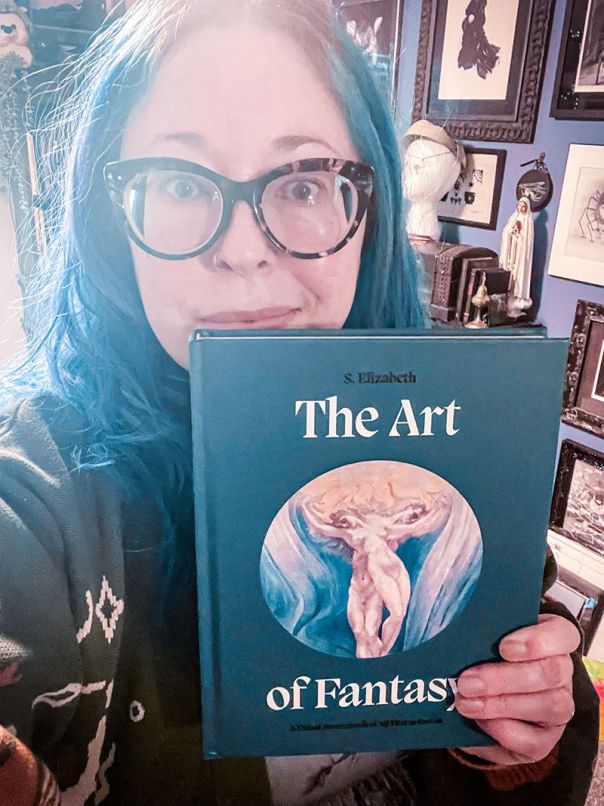
So, much as I did for the two previous books, I was compelled to create a “How To Wear” for my newest offering, The Art of Fantasy! These items were pieced together to create an ensemble full of *immaculate vibes* and not because I’m trying to get you to buy any of these things; my sartorial daydreams are opulent and not inexpensive, so yes–many of these things are stupidly pricey, I am well aware of that! Also, I apologize if some of these things are sold out or discontinued, but you can often find the same or similar items on resale sites.
Hello friends. Where did the spring (and summer!?) go? Well, here I am again, and thanks for paying me a visit. In this video,I’ll catch you up on what’s been going on with me, and, as usual, I’ll share a few favorites. And guess what else? My new book, The Art of Fantasy, is here! But don’t worry; I promise this is not an 18-minute video about my book.
Below is a listing of the items and various things and people mentioned found in this video, more or less in the order they were mentioned…
Whether you tumbled down a rabbit hole, traveled via a traumatic tornado or magic train ride, or perhaps even found yourself caught up in the machinations of an artist’s daydream of strange terrains, opulent palaces, and enchanted forests– the very idea of wonderlands where adventure dwells sends the imagination soaring and sets the scene for unforgettably dramatic visuals.
Artists construct worlds and invite us to enter. A painterly brushstroke is a door left ajar, a peek behind the rustle of a curtain or in the mirror’s depths, through which we catch a glimpse of another world. In that spirit, here are some unbelievable views from the lush, imaginative neverworlds found in my forthcoming book, The Art of Fantasy (to be released into this realm in less than a month’s time on September 12, 2023!)
This interview originally appeared on the Haute Macabre blog on May 25, 2017. It references some things that were happening in the artist’s life at that time, and looking back, I wish I’d been a bit more sensitive in my phrasing—many apologies to Tyler, who graciously and generously fielded my boorish questions with enthusiasm and aplomb. I think back upon his responses and am inspired anew, over and over again.
Since this interview, Tyler has become a very cool plant guru on Instagram AND has begun a project called Moonbeam Flora, creating gorgeous glow-in-the-dark bouquets out of invasive plants for meditative relaxation.
When I was in the sixth grade and it was the dreaded Science Fair projects time of the year (did everyone hate this as much as I did? Or was I just a really awful student?) my grandfather hit upon the grand idea that we were going to grow crystals in both salt solutions and sugar solutions and see which one was more successful. If I recall, the sugar solution yielded a better crop: small, but beautiful, delicate crystalline structures climbing upwards along a damp string tied to a wooden Popsicle stick, which hung across the top of a garage sale-scavenged glass mason jar. Absurdly proud of the results, I brought the project to school a few days before it was actually due, and was horrified as our classroom’s most popular girl, Mary Lisa Howell, entirely unprompted by me, reached into the jar of sugar crystals, snapped off a particularly lovely specimen, and started munching on it. I quite clearly remember her guileless face, looking at me as if she thought she was doing me a favor. Ugh! I locked myself in a bathroom stall, sobbed for twenty minutes straight, and vowed I was done with science forever.
Crystals, however, I shall forever be obsessed with. And when I discovered Tyler Thrasher’s exquisite creations in late 2014, my obsession reached a fever pitch. Tyler collects lifeless creatures and found objects and bestows upon them new life by growing shimmering crystal clusters on them. And I don’t know if his crystals have ever been eaten by an overzealous fan, but if he was able to bounce back, better than ever, after a devastating house fire – then he’s sure not going to let an eleven year-old bully with a sweet tooth get in his way.
As it turns out, Tyler Thrasher is a handful of things, including artist, scientist, music producer, traveler, rare plant collector, photographer (and even just a handful, period), and I was delighted that this goofball alchemist agreed to chat with me. Read on for our interview about life after the fire, creation in dark times, and the importance of curiosity, experimentation, and living your own goddamn story.
S. Elizabeth: First, I wanted to check in and see how you’ve been doing after the terrible fire that destroyed your home and belongings last December? I am a fervent checker of your instagram, and it seemed you didn’t stop creating, not even for a second. What propelled you forward during what must have been a pretty dark time for you? I realize that it must have been a nightmare, and I hope this isn’t a callow question, but I’m wondering if, through that heartache and loss, you drew inspiration for current or future work?
Tyler Thrasher: The first thing that helped during and directly after the fire would probably be my dark sense of humor. I’m no stranger to dark and pretty fucked up situations, and that sense of humor is what seems to keep me together sometimes and has in the past. After the fire I didn’t even consider a break from my work or from creating, it seemed to have the opposite effect, and looking back in my life that urge to create was birthed during one of the most traumatic moments in my life. I found myself as a kid creating and making art as a means to cope, and that urge seems to have persisted over the last 15 years. I did lose all of my work. All of the music I was working on, photos I had taken, and some of my favorite drawings and paintings.
I was/ am currently working on my first ever artbook, “The Wisdom of the Furnace”. One thing that propelled me forward was the title of the book. Before the fire, I had shot hundreds of images for my book of work that I will never see again, and oddly enough, before the fire, the book was titled “The Wisdom of the Furnace”. The next morning while I was sitting in my in-laws home, I was thinking about the book and everything I had lost for it, and the title sang. It was the same title it had always been, but it had realized itself and proclaimed its new purpose. The fire gave the title of my book some prestige and some well-earned prestige at that. The new and realized title of the book is what propelled me forward.
I know the “The Wisdom of the Furnace” is a hefty and mystical-sounding title, but if I could just defog its meaning a little bit, it might help some to understand why I was propelled forward. I chose the title in early 2016. I was thinking about old alchemical works and some of the advancements and progress that ancient study led us to. During my research I found lots of illustrations, code, and text that would reference or highlight the importance of fire and its vitality. The flame and the furnace were so essential for the alchemist’s Magnum Opus and the art of transmutation.
So much of what we know today regarding modern and practical chemistry came from the furnace. So much of what we know today regarding physics and modern science, in a sense, took place in the furnace. At first, the title of my book had a pretty straightforward meaning. But after the fire, I realized it was not just the furnace that gave us so much insight, but it was also the alchemist who boldly reached into it. The fire wasn’t going to give me answers; it wasn’t going to be an end result for the book or my work. The fire was just a catalyst, as most flames in the laboratory are. I realized that this book hadn’t even begun. Everything I shot beforehand was empty and vapid before the fire. It would take an effort from me beyond pointing a camera and shooting, but to get up and realize this catalyst and respect the potency of nature and the furnace.
I realized that despite losing everything for the book in the fire, the book would still be the thing I pulled out of the soot and the remains. And in essence, that sense of transformation is the vital core of alchemy.
Shit like this happens to me all of the time. I don’t think I believe in destiny, but every now and then, the universe gives me a little wink and a nudge.
So many folks describe your creations as “macabre”; I’m curious though, as to if you feel that’s an accurate representation of the work that you do?
I think macabre is a fair and accurate description. When I first started exploring this theme and medium, a lot of my friends and family thought it was a little disgusting. I mean I went from drawing landscapes to submerging dead insects into chemicals. I get it. I think parts of my work are rightfully macabre. My favorite thing EVER is when people ask what I do. When I describe what I do to others, yes its macabre. Description alone, I sound like a fucked-up mad scientist.
My other favorite thing EVER, is when I show them pictures, because they usually look very confused. And the response is usually the same, “OH! I had no idea what to expect! That’s so *Insert compliment here*”. And, of course, that always feels good! I think visually, it’s not so macabre. It is a celebration of life and an homage to what nature can do with one’s remains after life. In a way, it addresses a sense of purpose after consciousness, a purpose on earth and under the laws of nature. And I love that. It’s spiritual without being too much so, and it gives nature the respect it deserves. So much of what I do is a collaboration with nature.
The overwhelming theme of your work, even as it evolves, is “ curiosity and experimentation”–and that seems to be a code you wholeheartedly live by. I’m remarking on this having just seen some photos you posted on your instagram, a gorgeous series of nudes; your tender, graceful 2d illustrations, and after having listened in on your SoundCloud channel over the past week, it seems you are something of a musician, too! Not to mention those “Raise Some Heck” tee shirts you created! (Currently sold out, but I nabbed one!) Can you share with a bit about these different passions of yours, and what keeps you focused on the true essence of your work , whatever you might consider that to be?
To put it shortly, I get bored easily. HAHAHA. I always have. I don’t know why, but as a kid, boredom was literal hell for me. Mental anguish. Maybe I’m just mentally deficient, but I couldn’t and still can’t handle boredom. I’m also fiercely protective of what I like and what I enjoy doing, as I think most people should be. I think curiosity and experimentation are just vital for being human. We can’t run away from it, and I think whether or not you conform to that, we all, in some way are controlled by these urges.
The first thing I ever did was draw. It’s funny now because everyone knows my work by the crystallized pieces, and whenever I post an illustration, people are like “Wait you can draw?!” I don’t blame them! That’s a downside of social media, people see whatever they see first, and that’s their impression. I’ve been posting more of my 2D work lately because I want it to get some light and recognition. I enjoy doing them, and at some point, I would love it if those illustrations made me some money too!
Music has always been a passion of mine as well. I LOVE LOVE LOVE electronic music, specifically progressive house and trance music. I don’t know why, but I am compelled to believe they are the two most inspiring and motivating genres both mathematically and emotionally. I listen to these genres when I work out, drive, longboard. Anything that requires any type of movement towards an end goal. The repetitive elements and rhythms are just enough to shut my brain off and pull me into a zone of “get shit done”. The music I make is somewhere in this area with a little bit more “funk” every now and then. I’m still learning A LOT but I freaking love making music.
I think the fact that I make sure I do so many different things and keep my mind and spirit happy by trying new things is the “true heart of my work”. There’s so much out there, so much humans have created and discovered and explored and I would be a pretty lousy human if I didn’t give my brain the drug it needs and explore and discover more than just what’s immediately in front of me. (This is just the definition for a human for myself.) I have always lived by the code of “curiosity and experimentation,” and I hope this persists til I die because it’s been very good for me so far.
I saw you quoted in the Daily Dot from an article in 2016 where you stated that, “I don’t want to be working on anyone else’s story or art”. This is such a powerful declaration, and I’d love to hear more.
Well, who would?! I don’t mind helping others with their story or popping in as a side character that dies off in the next chapter, but there’s not enough time to help someone else live their story and try to pop back in for my own. I won’t and cannot be a sidekick in the story of “Tyler Thrasher,” and it breaks my heart when I see someone being a sidekick in their own story. This doesn’t mean you should live selfishly and have a complete disregard for others. It’s the opposite. I don’t think all good stories could exist without others. We need other people, creatures, and entities to help us along, and we need to help others along. Just make sure you aren’t living someone else’s story and neglecting your own. That sounds a little preachy. hahaha.
Another thing I meant by this is in regard to my degree. I got my degree in Computer Animation at Missouri State University. I was wildly convinced that I wanted to be an animator and make stories. That was until my school made the tragic mistake of bringing in an animator to talk about his career and life. And it was miserable. Possibly the saddest artist I had ever listened to. We were told that animators often work 60+ hours a week on average and on projects that meant absolutely nothing to them. This particular animator mentioned how he spent most of his conscious week working on Dora the Explorer and Zhu Zhu pets and I could’ve wept for him. I asked him if he had time for his own work and with a very tired sigh, he said “no.” I knew immediately that this was a bullshit scam and I wasn’t having any of it. I declared that day that I would be a freelance self-employed artist who would not work on anyone else’s story. I would work my ass off if I had to in order to make sure that part of my work remained pure and untouched by Dora and her evil companions.
I told my professors my goal, and they gave me a very nervous look. We had an assignment to come up with a four-year plan outside of school, who we wanted to work with and for, and what we wanted to be doing. I didn’t even turn in the paper. I just said, “I want to work for myself.” I, of course, failed that assignment, but I was honest and true to myself. I didn’t and don’t want to live selfishly. I want to inspire and help those around me, and I want to be inspired by those around me. I just don’t think the world needs more people working on Dora the Explorer. We’ve given her too much of our time, and I guarantee you no kids are waiting around for the newest story-breaking episode. They’re not even played linearly. The kids will be ok with the same 200 episodes we’ve made already, haha. I have a deep respect for the animations and projects individuals all agree to work on together and with passion. I have very little affinity or respect towards the studio or warehouse that pumps out the same empty project just to keep the artists busy, children distracted, and parents spending money.
When visiting a natural history museum, do you make a beeline for the glittering treasures of the gem and mineral rooms? Is Splendor your favorite board game because you love hoarding the jewels like a greedy dragon, and truly you don’t give a fart about the mechanics and strategies of gem mines, trade routes, or gaining wealthy patrons? Is that too niche a reference? Are you still with me?
Smithsonian’s mineral and gem collection at the National Museum of Natural History. My photo.
Steven Universe, created by Rebecca Sugar
Have you ever gazed into a stone and wondered as to the stories it stores? The powers it possesses? In her fascinating book, Lapidarium: The Secret Lives of Stones, Hettie Judah explores the hidden history of these lithic marvels, from their role in ancient cultures to their modern-day influences and uses.
An absolute feast for the senses, the book itself feels very much like a collector’s treasure hoarded wunderkammer of mythic and mysterious curiosities. It is split into six sections (Stones and Power, Sacred Stones, Stones and Stories, Stone Technology, Shapes in Stone, and Living Stones), and each section reveals a chapter devoted to unearthing an individual stone with imaginative, artful descriptions and a pretty wild, or wildly fascinating story connected to each stone.
It’s a stunningly presented and designed book, with color-coordinated pictures and beautiful illustrations by artist Nicky Pasterfield for each stone, evoking the charming pictures in old geological and scientific publications.
Referencing science, history, chemistry, physics, literature, philosophy, and pop culture, Lapidarium is an extravagantly storied chamber of stones, the next best thing to having a secret sparkling cache of curios at your fingertips. Writing with humor, compassion, and wit (I cackled out loud more times than I can count), Hettie leads us sure-footedly on our craggy journey down a glittering path of 60 mineralogical eccentricities, ancient souvenirs of deep-Earth drama, and travelogues that cross the strata of time as well as space.
Amongst these essays exploring how human culture has formed stone and, conversely, the roles stone has played in forming human culture, one will read of the Meat-Shaped Stone of Taiwan, a piece of banded jasper that resembles a tender piece of mouth-watering braised pork belly, There is the soap opera melodrama of Pele’s Hair, golden strands of volcanic glass, spun into hair-fine threads by volcanic gasses and blown across the landscape. And not to mention the hysterical metaphysical WTFery of angel-appointed wife swaps in the chapter of alchemist and astrologer John Dee’s smoky quartz cairngorm, as well as, the mystical modern-day TikTik moldavite craze vibing amongst those of the witchy-psychic persuasion. I cannot even tell you how many times I paused in my reading to open a new Google tab and research, thinking, “holy fake crystal skulls/malachite caskets/pyroclastic flow rap lyrics! I gotta learn more about this!”
From the elegance of emerald moons to humble fossilized feces, from violent lunar origin stories to simple earthen pigments, Lapidarium is richly abundant with interesting facts, poignant stories, and weird anecdotes about stones. And though I read this book straight through from start to finish, this is absolutely the sort of bibliomantic tome that one might flip through at random, choosing a chapter based on mood or whim: learn a weird rock fact, let it lodge in your brain like a wayward pebble in your shoe, and allow it to guide your energies for the day.
After finishing Lapidarium, I realized I could have happily spent loads more time in the terrestrial spectacle of those enigmatic realms, but once you get to the acknowledgments, that’s pretty much the end of the line (I read them all, anyway!) Not yet ready to leave this post-book mental space now lit crystalline and glittering with the fruits of the earth thanks to Hettie’s heady prose, I thought I might ask the author and art historian a few questions–which she kindly answered for me, below.
Unquiet Things: I’m curious whether you started this book with a favorite gem or stone in mind, but after your research and writing, you perhaps had some markedly different favorites.
Hettie Judah:I guess when I started, I was thinking more in terms of stone objects and artefacts – I’d probably have told you my favourite stone was a black opal from Lightning Ridge in Australia. In working on the book I became more interested in the way stone forms not only landscape, but the cultural expression that has played out within that landscape – whether that’s the standing stones of Avebury and Stonehenge, most of which are huge sarsens that used to lie around that landscape like flocks of sheep, or the marble of Paros and Naxos that established a specific aesthetic for temple building in Ancient Greece. When people ask me my favourite stone I usually tell them it’s the limestone under the Yorkshire Dales, a beloved piece of the British landscape – beauty of a different order to that of a ruby or moonstone.
Unquiet Things: In the vein of your research, what was one of the most surprising or strangest things you learned while digging into mineralogical science, history, legend, and lore?
Hettie Judah: The quest for the mythic philosopher’s stone crops up in a few different stories in the book. Alchemists got up to some pungent activities – Paracelsus suggested you could grow a human being by ‘placing’ semen in a flask, then burying the flask in a pile of warm horse manure and, after a set period, feeding it with a specially treated form of blood. The alchemical language of proto-chemistry was very much one of sexual intercourse – the male element reacting with the female element to produce a new substance – some of the language we use today still derives from these ideas. We talk about finding a crystal in a rock ‘matrix’ – as though the plain old ‘mother rock’ had given birth to a gemstone.
I love the legend of the Indian Valley of the Diamonds, said to be an inaccessible crevasse, the floor of which glittered with gemstones. Diamonds are lipophilic – they stick to fat. So the legend went that gem hunters would lob pieces of fatty raw lamb into the valley, and eagles would swoop down to pick them up and fly back up to their nests with gems embedded in the fat. The eagles would eat the meat, leaving the diamonds, which the gem hunters later retrieved. The legend was so well established that the symbol for India on European maps used to be the eagles carrying diamonds up from the valley.
Unquiet Things: There were many times I found myself giggling at a playful turn of phrase or peculiar fact while reading; there’s nothing I appreciate so much as learning and laughing at the same time. Looking back, is there a particularly weird or wacky excerpt, sentence, or even an entire paragraph that you find yourself thinking, “Well, I never imagined that was a thing I’d write about rocks!”
Hettie Judah: The early 19th-century geologist and theologian William Buckland was a magnificent source of wild stories – he was zoophagous, and apparently attempted to eat his way through the animal kingdom (and once authoritatively identified bat dung by taste). He was also fascinated by coprolites – petrified poo – and commissioned a decorative pietra dura tabletop to be made from his collection of fossilised fish turds.
I was determined to get kryptonite into the book – how can you have a collection of stories about stones without one on kryptonite? My editor was adamant that I couldn’t include it because it wasn’t ‘real’. So finding a great story about moldavite – basically ‘real’ kryptonite – was such a gift. I really enjoyed writing that one.
Overall, in every facet, Lapidarium: The Secret Lives of Stones is a brilliant must-have for anyone who has ever been fascinated by stones, either as a child or as an adult today. And as it happens…I have an extra copy of Lapidarium and am happy to share it with one reader of this blog post.
Not that I believe you need any convincing at this point, but …
💎 If you love stones, then this book is a treasure trove of information about all sorts of stones, from their scientific properties to their cultural significance.
💎 If you’re interested in history, then you’ll love learning about the role that stones have played in human cultures throughout the ages.
💎If you’re looking for a book that will transport you to far-off lands, Hettie’s stories will take you to the mountains of Appalachia, the beaches of South Wales, the caves of Mexico, Russian palaces, and Brazilian churches–and everywhere between and beyond.
💎 If you’re longing for writing that will make you think, you will enjoy pondering the author’s explorations of the philosophical and spiritual dimensions of stones, and our relationship to the natural world.
If you would like to win this copy of Lapidarium, please leave a comment in today’s blog post with your favorite stone or “rock fact,” and I will choose one winner from amongst those comments on Friday, August 18th. Due to shipping costs, this giveaway is limited to US readers only.
[THE GIVEAWAY HAS ENDED AND THE WINNERS–DARLA AND HAYLEY– HAVE BEEN CONTACTED. THANK YOU EVERYONE FOR READING AND SHARING.]
The Art of Fantasy (interior) L: Tino Rodriguez // R: Andy Kehoe Art
Here are some more peeks for you at various image spreads tucked into the pages of The Art of Fantasy. I can’t tell you how much fun I had curating this collection coaxed forth from myth, magic, fantasy, and art history. Maybe I had a little too much fun because one reviewer said they did not appreciate my attempts at humor. Ah, well. Sillies are gonna silly. I can’t help it!
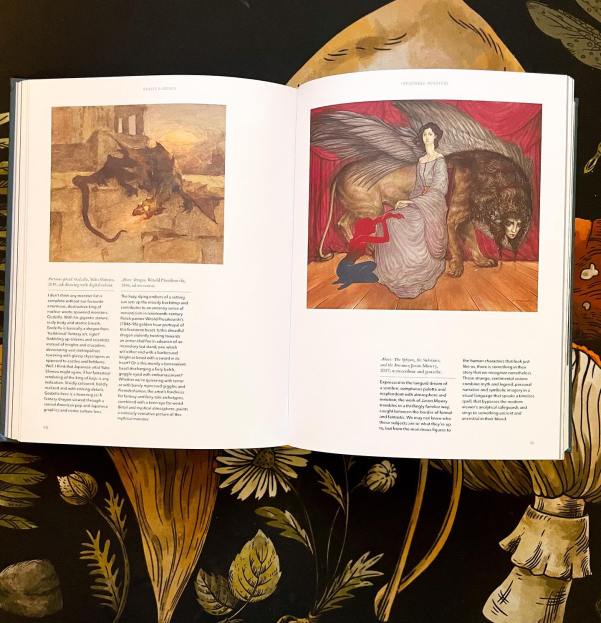
The Art of Fantasy (interior) L: Witold Pruszkowski // R: Jason Mowry
Were they referring to my caption for Witold Pruszkowski’s Dragon?
“The hazy, dying embers of a setting sun sets up the moody backdrop and contributes to an uncanny sense of romanticism in 19th-century Polish painter Witold Pruszkowski’s (1846-1896) golden hour portrayal of this fearsome beast. Is this dreadful dragon violently twisting toward an armor-clad foe in advance of an incendiary last stand, one which will either end with a barbecued knight or beast with a sword in its heart? Or is this merely a benevolent beast discharging a fiery belch, goggle-eyed with embarrassment? Whether we’re quivering with terror or with barely-repressed giggles and Fremdschämen, the artist’s fondness for fantasy and fairytale archetypes, combined with a keen eye for weird detail and mystical atmosphere, paints a curiously evocative picture of this mythical monster.”
(The monster was burping, okay? I said what I said!)
The Art of Fantasy (interior) L: Eric Velhagen // R: Leonor Fini
I read somewhere that “reviews are not for authors; they are for other readers,” and I kinda like that attitude. I try not to read reviews for my books–I am anxious enough as it is, and I don’t need another source of dread. Although when the first few start showing up, it’s hard to resist! But I got it out of my system for this go-round, and now I am done.
The Art of Fantasy (interior) L: Virgo Paraiso //R: Margaret Macdonald Mackintosh
Anyway! Although today is certainly not the last day you can preorder The Art of Fantasy, it *is* your last opportunity to nab some artsy preorder goodies! Find the link to do so in my bio, and in the meantime, feast your eyes upon these wonderments by the following artists.
The Art of Fantasy (interior) L: František Kupka // R: Laurence Schwinger
The Art of Fantasy (interior) L: Kiki Smith // R: Yuko Shimizu
The Art of Fantasy (interior) L: Frederick Sandys // R: Colleen Doran
The Art of Fantasy (interior) L: Daniel Maclise // R: Mr. Werewolf
The Art of Fantasy (interior) John Atkinson Grimshaw
The Art of Fantasy (interior) L: John William Waterhouse // R: Marie Spartali Stillman
“Incense” by Bela de Takach von Gyongos-Halasz, 1910; illustration from Penrose’s Pictorial Annual 1910-11 (Percy Lund Humphries & Co Ltd, London, 1911).Given by the artist to Annie Besant, British theosophist, writer, and women’s rights activist.
Hermès Un Jardin à Cythère is a fragrance I’d originally seen mentioned by LC of nearlynoseblind on TikTok, and all I really recalled was that it had notes of pistachio but that it smelled of olive oil cake. I have baked dozens of olive oil cakes by this point in my life, and so upon smelling the perfume was immediately able to make that connection…which was both exciting and a little irksome because did it actually smell like that, or did I just have it in my head that it smelled like that, because I’d already internalized that tidbit? And also, I couldn’t very well review it as such, because someone else had already used the same words [EDIT: I published this post without realizing I never finished this review. I am suffering from a bit of grief brain, and I don’t remember my thoughts, but if you want to watch my TikTok review, I did actually have a few ideas earlier in the month. TLDR; it smells like Icelandic Jólakaka.]
Mistpouffer from Stora Skuggan smells of cool, sweet, powdery porcelain, dainty and delicate like a small ivory sculpted ballerina on a shelf, but there’s a weirdly mineralic, off-kilter herbal note as well, wrapped up in a bit of foggy fluff, almost like a little gossamer candy-floss salted black licorice bouquet. Ultimately it reminds me of the ceramic Broken Ladies of artist Jessica Harrison–charmingly feminine figurines, bloodied with intricate anatomical horrors–perhaps a bit too much for sensitive types, but those of you who dig macabre delights will love these twisted ceramic beauties. And I think that’s what Mistpouffer is, too: a soft, subtly twisted beauty.
Even though I have always wished it were otherwise, I have never sniffed a precious jewel, glimmering gem, or polished stone that smelled of anything in particular–even though the dazzling drama in those crystalline depths seem to promise, at least to me, that these geological treasures should somehow be radiating the most marvelous perfumes. Alas! Nope! It is sadly a wish I’ve long let go. Sphinx Skin, however, rekindles this daydream in the most fantastical and feverish ways, because I’m absolutely certain that if a moody, golden topaz had a scent? It would be the smoky umbral honey, spectral shed snakeskin musk of Sphinx Skin, a collaboration between bloodmilk and Black Phoenix Alchemy Lab: heady, tobacco-infused amber with subtly shifting floral vanilla facets, a rich, sticky, resinous vein of dragon’s blood, and the faint, slithering earthiness of patchouli, dark, damp, rooty, and grounding. Formed from crystals in cooling magma (or so I understand), if we are being real here, topaz probably smells of the fumes and vapors wafting amongst the igneous cavities in which it grows, but here, in the surreal secrecy of our intimate cocoon, where the writer and reader connect via a shared dream and can believe as we please – let’s choose to believe in exquisite lapidary aroma magic, and that a glowing sphere of topaz smells like a small bottle of Sphinx Skin.
Green Spell from Eris Parfums is as if a celestial being of 100% chlorophyll descended from the heavens, its wings a crushing flutter of many leaves, broad and flat, delicate and curled, waxen, rubbery, pliant, radiating every variation of veridian. In a voice like seeping moss, like eroding rock, like insect wings disintegrating into the earth, it whispers to you, “Like, be not afraid, or whatever.” It’s the endless trailing succulent stem of a bittersweet pennywort patch through the soil until you reach a darkly massive gnashing malachite rootball nightmare. You awake with emerald scratchings on your palm and jade lashings of fern in your teeth.
Nightingale from Zoologist is, on paper, something I initially wouldn’t have thought my cup of tea–but that just goes to show what I know. This is an opulent mossy plum blossom with bitter, earthy oud, and hints of a sour, lemony geranium–like rose. It’s being referred to as a pink floral chypre which, probably because of my associations with all things pink, rings frilly and frivolous for what turns out to be a breathtakingly stunning fragrance with an unexpected complexity that translates into something profoundly emotional. In reading an interview with the perfumer, I learned that the inspiration for this perfume was an ancient poem written by Fujiwara no Kenshi, sister to the empress at that time. The empress was apparently trading her imperial duties for Buddhist vows, and upon her departure, her sister gifted her an agarwood rosary wrapped in a box with ribbons and a branch of plum blossom and read to her a poem she had written: “Soon you will be wearing a black robe and enter nunhood. You will not know each rosary bead has my tears on it.” In this scent, I truly experience a sense of love, loss, sisterhood, and yearning, and somehow, through that perspective, I even feel an existential sadness regarding the transient nature of time and existence. What an extraordinary, evocative fragrance.
Sometime in the last few weeks, I wrote about Nightingale, which I was very impressed with, and today I am wearing Sacred Scarab, which, while equally impressive, is the one I can actually see myself wearing. Nightingale is like the elegant gown you save for special occasions (although I don’t really believe in saving things for special occasions, but just go with it), and Sacred Scarab is, for me, the frock that gets covered in dirt and gravy because I never want to take it off. One of the scents wears me more than I’m wearing it, but the other just sort of…IS me. And what does that mean, anyway? Sacred Scarab is a scent of bitter, lemony aldehydes and earthy, murky, dusky musks, and when I say earthy, I don’t mean damp, loamy garden soil, but rather dusty clay, and subterranean strata of sedimentary rock, digging so far down into the earth you encounter tenebrous geological formations and stygian crystalline structures, ostensibly connected to the earth’s deep history–and yet to your unbelieving eyes and mine, wholly alien and otherworldly. It’s a fragrance that evokes at least a minor feeling of, if not the reality of a crumbling collapse of space and time, the prelude to the ecstatic rites of an ancient mystery cult of earth and stone. That initial mineralogical melodrama is breathtaking, and I probably enjoy those 15-20 minutes of the fragrance best, but the next stage and the dry down, a sort of “burnished date/sticky raisin resin incense scattered in the dry wood of a smooth cedar dish” vibe, is lovely as well and worth the wait, if you find the early sniffs are too overwhelming. I can’t decide if this scent is a prayer, protest, comfort, or curse, and I deeply love the unknowable mystery of that.
James “Jim” Stanley Walter (September 6, 1945 – July 20, 2023)
I haven’t spoken with my father in many years, but I spent a week or so of summer vacation with him in Houston when I was eleven. Most of that time went by in a blur, but there are a few things I clearly recall and which I actually think about quite often:
He was living with someone at that time, a new-to-me girlfriend who seemed very sweet and kind, and I warmed to her–as much as a shy little kid can–right away. Every night we would all play a game before bed. It was like Mad Libs, except there wasn’t a book for filling in blanks, we just made it up as we went along. I felt so clever and and smart after every round of story-telling, and I loved listening to my dad’s goofy stories and the silly way he played with words and language. As someone who spends a lot of time writing today, I think the whimsy of those games continues to make its way into my own words.
My dad rented studio space near his apartment, and every morning we’d head over there so he could work on whatever it was that he was doing at that time. He had a low wooden shelf jammed with an enormous back catalog of Heavy Metal magazines, and never having seen the likes of such darkness and weirdness, I would spend hours and hours curled up on a sagging sofa marveling at them from cover to cover. Ranxerox terrified and exhilarated me, Druuna’s naked, tentacular adventures may have been the catalyst for the first sexual stirrings in my weird little bod, and the art–oh, the cover art! From Julie Bell to Frank Frazetta, Jefferey Catherine Jones to Olivia De Berardinis, Crepax, Moebius, and my very favorite, Luis Royo…! Until that point, the fantasy and fairy tale stories I knew had a very certain look to them: dreamy and delicate, ethereal wisps of things. But Heavy Metal showed me a very different, raucous, rowdy, bold, brilliant type of fable; it showed me how to look for beauty in the things I found odd or repellent, or hideous, and horrifying. I never saw art –or stories– the same after discovering my dad’s cache of Heavy Metal magazines, and you can see that in everything from the clothes that I wear to the art on my walls to the books of art that I curate and write about.
During my visit that summer, there was something big happening. The Harmonic Convergence, an event of “cosmic importance,” was what they called the world’s first synchronized global peace meditation, which occurred on August 16–17, 1987. People were congregating in “power centers” and doing all sorts of new-age things, and as this also closely coincided with an exceptional alignment of planets, I think the woo-woo was probably off the charts. My dad called it “The Harmonica Convention” and wanted us to see what it was all about. I was scared because I thought I would have to talk to people about things. I don’t know why I thought that, but I was scared of talking to people, and that was always a huge fear.
The night before the event, we found a tiny baby bird that had fallen out of it’s nest, and I was desperate to ensure its survival. We kept it warm in a little shoebox with scraps of cloth, and tried to feed it so that it got nourishment, and we ended up staying all night keeping a watch on it. The next day I brought it to the Harmonic Convergence space with us, and I don’t remember looking a single person in the eye, because I sat down on the grass with my baby bird and never once looked away from it. I heard so many voices above me telling me that I was doing a good job, and there were so many heartfelt wishes and sweet sentiments murmured by passers-by. I may have replied, or maybe not. I don’t recall. Did anything big happen? I have no idea. There was only me and the littlest thing I’d ever held in my hands. And my dad cheering me on in his weird-dad way. And I was not scared of a single thing that day.
When I arrived home that summer, my (late) mother complained that I was squirrelly and secretive. I think what happened is that I discovered some big things about myself–about who I was and what I might become, and how things just “clicked” for me in many ways. It felt so private and personal, I never would have been able to articulate it, and I didn’t want to. The me who came home was very different from the me that had left, and all of the things I did and saw and learned–they were mine and mine alone.
My dad died last night. I don’t know how to feel. I don’t know if I’m “allowed” to grieve a man that I stopped communicating with twenty years ago; I feel like those rights aren’t mine to hold anymore.
I think right now, right in this moment, I’m sad for a version of our relationship that hasn’t existed since I was eleven years old, and that he’ll never know how that summer shaped me.
My AC has been out for five days, and I’m hot and tired and existing in a sort of fever dream fugue state, but I wanted to get it together for long enough to share some art that I am SO freaking beyond excited about in the pages of my forthcoming book, The Art of Fantasy: A Visual Sourcebook Of All That Is Unreal.
Fantastical artists pictured here, names all out of order because I cobbled all these words together from something I already posted on Instagram: Chie Yoshii, Colleen Doran, Paul Lewin, Tristan Elwell, Julie Bell, Atsuko Goto, Brom, Carrie Ann Baade, Julie Dillon, Victo Ngai. And I would love to include 200 more artworks in this post, but why would you bother buying the book if I did? Hee hee!
And don’t forget to get your preorder goodies, including a signed bookplate, by clicking on this link and doing whatever it tells you to do. I don’t honestly remember. I’m too hot!
Red Lady, Gerald Brom, 2015, oil.
CHARACTER III, Atsuko Goto, 2022, pigments, gum arabic, Japanese ink, gold powder, silver powder, silver leaf, gold mica, natural mineral pigments, lapis lazuli on glued cotton cloth.
Visionary, Carrie Ann Baade, 2018, oil on canvas.
Hemera, Chie Yoshii, 2014, oil on wood panel.
Cover art for Snow, Glass, Apples by Neil Gaiman, Dark Horse Comics, Colleen Doran, 2019, pen and ink.
Little Sister, Julie Bell, 2011, oil on panel.
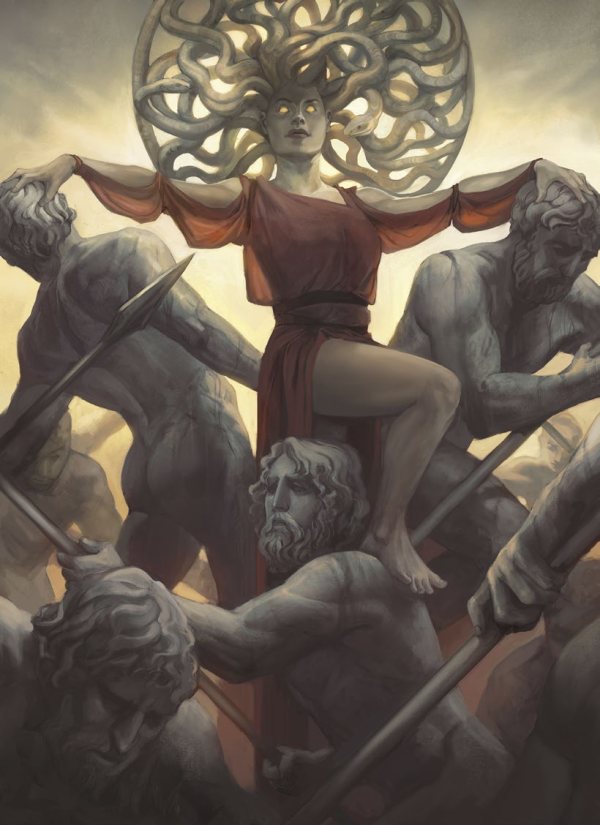
Medusa II, Julie Dillon, 2022, digital.
Arrival on Ganymede, Paul Lewin, 2021, acrylic on wood.
Frogfolio Utopia, Victo Ngai, 2012, mixed media with digital.
Pre-order your copy of The Art of Fantasy by August 1 from any retailer and be one of the first 100 readers to receive bonus goodies! Details here.
Behold, my office wall’s final form! Did it take a lot of holes in the wall to get here? Sure it did! Did I drop many tiny nails on the carpet and retrieve far less than I lost? I mean, it happens. Did I map out a strategy for efficient use of time? Look—